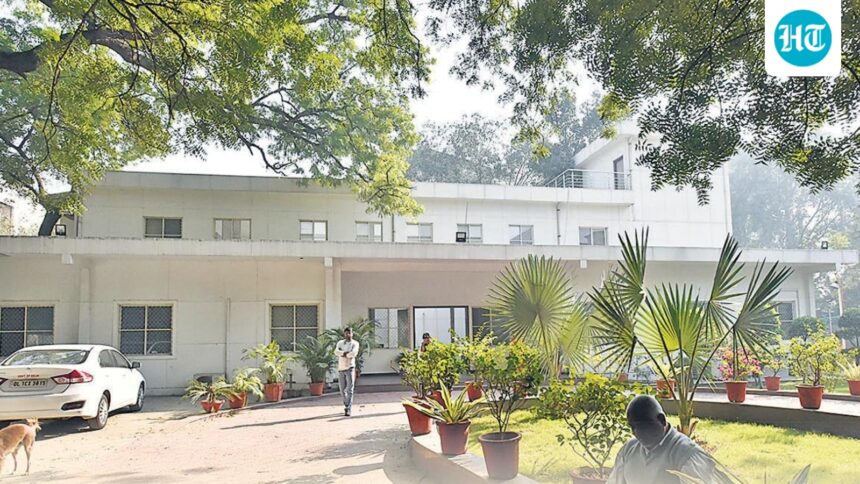
For many years, Delhi’s political class treated No. 33 on Sham Nath Marg as an unlucky address – a government bungalow so steeped in tales of misfortune that even ministers and senior staff largely kept a distance from it. Now, the Delhi government is preparing to erase that legacy by demolishing the colonial-era building and replacing it with the capital’s first dedicated disaster management headquarters.

The site is set to be redeveloped into the city’s first dedicated headquarters for the Delhi Disaster Management Authority (DDMA), complete with a state-of-the-art Emergency Operations Center (EOC), as HT had previously reported. The move is expected to give new purpose to a prime piece of land that has remained largely undeveloped for years.
But before this house makes way for the new facility, its unusual history continues to attract attention. Here’s a look at how 33 Sham Nath Marg earned a reputation as one of the most ‘jinxed’ addresses in Delhi.
Troubled reputation
This two-storey bungalow is located in the leafy Civil Lines area, on over 5,500 square meters of land. Built in the 1920s during British rule, it features sweeping lawns, multiple conference rooms, staff quarters and sprawling gardens.
Soon after Independence, the property emerged as the preferred residence of the Delhi Chief Minister due to its proximity to the Vidhan Sabha. However, a series of setbacks suffered by its occupants over the decades gradually eroded its reputation as an unlucky address.
The first resident was Delhi’s first Prime Minister, Chaudhary Brahm Prakash, who moved into the bungalow in 1952. His term ended prematurely in 1955 amid controversy over an “alleged scam”.
Nearly four decades later, the bungalow was allotted to Madan Lal Khurana after he became Prime Minister in 1993 under the newly created National Capital Territory. His mission also ended with Khurana’s resignation in 1996 amid allegations linked to the hawala scandal.
After these successive episodes, whispers about the “curse” of the drug began to spread in political circles.
“Unlucky” style.
The perception only deepened with its subsequent occupants.
Sahib Singh Verma, who succeeded Khurana as Prime Minister, used the bungalow as his camp office. He too did not complete his term, and was eventually replaced by Sushma Swaraj, Delhi’s first female chief minister.
This belief gained further attention in 2003 when Deep Chand Bandhu, then a minister in the Delhi government, moved into the country house despite the advice of aides and well-wishers. Shortly afterwards, he contracted meningitis and later died in hospital, further cementing the drug’s ill-fated reputation.
Even after the hut stopped serving as a residence, the story continued.
After a series of property-related setbacks, successive prime ministers, including Sheila Dikshit, chose not to move there.
The last senior government employee to work from the building was Yasmin Shah, vice-chairman of the Delhi Dialogue Committee. In November 2022, Lieutenant Governor VK Saxena directed then Chief Minister Arvind Kejriwal to remove Shah from office over allegations that he misused his office for political purposes, adding another chapter to the long list of surprise property exits.
Why change is important
While the bungalow’s reputation persists in political circles, officials say the redevelopment is driven by practical need.
Delhi currently does not have a separate DDMA building, with disaster management functions spread across different offices. Officials believe the dedicated headquarters will improve coordination during emergencies and enhance the city’s response capabilities.
The proposed center is expected to bring together representatives from multiple government departments and agencies, including the New Delhi Municipal Council, the Delhi Development Authority and the Delhi Police.
At present, the Emergency Operations Committee operates out of the DDMA office in Civil Lines and faces space constraints.
“The current setup has limited space. Once a disaster-related call is verified, fire brigades, police and rescue teams are alerted. The district magistrate and rescue teams are also informed, while the Emergency Operations Committee monitors and coordinates the response,” an official said.
The redevelopment plan marks the end of an era for a property that has sat largely vacant for more than two decades, giving new purpose to an address known more for political folklore than public administration.