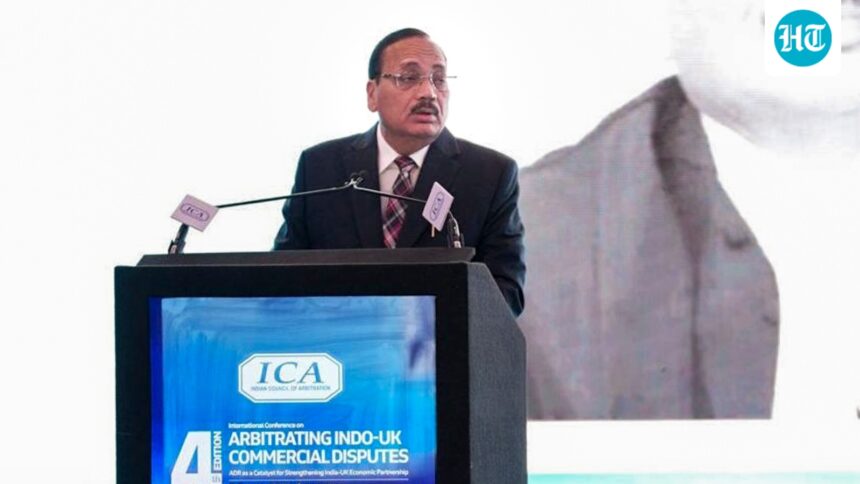
Chief Justice of India (CJI) Surya Kant on Thursday underscored the constitutional independence enjoyed by high courts, stating that the Supreme Court is not a “spectator” supervising its functioning and must respect the independent constitutional space it occupies.

The ICJ noted that the Supreme Courts, by virtue of their broad powers under Articles 226 and 227 of the Constitution, may in some respects exercise broader jurisdiction than the Supreme Court itself.
Read also: UP minister claims possible defections from SP and Congress: ‘Most MPs and MLAs are in touch with us’
“We are not sitting here as administrators regulating the functioning of high courts. They are constitutional bodies and their powers under Articles 226 and 227 are sometimes better than this court. We must respect their constitutional independence,” CJI Kant said while heading a bench that also included Justice V Mohana.
These observations came during the hearing of an appeal filed by the Jharkhand State Pollution Control Board (JSPCB) against an interim order of the Jharkhand High Court restraining it from granting approval to operate stone mines and stone crushers within one km of the demarcated boundaries of protected forests in the state.
Read also: ‘FTA in final stages…after ups and downs’: MEA drops major update after Modi-Trump G7 meeting; An American official will visit the country soon
These observations are important because they confirm the constitutional position that the High Courts are not subordinate to the Supreme Court in the exercise of its constitutional jurisdiction. While Article 141 makes the law declared by the Supreme Court binding on all courts in India, the High Courts remain independent constitutional courts with broad powers of judicial review under Article 226 and supervisory jurisdiction over all courts and tribunals within their territorial limits under Article 227.
Unlike the jurisdiction of the Supreme Court under Article 32, which is limited to the enforcement of fundamental rights, Article 226 enables the High Courts to issue orders not only for the enforcement of fundamental rights but “for any other purpose” as well, making its jurisdiction considerably broader in some respects. Constitutional courts have repeatedly described Article 226 as one of the fundamental features of the Constitution and a vital safeguard against executive abuse.
Read also: Prime Minister Modi at the Paris event urges European technology companies to tap into India’s talent pool
The present dispute before the Supreme Court arose out of a challenge to the 2015 notification issued by the JSPCB reducing the minimum permissible distance for setting up stone mines and stone crushers near forests and forest lands from the previously stipulated distance of 400-500 meters to 250 metres.
Hearing the petitions challenging the notification, the Jharkhand High Court, by an interim order dated January 16, restrained the JSPCB from granting any approval for quarrying or stone crushing operations within one kilometer of protected forests.
The Supreme Court prima facie found that the notification was inconsistent with the directions issued in 2022 by the Supreme Court in long-term forest conservation proceedings in the TN Godavarman Thirumulpad case.
Referring to the Supreme Court directions requiring creation of an eco-sensitive zone of at least one kilometer length around protected forests, the apex court observed that the impugned notification appears to be in “prima facie violation” of those directions.
“Unless this aspect is properly explained, we do not consider it safe to allow the JSPCB to grant any approvals for operating stone mines or crushers in this area,” the apex court said.
When the matter came up before the Supreme Court on Thursday, senior advocate Meenakshi Arora, who appeared before the Pollution Control Board, attacked the interim restrictions imposed by the apex court.
But the bench was unwilling to intervene. Noting that the case has already been listed for final hearing before the Supreme Court, the Supreme Court noted that all the issues could be suitably examined there.
The matter ultimately ended with the Board requesting permission to withdraw the special leave petition.
Recording the application, the bench observed in its order: “Counsel for the petitioner seeks withdrawal of the existing SLP as the matter is up for final hearing before the Supreme Court…The petitioner is entitled to raise all appeals before the Supreme Court.”