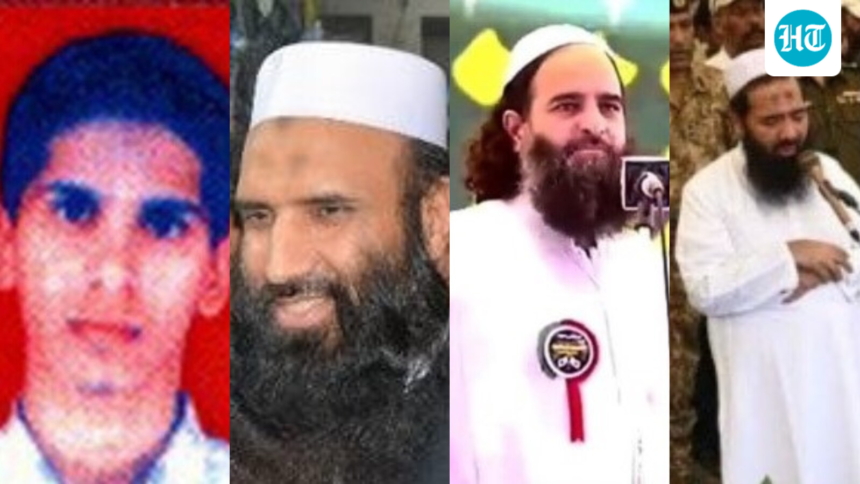
Of the 23 terrorists, 13 belong to the Lahore-based Lashkar-e-Taiba, while the remaining 10 belong to the Bahawalpur-based JeM terrorist gang.

The Modi government on Saturday designated 23 terrorists from Pakistan-based Lashkar-e-Taiba and Jaish-e-Muhammad (JeM) outfits banned under the provisions of the UAPA as part of the ‘Prahar’ strategy to address emerging and evolving terrorist threats.

Of the 23 terrorists, 13 belong to the Lahore-based Lashkar-e-Taiba, while the remaining 10 belong to the Bahawalpur-based JeM terrorist gang. The list includes 16 people of Pakistani nationality and seven Indians working outside Pakistan. Many of them have active arrest warrants and ongoing terrorist investigations against them. Those named were found to be working in a range of jobs, such as propaganda through front organisations, terrorist recruitment, training, arms, smuggling and infiltration of cadres into Indian territory.
Among the identified terrorists, Saifullah Khalid is closely linked to Jamaat-ud-Dawa terrorist activities. Khaled, a US-designated global terrorist, serves as deputy chief of LeT.

Hafiz Abdul Rauf, another Lashkar terrorist, led the funerals of terrorists killed in ‘Operation Sindoor’, launched by India against Pakistani terrorist targets on May 7, 2025. Rauf, who has been designated a global terrorist by the US, was seen offering prayers at Lashkar’s Muridke camp along with several senior Pakistani army officers.

Those listed as terrorists by JeM have a more (formal) military structure that focuses on infiltration and high-profile attacks against India. Its leadership includes Mufti Muhammad Asghar Khan, the so-called chief commander of Kashmir operations, and Masoud Ilyas Kashmiri, the so-called emir of the JeM in Pakistan-occupied Kashmir. The army relies on launch commanders such as Abdullah Jehadi, Mohammad Mossadegh and Waseem Noor to facilitate the cross-border infiltration of terrorists, weapons and ammunition via tunnels and drones.
Masood Ilyas Kashmiri is in charge of recruitment and runs the social media wing of JeM. Operating from PoK, the Kashmiri is one of the prime accused in the April 2022 Sinjuan terror attack.

Recruitment is a crucial function of these banned organizations as terrorist activists use social media platforms to target youth in Jammu and Kashmir as well as remote areas of India. As an online handler, Muhammad Shahid Faisal recruits young people to make bombs and select targets. He is a software engineer from Bengaluru and has been involved in several terrorist attacks in India in the past. Faisal was the main handler of the 2012 Bangalore conspiracy case.
While Indian diplomatic efforts ensured that the US State Department designated the LeT front TRF as a foreign terrorist organization and a global terrorist group on July 18, 2025, the main purpose of the listing is to deter radicalization, recruitment and cross-border infiltration of terrorist activities in India. The list also aims to illustrate that the Modi government has a zero-tolerance policy against terrorists, which includes dismantling the terror regime, undertaking decisive counter-terrorism operations with sustained global diplomacy acting as a force multiplier.

He is the author of Indian Mujahideen: The Enemy Within (2011, Hachette) and Confronting the Himalayas: The Chinese Assertion and the Indian Response (2014, Hachette). He was awarded the K Subrahmanyam Prize for Strategic Studies in 2015 by the Manohar Parrikar Institute for Defense Studies and Analyzes (MP-IDSA) and the 2011 Ben Gurion Prize from Israel.Read more