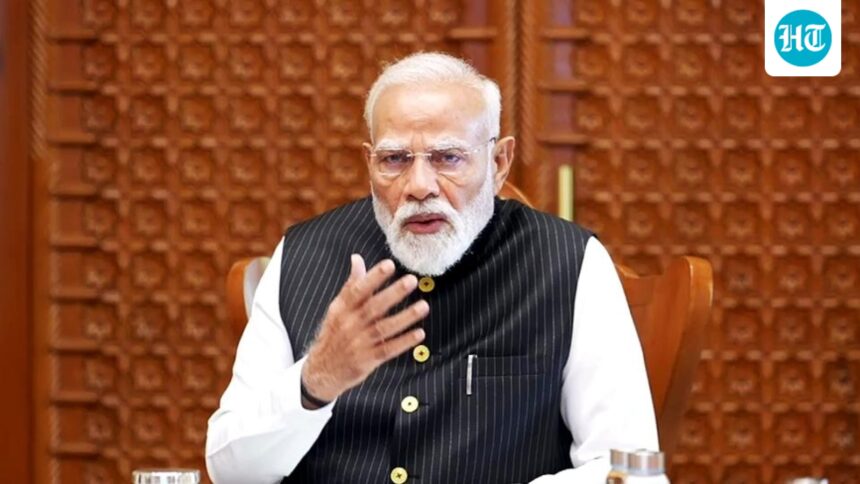
New Delhi: The Union Cabinet led by Prime Minister Narendra Modi on Wednesday approved the approval $Rs 1,800 crore to continue the Immigration, Visa, Foreigner Registration and Tracking (IVFRT) project after March 31, for another five years.

IVFRT, which has been operating since 2010, assists immigration officers, linking all functions related to immigration, visa issuance and registration of foreigners in India.
The identity of travelers is verified at Indian Missions abroad, Immigration Check Posts (ICPs) and Foreigner Regional Registration Offices (FRROs), and information such as hotel form, student form, arrival/departure details are stored in the IVFRT database.
Notably, immigration authorities were able to locate the six recently arrested Ukrainian citizens and US citizen Matthew Van Dyke, by tracking the Form-C mandatory submitted by all foreigners to the FRROs (Foreigners Regional Registration Office) in connection with their hotel stay.
According to a statement issued by the Press Information Bureau (PIB) on Wednesday, “The primary objective of the IVFRT is to modernize and modernize immigration and visa services within the framework of secure and integrated service delivery. It aims to facilitate legitimate travelers while enhancing national security.”
“The Union Cabinet headed by Prime Minister Narendra Modi has approved the continuation of the IVFRT scheme after March 31, for a period of five years from April 1, 2026 to March 31, 2031 with a budget outlay of Rs 1,800 crore,” PIB said.
The scheme “seeks to expand and enhance the scope and capacity of the existing IVFRT system by not only reimagining and revamping the existing structure, but also introducing the latest technological solutions to enhance the user experience without compromising the security architecture,” PIB said.
“Modernizing the IVFRT project is necessary to meet the evolving demands of global travel and address emerging national security challenges,” she added.
Emphasizing that following the recent enactment of the Immigration and Foreigners Act, 2025, which simplifies visits by foreigners in India, the PIB said “it has become necessary to strengthen and modernize the IVFRT system to effectively meet the emerging requirements and future challenges in the field of immigration control and management of foreigners including illegal migration.”
He added, “The continuation of the project is not just a technical upgrade, but a strategic shift in line with the Government of India’s vision to enhance international mobility through a global immigration and visa system. The next phase will focus on three broad areas: (a) emerging technological innovations, (b) transforming core infrastructure, and (c) improving technology and services.”
The scheme will modernize the immigration and visa ecosystem by adopting emerging technologies, including mobile-based services and self-service kiosks for smooth and safe passenger movement, PIB said.
“It will modernize and expand core infrastructure across immigration centres, FRROs, and data centers to build a resilient and scalable nationwide system. Additionally, it will improve technology and service delivery by introducing unified digital platforms, revamping core application architecture, and enhancing network and deployment frameworks to improve efficiency and user experience, which will facilitate legitimate travelers while strengthening national security.”
The government also emphasized that the project will help maintain service continuity and introduce innovative technological solutions to attract more foreign tourists to India in the future.
“This will give a boost to the tourism, medical and business sectors. IVFRT has huge positive externalities that will boost international traffic, business, trade and tourism. This would pave the way for economic growth and thus contribute to job creation,” he added.
IVFRT currently covers 117 Immigration Centres, 15 FRROs, and 854 Foreigner Registration Officers (FROs) / Superintendents of Police (SPs) / Deputy Commissioners of Police (DCPs) across the country.
The system “has led to significant improvements in service delivery and operational efficiency across the immigration and visa functions,” PIB said. “This service has enabled a 100% contactless and faceless visa process with online appointment scheduling and payment facilities, which has accelerated visa processing times as 91.24% of e-visa applications were processed within 72 hours over the last five years. The average passenger clearance time at immigration centers has also reduced to 2.5-3 minutes including biometrics, from the traditional 5-6 minutes,” PIB said.
“The IVFRT system has brought huge economic benefits due to ease of doing business, convenience and ensuring security. Tourism, business, commerce, service industry especially the aviation and hospitality industry have benefited extensively from the IVFRT system,” he added.