Dear reader,

Like many writers, I became obsessed with artificial intelligence. Give me a piece of my recent writing and my mind will start racing, trying to figure out the ghost in the wires.
I scan the text for the AI “says”: the infamous em dash, the rule of three (“Not A. Not B. Just C.”), and the tell-tale words that the AI loves like “digging,” “texture,” and “quiet” — the quiet sadness of adult friendships, the quiet erasure, the quiet…..
There the individual voices come with their own quirks, as the little roadside dhabas serve aloo parathas, butter chicken and noodles. Instead, you find everywhere the smart and elegant privileges of large language models, with their readability and short, snappy sentences.
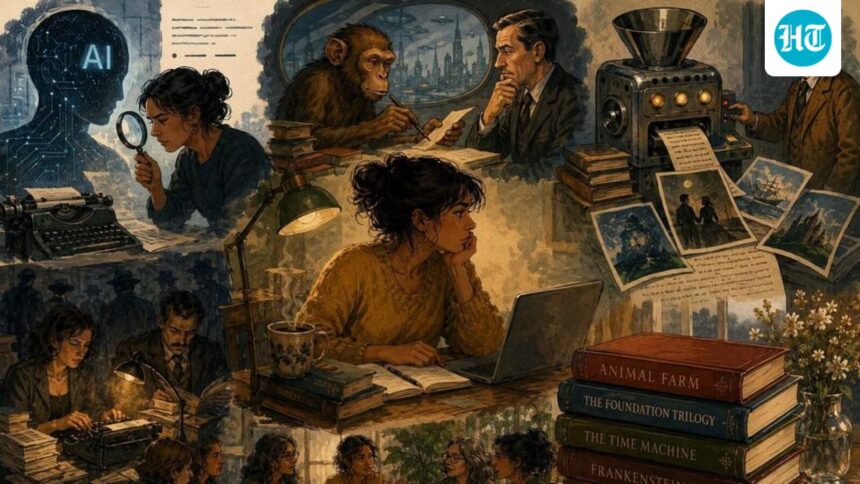
Storytellers had predicted this. Go back in time, for example, to 1953, to science fiction writer Isaac Asimov’s short story, “Monkey’s Finger.” Here, an LLM-like monkey fed the world’s greatest texts shows how he can do better than a writer, who is then pressured by his publisher to change the ending of his story.
In “The Great Automatic Grammatizator” by Roald Dahl, engineer Adolph Knipe invents an LLM-like Grammatizator that is fed “plots”, “tropes” and “writing styles”, and then programmed to come up with different stories. In conclusion, “Half of the novels and stories published in English were produced by Adolf Kneipp at the hand of the great mechanical grammarian.”
Last year, Nnedi Okorafor, the Hugo and Nebula Award-winning Nigerian-American writer, published “Death of the Author.” It tells the story of Zilo, a disabled Nigerian-American writer in her early 30s. On another topic, we have the story of a world of robots. I loved the book because of the way it looks at the nature of storytelling as he moves between these two threads, one human and one machine, looking for a solution and finding it in a surprising twist.
While Asimov and Dahl feared that machines would replace us, Okorafor imagines possible solutions.
Now the literary world is in an uproar as one writer after another admits to using artificial intelligence in their creative process. Earlier this year, romance writer Carol Hart was featured in a viral story, where she proudly reported that she uses artificial intelligence to write more than 200 romance novels a year, many under pseudonyms.
A few days ago, Olga Tokarczuk caused a stir by admitting to using artificial intelligence in her writing.
“Often I ask the machine: ‘Dear, how can we develop this beautifully?’” the 64-year-old Polish Nobel Prize-winning author reportedly told an interviewer.
How do we, as readers, respond to this? There are tools to detect the use of AI, but they are difficult, because AI mimics human patterns so well that it is almost impossible to detect. AI uses the same human writing rules that humans have used for centuries. If you look for dashes, for example, you’ll find them in the most famous writers, including poets like Emily Dickinson.
In our book club, we’re supposed to discuss The Wife, an investigation by Australian journalist Anna Funder into how George Orwell used his wife Ellen’s ideas and also her writings in works like Animal Farm without ever acknowledging them. Instead, we discuss AI in writing, how to spot it, its ethics, and whether we should read authors who acknowledge the use of AI.
My favorite answer to the question to read or not to read comes from my friend and book club member, Kavitha.
“Maybe it’s time to go back to reading only the works of previous centuries, which may have been edited, embellished, embellished or written only by unacknowledged wives,” she says.
(Sonia Dutta Chowdhury is a Mumbai-based journalist and founder of Sonya’s Book Box, a personalized book service. For all questions on life and literature, email sonyasbookbox@gmail.com.)