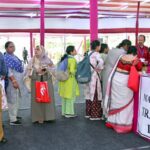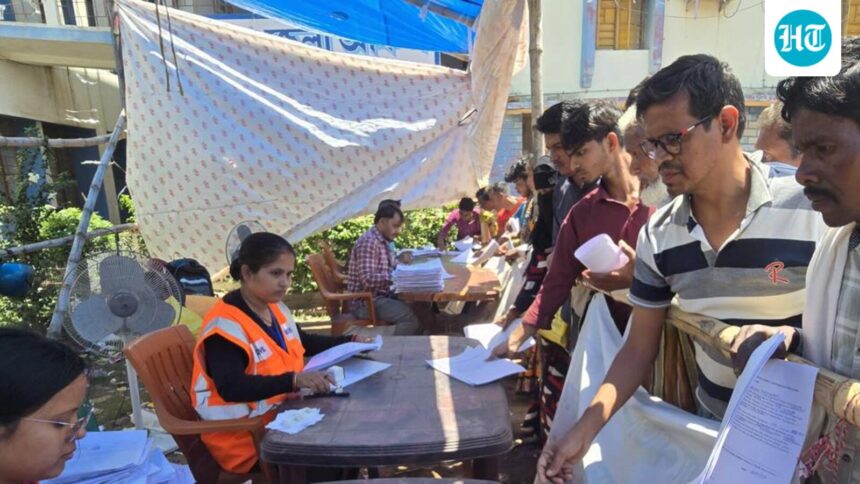
In a village near the banks of the Ichamati River in Taki constituency, an elderly Muslim man tells us that one son and one daughter (but not the other children) of his family were removed from the electoral rolls during the Special Intensive Review (SIR). The Booth Level Officer (BLO) told him that their birth certificates had been rejected and helped them reapply online. This process shattered his trust in the bureaucracy. His wife is too afraid to come out to meet us, and warns her husband to stop talking to “educated” people. “At this point, we can only hope that they will put my children on the final list,” he tells us in despair.

Just a few kilometers away, a middle-aged Hindu man working in Gujarat’s Bharuch district returned to cast his vote. When we asked about the SIR, he raised his voice and declared: “The SIR had to be implemented; no one was circumcised in the Hindu villages. I heard that a Muslim man had 600 children on the electoral roll!” Another person responds with a chuckle, saying, “I heard a hundred, but this is even higher!”
In the mainstream media, the focus has been on documenting the “count” in the SIR. How many names were removed from the lists, and from where? Were only Muslims removed from the lists or Hindus as well? But on the ground, it is not just about numbers, it is also about reshaping power equations and generating narratives about who has the right to participate in the country’s affairs.
As people make their way through a morass of mismatched documents and paper-based bureaucracy in India, they are confronted with the haphazard nature of inclusion and the blurring of “inconsistencies” so severe that they cost citizens the right to vote. If SIR is implemented using well-defined procedures and is publicly scrutinized, any exclusion can be understood and contested in a rules-related manner. But the ambiguity surrounding exclusion has generated polarization and radically changed notions of citizenship. No one really knows why their neighbors were removed from the electoral rolls, and they can only speculate. Are they from Bangladesh? Are they harboring fake voters? Do they have illegal documents? Or is it unfair targeting?
There were ugly Hindu-Muslim riots in Baduria, about 30 minutes from Taki, a decade ago – with a Facebook post and subsequent rumors fanning the flames of communal violence. While things have calmed down since then, everyone remembers the riots. The ambiguity of the SIR is made clear to those nearby by its grafting on the existing Hindu-Muslim fault line.
But it would be an oversimplification to view this as a narrative construct. SIR fundamentally changes how citizens relate to the state. While there is no technical connection between Indian citizenship and inclusion in the electoral roll, most citizens consider their voice to be one of their fundamental rights – ensuring equality for every citizen. Moreover, it is not difficult to see similarities between the deletion of voters with “discrepancies” to be adjudicated in “courts” and the National Register of Citizens practiced in the neighboring state of Assam.
This connection between citizenship and voting has led citizens to demand redress for a series of contradictory and inappropriate documentary procedures. Namasudras constitute more than 16% of the Scheduled Caste (SC) population in West Bengal, according to the latest census; They are particularly numerous along the border areas of Nadia and North 24 Parganas – where the majority have traditionally walked across the border. A large proportion of Namasudras are followers of the Matua Mahasanga, an anti-caste sect that once counted Pinapani Devi, called Puru Ma (Great Mother), as its head. But as with many things in Bengal, politics tore the family apart. Buru Ma’s daughter-in-law, Mamata Bala Thakur, sided with the Trinamool Congress (TMC), while her grandsons Shantanu Thakur (local MP) and Subrata Thakur (current legislator and candidate in this election) sided with the Bharatiya Janata Party (BJP).
Next to the shrine in Thakurnagar, the headquarters of the Matua Mahasangha, there is an office where people can apply for a ‘Hindutva Dharma Certificate’ next to another office called the CAA Help Centre. Those at the CAA described a process that requires a Hindutva Dharma certificate and personal documents to apply for citizenship through the CAA. Of course, there is no legal basis for such a religious certificate, nor is it an actual requirement for CAA certification. (In fact, those at the center quickly backed down when questioned.)
It was a huge shock to the Matua family when many found themselves left out of the voters list. However, the CAA was a key political demand of the Matua community, the basis upon which it could demand legitimate entry into the electoral rolls. The above processes illustrate how the ambiguity of documentary procedures can be leveraged to develop political identities. While the TMC swept the 2021 state elections, the BJP won 5 out of 7 assembly constituencies in Bongaon district including the Jayaghata Assembly constituency. On the penultimate day of the 2026 election campaign, Prime Minister Narendra Modi held a rally in Thakurnagar to reiterate his commitment to the community.
The sum of these complex documentary procedures for electoral register and citizenship was to pave the way for differentiated citizenship between Hindus and Muslims. Through political patronage to navigate this process, some Hindus who have recently come to India achieve legitimacy in the eyes of the state, while Muslims, even if they have been here for generations, are forced to “document their legitimacy.”
In a conversation in the tea gardens next to the Teesta River in Mal constituency in north Bengal, we met a Muslim shopkeeper who explained the issue clearly: “Now the state can continue to ask us for documents. Today, I may be fine, but my children will have to prove their identity again and again to live here.”
Bhanu Joshi is a visiting assistant professor at Ashoka University. Nilanjan Sircar is an Associate Professor at Ahmedabad University. The opinions expressed are personal.
.