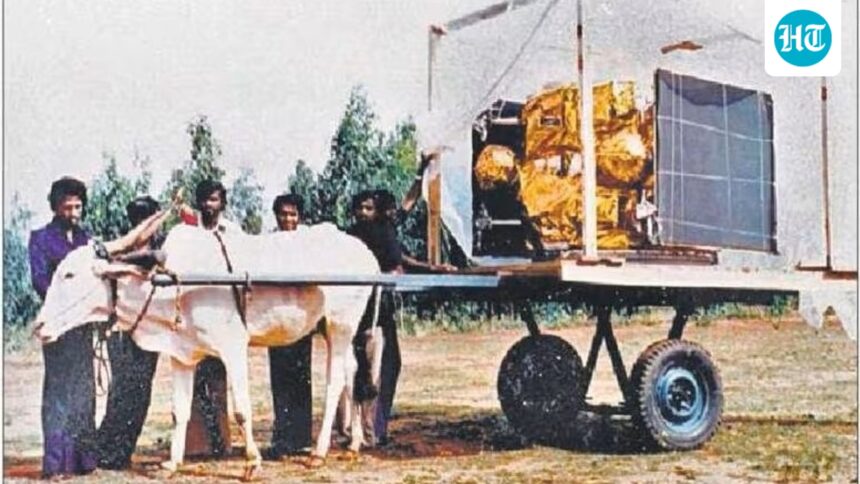
Decades ago, ISRO scientists placed the Indian Space Agency’s first communications satellite on an ox cart. It was directed to an open field, as an improvised solution to a problem that the agency did not have the capacity to solve at the time.

The satellite antenna had a problem. Issues were detected with telemetry, tracking and control (TT&C) links, which are critical to maintaining connectivity. But testing required adequate antenna range, with the satellite structure placed under a thermal blanket, a type of facility that Isro did not have at the time. So, scientists came up with a local solution: they placed the satellite on an ox cart to ensure a non-magnetic environment and conducted the test outdoors.
This satellite was Apple.
Forty-five years ago, on June 18, 1981, India’s space efforts achieved a major milestone by placing an experimental satellite into orbit, pushing the country to the threshold of a domestic satellite communications system.
The Ariane Passenger Payload Experiment (APPLE), the Indian Space Research Organization’s first indigenous and experimental communications satellite, was launched into an elliptical orbit at around 6.20 pm (IST) by the European Space Agency’s Ariane rocket from Kourou in French Guiana.
The 673-kg satellite is expected to bring about radical changes in India’s communication systems once it maneuvers to a geostationary position. It was blasted into space along with the European Space Agency’s Meteosat weather satellite and the CAT technology capsule.
About half an hour after the launch, tracking stations in Sriharikota, Fiji and Kuru began receiving signals from Apple, providing data on altitude, temperature and the operation of its various electronic systems.
But the launch was not without hiccups. Two successive technical malfunctions – first in the electrical system and then in the radar system – delayed take-off by more than an hour. Although a second postponement of the countdown threatened the launch schedule, senior scientists hastily gathered and decided to go ahead with the mission. It later became clear that the red signal that led to the postponement was due to cloud cover, while all other systems were operating normally.
Read also: 15 Satellites Lost, But ‘KID’ Made Its Way Out: The Stranger in ISRO PSLV C62 Mission Setback
Reports from Kourou said that about 16 minutes after liftoff, an Ariane rocket placed Meteosat into orbit. Forty seconds later, Apple separated from the CAT and was injected into orbit. Scientists in Kourou erupted in cheers as the 48-metre-tall, three-stage Ariane rocket disappeared into the sky, and signals were received confirming the launch was a success. India’s ambassador to France, M K Rasgotra, and a team of Indian scientists led by ISRO chief Satish Dhawan were present in Kuru to witness the explosion.
Later reports said that all rocket and satellite systems were operating normally, and that both Meteosat and Apple were on track. Mission Control confirmed that the satellite successfully received commands issued to APPLE after its first pass.
APPLE was designed and built in just two years with limited infrastructure in industrial sheds. It has been used for about two years to conduct extensive experiments on time, frequency, code division, multiple access systems, radio networking, computer interconnection, random access, and packet switching experiments.
Apple went out of service on September 19, 1983.
It has given ISRO valuable practical experience in the design and development of three-axis fixed geostationary communications satellites, as well as in orbit raising maneuvers, in-orbit deployment of appendages, and station maintenance, among other key technologies.
Apple later led to the development of a large constellation of satellites in the INSAT and GSAT series, which revolutionized the country’s technological and economic growth.