With the Trinamool Congress splintered in the wake of its 2026 defeat in West Bengal, former chief minister and party chief Mamata Banerjee faces a prospect that seemed unlikely even six months ago: a return to the Congress — the same party she left to build her political empire.

It began in 1984, in Jadavpur, where a young woman from an obscure middle-class family ran on a Youth Congress ticket against Somnath Chatterjee, a formidable figure in the Communist Party of India. She won that contest, in one of the first signs that Banerjee was not a typical politician.
But Congress tested her patience. By the late 1990s, she had concluded that the party would never seriously confront the Left, and in 1998, she withdrew and founded the Trinamool Congress – built on her personality, grievances and street-level instincts.
What followed was one of the most remarkable epics of Indian politics. She joined the BJP during the Atal Bihari Vajpayee years, and twice served as a minister at the Center until 2001. By 2026, Banerjee had distanced herself from the BJP, believing – rightly – that the Muslim vote was indispensable to defeating the Left in Bengal.
Taking her agitations to Keshpur and Garpeta in West Midnapore, to Singur in 2006, and to Nandigram in 2007, she led the charge against the state government’s land acquisition drive and suffered casualties in the process. Buddhadeb Bhattacharya, the chief minister who was trying to rebuild West Bengal’s image for industries, was unable to withstand the wave it created.
In 2011, in its thirty-fourth year, the Left Front fell.
Banerjee became Prime Minister, the first woman to hold the state’s highest office. It defeated the left by appropriating its own rhetoric: speaking for the poor, the marginalized, and the streets. Within a year, she broke the Congress alliance that had helped her come to power.
Over the next decade, corruption cases – Sarada, Narada – spread but did not sway voters. She won again in 2016.
When the BJP won 19 Lok Sabha seats in West Bengal in 2019, it recalibrated: it ramped up its welfare schemes, toned down what its critics called minority appeasement, and strengthened its Hindu identity. In 2021, her party returned to power with 213 seats in the state. It has now defeated three of India’s main political movements: the Left, the Congress Party, and the Bharatiya Janata Party.
The 2026 House of Representatives elections ended this streak.
The BJP’s victory in West Bengal last month, after 15 years of TMC rule, sparked a partisan crisis that moved more quickly than most political observers expected. Fifty-nine of the party’s 78 legislators rebelled and backed Ritabrata Banerjee as leader of the opposition in the state assembly — an open challenge to the party’s functioning and, specifically, to the role of TMC national general secretary Abhishek Banerjee, who is widely seen as Mamata’s heir apparent.
At least 15 TMC Lok Sabha legislators have defected since then, with MP Kakoli Ghosh – a four-term MP – garnering the support of 19 MPs and declaring his support for the BJP-led National Democratic Alliance. The number 19 is precisely the threshold required to escape anti-defection measures against MPs.
The party’s Rajya Sabha losses were also rapid. Three TMC MPs resigned within a week: Sukhendu Sekhar Rai, who cited “unbridled corruption” and “chaotic governance”; Sushmita Dave; The latest one is Prakash Shik Barak on Thursday.
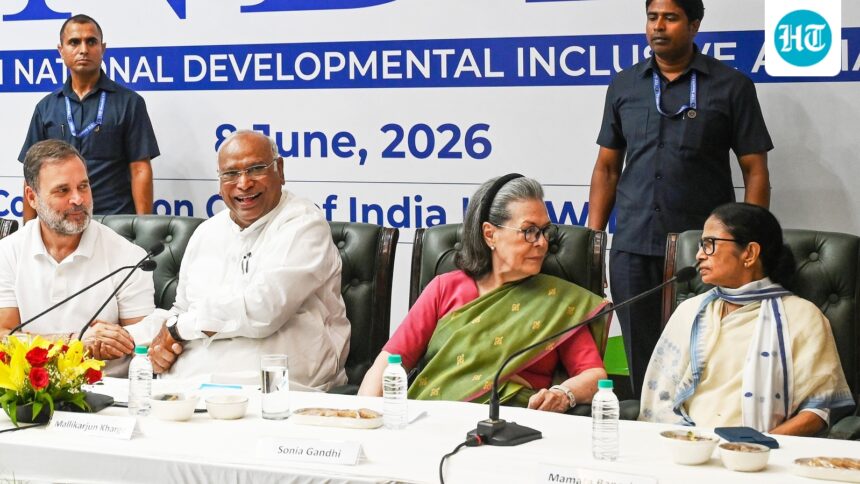
Amid this crisis, the possibility of a Congress party merger has emerged – fueled in part by Banerjee’s meeting with Congress parliamentary leader Sonia Gandhi in Delhi on Tuesday, and Abhishek Banerjee’s meeting with Rahul Gandhi soon after.
The two parties have publicly distanced themselves from these speculations, but the talks are taking place and their importance is not lost on observers.
“The Congress must go with the Left in West Bengal for its revival. The Gandhis must not forget how Mamata won the 2011 elections with the help of the Congress and, over the next 15 years, did her best to demolish the Congress in West Bengal,” Suman Chattopadhyay, a Kolkata-based political commentator, told HT.
A more fluid merger or alliance, if either occurs, would complete the arc.
The party that Mamata Banerjee founded to escape the Congress, outlast the Left, take on the BJP, and dominate West Bengal for 15 years, may finally find itself in the house she left 28 years ago.