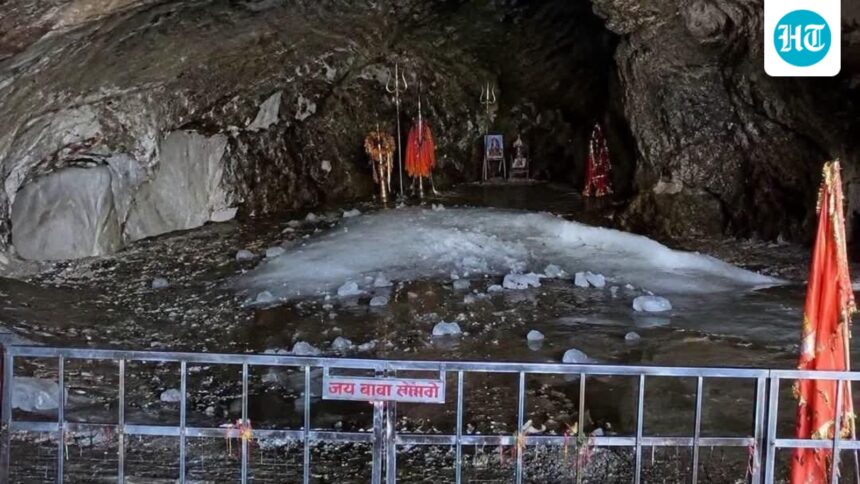
The Amarnath Yatra, which began on July 3, more than a year after the deadly terror attack in April last year, has received an overwhelming response. But it appears to have faced another problem, as several news reports indicate that the naturally formed ice, also called Baba Parvani, has melted by more than 90 percent, just days into the pilgrimage.

the The Amarnath cave shrine is located at an altitude of about 3,888 meters (12,756 ft) in the Himalayas in the Anantnag district of Jammu and Kashmir. It is located below the Lidder Valley in the Himalayas of Kashmir. Pilgrims can reach the shrine via the traditional 48 km Pahalgam Route or the shorter but steeper 14 km Baltal Route.
while The Jammu and Kashmir administration has hailed the record number of devotees returning to the Amarnath cave shrine, and many in the Union Territory have raised the alarm over the rapid thawing of the lingam. Among them is PDP leader Elijah Mufti.
Iltija Mufti sounds the alarm
Moving on to social media platform X, the leader of PDP Iltija Mufti blamed climate change on “unintentional logging, illegal mining, poor waste management, and dangerous depletion of water levels” as factors behind the premature melting of the Amarnath Lingam.
“Just one week after the Amarnath Yatra, the naturally formed lingam has already melted. Climate change caused by indiscriminate logging, illegal mining, poor waste management and dangerous depletion of water levels are major factors. Unfortunately, the environment has become a victim of Kashmir’s politics. It has no energy currency,” Mufti wrote.
She added: “For our mountains, rivers and glaciers to survive, we need a long-term sustainable environmental and tourism policy. Like Bhutan. Otherwise, Kashmir will cease to exist.”
Many devotees who went on the first batches of the yatra told various media outlets about the thawing of the lingam. Many other people took to social media to post about it.
The shrinkage of the sacred ice formation, revered for centuries as Baba Parvani, has reignited an ancient controversy. Will climate change cause ice to melt earlier each year? Will rising numbers of pilgrims and expanding infrastructure within the fragile Himalayan ecosystem accelerate the shrinkage of the lingam?
Is recording the pilgrim’s footsteps responsible?
The Amarnath Yatra began on July 3 this year under unprecedented security measures after April 2025 Pahalgam terrorist attack that killed 26 civilians. Despite security concerns, the number of pilgrims has increased. At least 93,000 pilgrims visited the shrine in the first four days.
More than 32,000 devotees had offered prayers by July 5, while more than 20,000 pilgrims visited the shrine on the second day of the yatra alone, The Hindu reported. This was the highest second-day turnout in several years. Lieutenant Governor of Jammu and Kashmir Manoj Sinha, who also heads the Shri Amarnath Shrine Board (SASB), described it as a “massive surge” compared to the previous four years. However, he also expressed concern about the increase in numbers of unregistered pilgrims, with thousands arriving without mandatory health certificates or RFID registration, warning that they are overtaxing security arrangements and infrastructure.
“We are witnessing a huge influx of unregistered pilgrims. I strongly urge those who do not have prior registration to be patient and wait for their turn. This cooperation is essential for a smooth and seamless yatra experience,” Sinha was quoted as saying by The Hindu.
The council has set the daily number of pilgrims at 10,000 along the Pahalgam and Beltal routes.
In response to concerns about premature thawing of ice, Amarnath Lingam, Chief Minister of Jammu and Kashmir Omar Abdullah said that the number of pilgrims has already been regulated as per the Supreme Court directives.
“There is already a maximum limit imposed by the Supreme Court… As for the icy lingam, it is created by nature. Neither you nor I can decide how long it will remain,” the Prime Minister was quoted as saying by Greater Kashmir newspaper.
Climate change a factor?
Scientists have repeatedly warned that the Himalayas are warming faster than many other mountain systems globally. Rising average temperatures, changing snowfall patterns and retreating glaciers are becoming increasingly evident across the state of Jammu and Kashmir.
Media reports have cited the unusually warm conditions around the cave and surrounding glaciers as one of the main reasons for the rapid melting of the stalagmites. Amarnath Cave is located at an altitude of about 3900 metres. Even slight increases in ambient temperature, combined with changes in humidity inside the cave, can affect the growth and survival of the naturally occurring ice structure.
The Amaranth Way has undergone significant changes over the past two decades, with roads widened and temporary accommodation expanded, community kitchens moved closer to the shrine, the introduction of electricity and solar lighting, and the use of heavy machinery to improve access. Recently, the Center also approved the ropeway project. Discussions continue about the proposed tunnel between Sheshnag and Panstarni.
While these steps have made the pilgrimage safer and more accessible, the cumulative effect of expanding infrastructure and increasing human activity in an environmentally sensitive area may alter the cave’s microclimate.
Moreover, this is not the first episode of its kind. According to a report by AajTak, the Lingam melted within 29 days in 2018, 38 days in 2020, 28 days in 2022, and within about a week in 2024. This year, the melting seems to have happened even earlier.