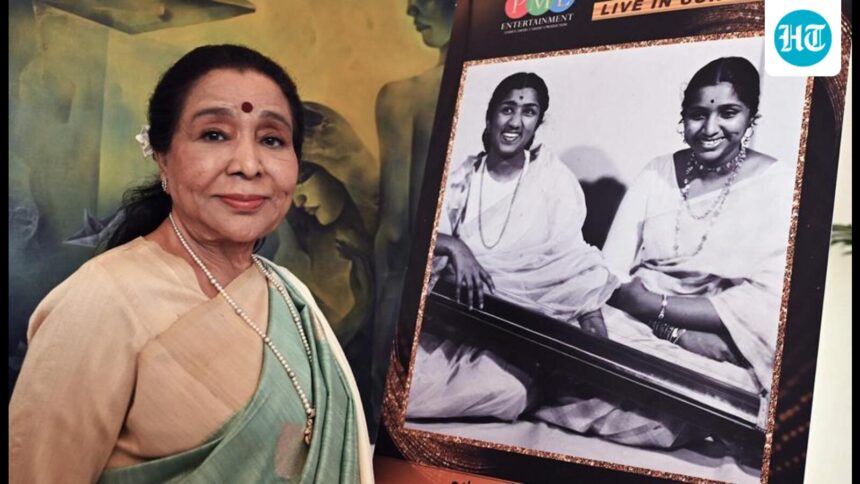
If Indian music is a vast night sky, filled with constellations of discipline and dedication, then Asha Bhosle will be a restless comet that refuses to follow a fixed orbit. It has flashed through eras, styles and expectations, leaving behind a luminous trail that others cannot help but admire.

“Versatile” is a word often used to describe ease. But it may be important to understand where diversity comes from. I feel like that was her instinct for emotional truth, even in the most stylized compositions. She can enter a song and inhabit it completely, whether it takes hurt, seduction, depression, or abandonment.
Her voice had an elasticity that allowed it to bend just enough but not really break. It can be playful, sensual and sad depending on what is required. Everything, one hundred percent, no half measures. Badi Ghulam Ali’s famous admiration-filled quip about Lata Mangeshkar, “Kambakht kabhi bhoole se bhi besuri nahin hoti hai”, is equally applicable to Asha as well.
Her gayaki music carried a distinct sense of rhythm that sounded almost conversational. There was a hint in her expressions that suggested she was speaking directly to someone she knew. This created an intimate connection with the listener and targeted your heart instantly. I understood the spaces between notes, the pauses that create anticipation, and the subtle twists that turn a line into a stunning melodic experience.
One of her most notable qualities was her fearless engagement with genres that others might treat with caution. Cabaret songs, folk tunes, ghazals, pop experiments, and classical compositions, she embraced them all with the same amount of curiosity, expertise, and ingenuity. In doing so, she expanded India’s singing vocabulary. Songs like “Piya Tu Ab To Aaja” or “Dum Maro Dum”, apart from achieving cult popularity, became cultural transformers.
However, the same person can sing ‘Chain Se Humko Kabhi’, ‘Dil Cheez Kya Hai’, ‘Bheeni Bheeni Bhor’, ‘Koi Diya Jale Kahin’, and collaborate with the likes of Boy George and Kronos Quartet.
If her songs with OP Nayyar created a unique package, her collaboration with RD Burman (Pancham) was a complete garden rage. They engaged with a boldness unusual for the time and turned it into one of the most fertile creative partnerships in Indian music. Together they have created a soundscape that sounds modern without losing any of its roots.
Pancham understood the textures in Asha’s voice that could carry unconventional melodies. Asha, in turn, trusted his vision and surrendered to the demands of his compositions with complete faith. Their work together produced moods that persisted long after the music stopped.
To talk about her art without acknowledging her sister’s shadow would be somewhat incomplete. Growing up alongside Lata Mangeshkar meant living in the presence of an already accepted legend. Comparisons were inevitable, and perhaps often unfair. But Asha did not try to imitate or compete on the same terms.
She’s carved out her own space, a space that’s less about perfection and more about personality. By doing this, she made sure that her voice would not be confused with anyone else’s. Pancham summed up the comparison best: “If one is Don Bradman, the other is Gary Sobers!”
Her longevity at the top has been a result of her extraordinary adaptability, coupled with a relentless work ethic. She was willing to learn, unlearn what she had learned, and repeatedly reinvent herself. And when the music scene changed, it changed too, without losing its basic identity. Young composers found in her a collaborator who could still surprise them. This ability to remain relevant across decades is perhaps her greatest achievement.
She was able to give public concerts until last year, which is an amazing achievement, as she sings on stage for long periods. But behind all these obvious successes and cult status lies a personal life marked by turmoil and trials. Married young, estranged, and left to raise children in difficult circumstances, Asha Bhosle’s early years were a far cry from the glamor that later surrounded her. But she overcame these challenges with the flair of a wizard, and refused to let them define her limits.
Instead, she seems to have deepened her emotional repertoire, allowing her to bring a rare authenticity to songs of longing and heartbreak. I wish I had the opportunity to make a biographical documentary on Asha Bhosle the way I did on RD Burman. It will be the story of a woman who refused to be contained by circumstance, comparison or tradition and emerged as a singing phenomenon that India simply adores.
It follows the journey of a young girl who navigates the shadows of a legendary family, and finds her own voice in a world that has often tried to define her. It will embody the evolution of Indian music from the golden age of singing to the experimental sounds of later decades.
Ultimately, Asha Bhosle’s legacy is not limited to the thousands of songs she sang. It lives on in the way those songs continue to feel alive, breathing, and connected. Her voice reminds us that music isn’t just about notes and technique, but about the courage to feel deeply and express those emotions without fear.
She remains, even today, a moving constellation in the firmament of Indian music – unstable, vibrant, and ever-changing. And that was perhaps her greatest gift to us fans and admirers. You have shown us how to truly endure; One must become a smooth melody, able to sing it anew, over and over again, in the ever-changing rhythm of life, absorbing time, desire, rebellion, and memory.
Brahmanand S Singh is a National Award-winning director and author