“Art, like knowledge, is the common heritage of humanity and should not be limited to borders,” says Geo MD defending honor of Asha Bhosle after PEMRA notification.

After Pakistan Electronic Media Regulatory Authority, PEMRA, issued a show-cause notice to Geo News for broadcasting content related to the death of legendary singer Asha Bhosle, it sparked a broader reaction around art and the subcontinent’s shared cultural roots.

Azhar Abbas, Managing Director, Geo News and President, Association of Electronic Media Editors and News Directors (AEMEND), shared the news of the notice.
He wrote in the [Pakistan Electronic Media Regulatory Authority or] PEMRA has chosen to restrict this.”
Abbas did not stop at defending his channel’s editorial choices.
He called for a common culture: “Art, like knowledge, is the common heritage of humanity and should not be limited by borders.”
He further noted that “Asha Bhosle herself was an admirer of legendary Pakistani singer Noor Jahan, whom she fondly called her ‘elder sister’. She collaborated with Nusrat Fateh Ali Khan and revived the poetry of great Urdu poets like Nasir Kazmi.”
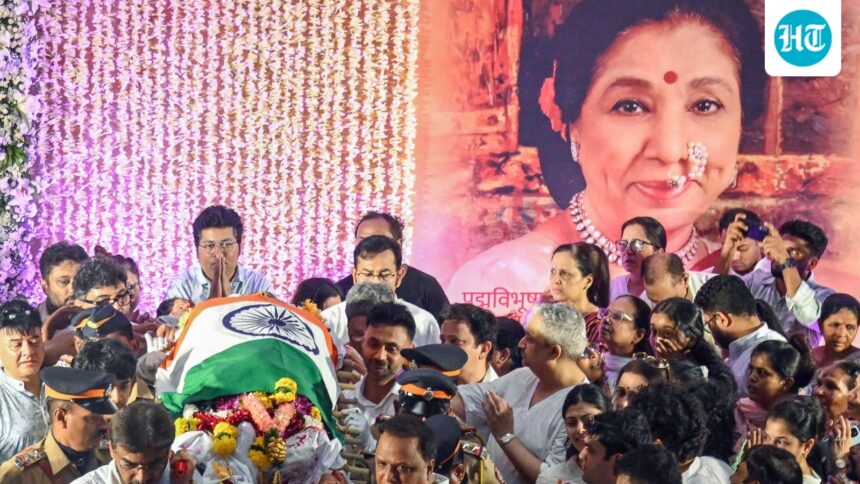
Asha Bhosle died in Mumbai on April 12, 2026, at the age of 92.
As condolences poured in from around the world, Geo News – one of Pakistan’s most prominent television channels – covered her death by revisiting her music and legacy.
What the notice argued, Geo MD responded
The Media Regulatory Authority issued a notification citing a 2018 Pakistan Supreme Court order that banned the broadcast of Indian content on television. It summoned Geo News CEO Mir Ibrahim Rehman for a hearing on April 27.
But Abbas struggled to separate fragile politics from art.
“In times of war and conflict, art and artists should not become victims,” he wrote. “Intellectuals, musicians, and creative people are often the voices that stand against hatred and division, and they are the ones who bring people closer together.” India and Pakistan engaged in military exchanges last year after the terror attack in Pahalgam in India’s Jammu and Kashmir region. India carried out ‘Operation Sindoor’ against terrorist bases in Pakistan.
Dia reminder, more interaction
The backlash to the PEMRA notice was not limited to that of Geo News.
Political commentator Rauf Kalasra even cited historical context. “Please don’t take us back to the harsh years of 1980s of Gen Zia, when owning a VCR/movies was a crime and punished. This is the age of Netflix and AI. Don’t make us look like fools in this era,” he wrote.
The reference to General Zia was in reference to his military rule in the 1980s, which was characterized by cultural restrictions and a climate of censorship.
Another user
Pakistani artists paid tribute to Asha Bhosle. Actor Ehsan Khan described her death as “the end of an era.” Another actor, Adnan Siddiqui, wrote that her voice “had a way of filling even the quietest moments with something devastatingly human.”
“Thank you for the feelings you gave us, the memories you became and the magic you left behind. You will always be heard, somewhere…somehow,” my friend added.
However, there were reactions in favor of the notice as well, one of which was from a user named Kamran Malik: “Very good decision by Bimra. It’s an eye for an eye policy, if they don’t respect our sovereignty then why should we puff up? The subcontinent sounds nice in theory.. but the reality says otherwise. If sovereignty is not respected, there is no reason to pretend everything is normal.”

Arish Chhabra is an associate editor on the Hindustan Times online team, where he writes news reports and explanatory features, as well as overseeing the site’s coverage. His career spans nearly two decades across India’s most respected newsrooms in print, digital and broadcast. He has reported, written, and edited across formats—from breaking news and live election coverage, to analytical long-reads and cultural commentary—building a body of work that reflects editorial rigor and a deep curiosity about the community for which he writes. Areesh studied English Literature, Sociology and History along with Journalism at Punjab University in Chandigarh, and began his career in that city, eventually moving to Delhi. He is also the author of Little Big City: What Life is Like from Chandigarh, a collection of critical essays originally published as a weekly column in the Hindustan Times, which examines the culture and politics of a city that is much more than just its famous architecture – and in doing so, holds up a mirror to modern India. During his stints at BBC, The Indian Express, NDTV and Jagran New Media, he has worked across formats and languages; Mainly English, as well as Hindi and Punjabi. He was part of the crack team for the BBC Explainer project which was replicated around the world by the broadcaster. At Jagran, he developed editorial guides and trained journalists on integrity and quality content. He has also worked at the intersection of journalism and education. At the Indian School of Business (ISB) in Hyderabad, he developed a website to streamline academic research in management. At Bennett University’s Times School of Media in Noida, he taught students the craft of digital journalism: from newsgathering and writing to social media strategy and video storytelling. Having moved from small town to larger city to megalopolis for education and work, his intellectual passions lie at the intersection of society, politics, and popular culture—a perspective that guides his writing and worldview. When he’s not working, he’s constantly reading long-form journalism or watching cerebral content, sometimes both at the same time.Read more