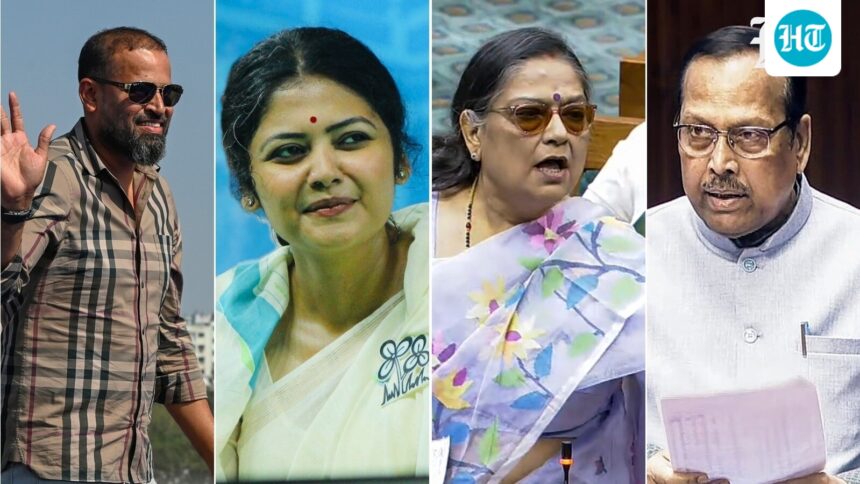
Twenty rebel Trinamool Congress MPs announced to the Lok Sabha Speaker on Sunday that they have merged with a party that does not hold a single seat anywhere in India.

This move, apparently aimed at avoiding activation of the anti-defection law, has become one of the disputed provisions. This was the second time this question had been asked this year, just weeks after seven Aam Aadmi Party MPs made a near-identical move in the Rajya Sabha.
Whether this maneuver will depend less on political calculations and more on a legal question the Supreme Court has yet to answer conclusively: Can a group of lawmakers announce a merger on their own, or must the political party they represent agree?
What is the anti-defection law and what does it allow?
The anti-defection law in India was introduced through the Tenth Schedule to the Constitution, which came into effect through the 52nd Constitutional Amendment in 1985. It was a response to the phenomenon of “Aya Ram, Jaya Ram” politics – where legislators switch parties mid-term to bring down governments or secure personal advancement.
The Tenth Schedule disqualifies any legislator who voluntarily renounces party membership or votes against the directions of his party in the House.
The law established two original exceptions. The first was “schism”: if a third of the members of the legislature defected, the rebels were protected from disqualification. However, this requirement was removed by Constitutional Amendment No. 91 in 2003, after it was routinely manipulated to engineer departures under the guise of official division.
What has survived is one exception: integration. Paragraph 4 of the Tenth Schedule sets out the conditions. Disqualification will not apply if the original political party merges with another party and at least two-thirds of the members of that party’s legislative group approve such merger. The language of the law suggests two conditions: a decision at the political party level, and legislative approval by at least a two-thirds majority.
Twenty representatives and one mysterious party
The Trinamool Congress crisis comes in the wake of the party’s defeat in the West Bengal Assembly elections, which produced the first BJP government in the state. Rebellion soon emerged within the parliamentary group.
Kakoli Ghosh Dastidar, who was dropped as chief whip, has emerged as a prominent rebel face. She was joined by former floor leader Sudip Bandopadhyay, deputy leader Shatabdi Rai, and a cross-section of the party’s Lok Sabha contingent which included actors Deepak Adhikari, Sayoni Ghosh, John Malliah, former cricketer Yusuf Pathan and former Indian football captain Prasun Banerjee, among others.
On Sunday, nineteen of the rebels personally submitted their letters to Parliament Speaker Om Birla. Rachana Banerjee, 20, gave her consent in a letter from Malaysia.
Together, they told Birla that they have merged with the National Citizens Party of India, or NCPI – a party registered in 2022, which last contested elections in 2023 and currently holds no elected seat at any level.
A BJP MP involved in the discussions told HT that NCPI was chosen to maintain insurgent connectivity with West Bengal while expanding its symbolic reach to the northeast.
The practical consequences, if the merger is approved, are significant. TMC’s Lok Sabha strength will come down from around 28 to eight. In the Rajya Sabha, the party’s number of seats has already come down from 13 to 10 seats. The NDA’s Lok Sabha seat tally will rise from 294 to 314 – 46 seats short of a two-thirds majority, although the alliance will be eight seats short of that threshold in the Senate.
Mamata Banerjee’s TMC on Sunday took its own measures. TMC Lok Sabha floor leader Abhishek Banerjee has written to the Speaker, arguing that “partition is no longer available under the Tenth Schedule” and that the TMC remains “one indivisible political party”.
He cited the 2023 Supreme Court ruling in the Maharashtra political crisis — which drew a sharp distinction between a political party and its legislative wing — to say that no group of members can form a parallel faction and demand independent recognition in the House.
path Live updates on TMC crisis here
Senior lawyer and independent MP Kapil Sibal was more direct: “Rebels from the TMC legislative party cannot merge with a political party; this can only happen if the TMC wishes to do so. Exclude them.”
The TMC leadership has indicated that it may approach the courts, reflecting the legal challenge faced by the AAP after seven MPs from the party joined the BJP in April.
Legal discussion
At the heart of both the AKP and the TMC’s disputes lies a constitutional question that the Tenth Schedule has not clearly resolved: does Section 4 require an actual decision by the political party to merge, or is a two-thirds legislative bloc sufficient on its own?
The language of paragraph 4 refers to the “original political party” – the broader organization, not just its elected representatives on the council. Paragraph 4 draws a structural distinction between the two: a political party presents candidates and issues whips; The legislative party is those candidates once elected. Treating them as interchangeable means lawmakers can effectively sever ties with the party that sponsored their state while claiming constitutional immunity.
2023 issue
The Supreme Court heard the neighboring terrain case in Subhash Desai v. Principal Secretary, Governor of Maharashtra in 2023. That case, which arose out of Maharashtra’s political crisis, did not directly involve a merger claim, but the court drew a line: a legislative party cannot act independently of a political party.
The court held that the Tenth Schedule draws a “clear line” between the two, and that a legislative majority cannot determine the identity of a political party or its decisions. If legislators cannot appoint a rival president or claim party identity in large numbers, it follows – by the same logic – that they also cannot implement a merger unilaterally.
However, the legal situation has not been settled.
In 2022, the Bombay High Court upheld the alleged “merger” resulting from the defections in Goa on the basis that two-thirds of the legislative party had joined another party – without requiring evidence that the original political party had itself taken the decision to merge.
This interpretation, currently challenged before the Supreme Court in Girish Chodankar v. Speaker of the Goa Legislative Assembly, treats Section 4(2) as a stand-alone provision, making the legislative two-thirds threshold the only qualifying requirement.
Critics say that this reading drains the integration exception of its constitutional purpose and turns it into an official license for organized dissent.
The Supreme Court’s ruling in the Chodankar case – which is still pending – is expected to determine whether Section 4 should be read in conjunction, requiring a party-level merger decision and legislative approval, or separately, where legislative numbers alone suffice. The TMC insurgency, unfolding in real time on a parliamentary scale, adds great urgency to this resolve.
Role of speaker
In the near term, the fate of the TMC rebels rests with Lok Sabha Speaker Om Birla. He will verify the signatures of the 20 representatives before deciding on the merger case. The Speaker – or the Speaker of the Rajya Sabha in parallel proceedings involving the AAP – acts as the first constitutional authority in matters of disqualification, with the courts reviewing those decisions, not replacing them at the first instance.
Until the ruling is issued, the rebels occupy a legal anomaly: they continue to belong, on paper , to the party on whose ticket they were elected. This means they remain subject to the TMC’s whip – and could face additional grounds for disqualification if they vote or act against it during the intervening period. The Tenth Schedule does not set a time limit within which the Speaker or the President must make a decision on recusal applications, a gap that allows this ambiguity to continue through consequential legislative action.
If the repeal of the divisive article in 2003 was intended to tighten the law, the merger exception has increasingly become the outlet through which organized defections seek to pass. The AAP episode in April was one test. The rebellion of the Transitional Military Council – 20 MPs, a party with no representatives, and a government allied with the National Democratic Alliance in waiting – is another example.