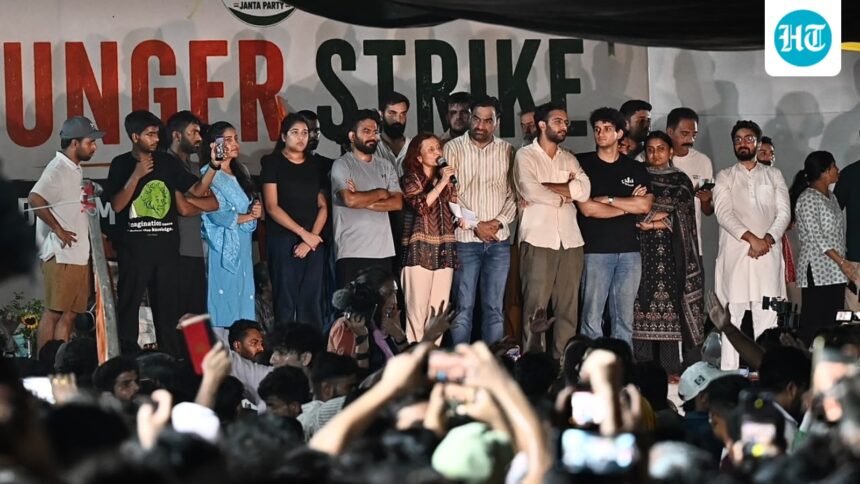
The stage is set for a tense start to the monsoon session of Parliament on Monday, with the Cockroach Janta Party (CJP) going ahead with its proposed ‘Sansad Chalo’ rally even as the Delhi Police refused permission for the protest and imposed prohibitory orders in most parts of the New Delhi area except the protest site near Jantar Mantar.

The planned march comes amid activist Sonam Wangchuk’s ongoing indefinite hunger strike, which has entered its third week after police took him to Delhi’s Safdarjung Hospital on Saturday.
While Wangchuk’s supporters vowed to continue agitating over alleged paper leaks and educational reforms, police warned that any unauthorized gathering or procession towards Parliament would invite legal action.
The convergence of politically charged protests with Parliament’s opening day has led to tight security across the national capital, setting the stage for a potentially eventful Monday.
Also Read: CJP Parliamentary March 20 July Live: Section 163 imposed in parts of New Delhi, bans gathering of five or more people
CJP call for ‘Sansad Chalo’
CJP founder Abhijit Debaki urged his supporters from across the country to gather at Jantar Mantar in large numbers before heading towards Parliament. Addressing his supporters on Sunday, Debke claimed there could be a police crackdown, and appealed to protesters to remain prepared as the agitation continued.
The proposed march is being organized in support of Wangchuk’s indefinite hunger strike and the group’s demands for action over the alleged NEET paper leak, as well as the resignation of Union Education Minister Dharmendra Pradhan. Delhi Police transferred Wangchuk to Safdarjung Hospital on Saturday after his health deteriorated during the fast, but his supporters vowed to go ahead with the agitation.
On Sunday, Wangchuk’s wife, Gitanjali J. Angmo, relayed a message from the activist urging her supporters to keep Monday’s march peaceful and ensure the movement is not abused.
Read also: Wangchuk’s wife says he can end hunger strike, conditions set as crowds swell at CJP’s march to parliament on July 20
No sign from Delhi Police
Delhi Police clarified that no permission was sought or granted for the proposed parliamentary march. The force also reminded citizens that prohibitory orders under Section 163 of the Bharatiya Nagarik Suraksha Sanhita (BNSS) Act remain in force in the New Delhi area, except for the designated protest site at Jantar Mantar. These restrictions prohibit unauthorized gatherings, demonstrations and processions, especially around Parliament and other areas with heightened security measures.
The police have warned that anyone violating the prohibitory orders will face prosecution under the relevant provisions of the Bharatiya Nyaya Sanhita (BNS).
Security measures have already been tightened ahead of Monday’s protests. Multiple entry points into the New Delhi area have been converted into high security zones with elaborate barricades, round-the-clock surveillance, extensive vehicle checking and deployment of additional personnel to prevent any law and order situation.
The tight security measures reflect concerns about any attempt by demonstrators to head towards Parliament on the opening day of the session.
Parliament is preparing for a stormy session
The proposed protest coincides with the first day of Parliament’s seasonal session, scheduled to last from July 20 to August 13 with 19 sessions over 25 days. Prime Minister Narendra Modi is expected to address the media before the proceedings begin, while both houses are expected to witness heated exchanges between the government and the opposition on a range of political and legislative issues.
The opposition has already signaled an aggressive stance, with parties staging a symbolic walkout during the all-party meeting on Sunday over the participation of the newly formed National Citizens Party of India (NCPI), which includes 20 rebel Trinamool Congress MPs. The controversy is expected to extend to Parliament on Monday.
The Center is also expected to introduce several major bills during the session, including the Supreme Court (Number of Judges) Amendment Bill, the Foreign Contribution (Regulation) Amendment Bill, the Vixit Bharat Shiksha Adishthan Bill, among others.
The opposition parties are expected to raise issues such as the leak of NEET-UG papers and the case of alleged misappropriation of donations to the Ayodhya Ram Temple, paving the way for a stormy session.
(With inputs from agencies)