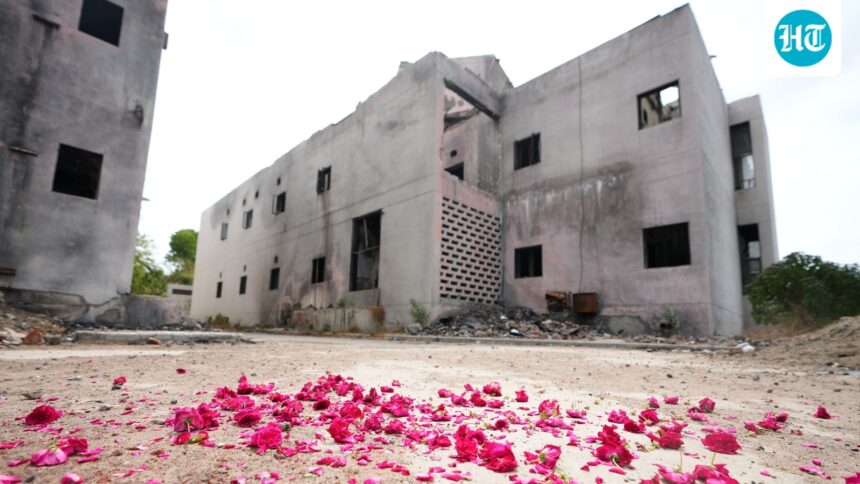
A year after Air India Flight 171 – a London-bound Dreamliner – crashed seconds after take-off in Ahmedabad in Gujarat state, the memory of the victims still haunts the forensic experts who helped identify them. The accident, which occurred on June 12, killed 241 people out of 242 people on board.

HP Sanghvi, Director, Directorate of Forensic Sciences, Gujarat, reveals one particular photo that has stayed with him. Sanghvi and his team of 38 forensic scientists worked relentlessly for 15 days to examine the biological samples of those who lost their lives in the tragedy.
The head coroner remembers a woman’s severed hand, her fingers tightly intertwined as if she was pleading for help. “It was as if she was crying out for help… Even now, a year later, we can only imagine the horror of her last moments,” Sanghvi told news agency PTI. For Sanghvi, the scene is a testament to the horror she felt in her final moments, and to the trauma that came with identifying the bodies.
Read also | Air India: No pressure on AI-171 families for final settlement
After AI-171 crashed into a hostel complex on the afternoon of June 12, 2025, killing all 241 people on board and 19 people on the ground, many of the dead were charred to the point of being unrecognizable. It fell to Sanghvi and his DFS team to conduct DNA identification, as well as examine the damaged electronic devices pulled from the ashes and extract any information they could from them, the agency said.
“100 DNA profiles in 100 hours”
Sanghvi said he was informed about the incident through a text message during a meeting at the Department of Field Support headquarters in Gandhinagar. After learning of the extent of the tragedy, the directorate gathered DNA experts from all over the state. The agency also secured additional chemical analysis kits and backup machines for scientists, the agency said.
Sanghvi said that the first samples arrived after midnight on the day of the tragedy. “QAR teams were able to generate 100 DNA profiles within the first 100 hours,” the head forensic pathologist told PTI. In the following days, forensic scientists made every effort to complete the task before them. Narrating the difficult days, Sanghvi said it was a round-the-clock operation for experts.
Read also | Air India rejects Rupani’s daughter’s claims of pressure on families of AI-171 victims: ‘No deadline to accept compensation’
Within a 15-day forensic process
Extraordinary scientific efforts were made over the next two weeks, with the laboratory receiving more than 180 biological samples.
Of these cases, many were severely compromised by intense heat and rapid burning, making extraction of viable tissue difficult. For this, Sanghvi said scientists isolated usable DNA from burnt tissue, a delicate 30-step process, PTI reported.
In between these efforts, experts often found that extreme heat destroyed cellular structures, causing them to reset and start the process all over again. However, Sanghvi said that despite the time-consuming effort, scientists continued their efforts.
“Our teams stayed here 24/7,” Sanghvi said. “In the end, they were able to return these digital remains to the grieving families, bringing back the final living memories of the people they lost,” he added.