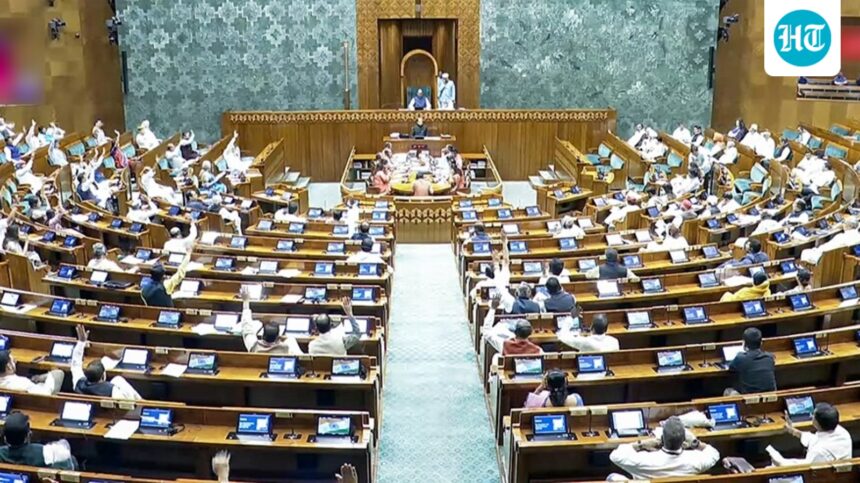
The government is working to introduce a draft law that would separate the reservation of seats for women in legislative assemblies from the census and the so-called delimitation process, with the possibility of an amendment to the effect, perhaps as early as this weekend, people familiar with the matter said.

The move could increase the number of seats in the Lok Sabha to 816, one of the people cited above added on the condition of anonymity. 273 of them will be allocated to women, and the proportional representation for each state will remain the same.
Since many opposition parties have proposed immediate implementation of the law, at the time of its passage in 2023, the government’s proposed amendment is likely to gain widespread support.
The 816 figure is close to the 814.5 that could be reached by increasing the number of seats in the Lok Sabha, currently 543, by a third.
Proportional representation means, for example, that Uttar Pradesh, which has 80 seats in the 543-member Lok Sabha (14.73%), will get 120 seats in the new Lok Sabha; Tamil Nadu, with 39 seats (7.18%), will have 59 seats.
An NDA ally leader said the government had informed them that a delimitation committee would be formed by June to implement the process of redrawing constituencies before implementing reservation in 2029 in the Lok Sabha.
The demarcation process was scheduled to take place in 2026 and was to be based on the 2021 census (which was never conducted). It was widely expected that the process, which ensures that the number of representatives a province sends to the Lok Sabha, roughly reflects its population, will be implemented after the 2027 census. Southern states have raged against the plan because it would effectively punish them for successfully controlling their populations — a national imperative during the 1970s, 1980s and 1990s — and reward outliers like Bihar and Uttar Pradesh.
It is certainly not clear how the government plans to address the imbalance if its plan for a women’s quota goes through – because that would mean that a vote in Tamil Nadu, or Kerala, for that matter, would carry more weight than a vote in Uttar Pradesh.
Discussions with the opposition
The people cited primarily said the government had begun reaching out to opposition parties to build consensus on the amendment which is expected to be tabled before the session ends on April 2. They added that the decision to continue the session over the coming weekend, citing pending business, may have been prompted by this.
Union Home Minister Amit Shah on Monday met leaders of other parties and all NDA partners to discuss the issue, HT has learnt.
According to another person, the minister met leaders of BJD, YSRCP, NCP (SCP), Shiv Sena (UT) and AIMIM to discuss the provisions of the amendment.
Read also | The government is studying a lottery system and separating women’s quota from the census and border demarcation
The government is considering delinking the Nari Shakti Vandhan Adhinyam Act or the Constitution (One Hundred Sixth Amendment) Act, also known as the Women’s Reservation Act, from the earlier stipulation requiring demarcation to be carried out on the basis of the 2021 Census.
“We understood that the total number of seats allocated to women would be determined on a lottery basis… and every third seat would likely be for women,” the first person said. “There was no discussion about whether these seats would be fixed or reserved for women on a rotating basis.”
A third person said the proportional representation of states in the Lok Sabha would be fixed. One-third of the seats currently allocated to the scheduled sects and tribes will be allocated to the women of these sects. “There are many castes to take into account, so caste census will not be used to determine these reserved seats,” this person added.
This person explained the logic of not waiting for the census, saying that since the exercise “will continue (until 2029), waiting for its completion would have delayed it (sequestration), and that is why it is being done now.”
A fourth person admitted that although discussions about the amendment are continuing, no decision has been made regarding its introduction this week.
“Either it will be served now or the house will go into recess and then come back together to make this adjustment…” that person said.
It was decided that the opposition would press for an all-party meeting to discuss the issue, an opposition legislator said at a meeting chaired by Leader of the Opposition in Rajya Sabha and Congress chief Mallikarjun Kharge. The opposition MP said: “The issue of support or non-support will not arise until we know what the government has proposed.”
In response to the opposition’s request for a detailed memorandum on the proposed amendment, a government official said: “Our intention is to build consensus and we are open to discussions.” The government will certainly need to involve opposition parties, and the proposed amendment will require a two-thirds majority.
If the amendment is passed, the 2027 Assembly elections in Uttar Pradesh and Uttarakhand could see a third of seats in the expanded state assemblies reserved for women. Using the same formula, the number of seats in the Uttar Pradesh Assembly will increase from 403 to 605, and in the Uttarakhand Assembly from 70 to 105.
Hizb ut-Tahrir had previously stated that the government is exploring a lottery system to determine which third of electoral districts should be allocated to women.
The law seeks to reserve 33% of the seats for women in the House of Representatives and the Legislative Assemblies. Several opposition parties, including the Congress, TMC and DMK, had earlier suggested separating the reservation process from boundary demarcation and census. The Women’s Reservation Bill was approved in September 2023 in a special session. This was the first legislation to be passed in the new Parliament building.
The border demarcation process was frozen (in 2002) until after the first population census conducted after 2026.