For centuries, the lifespan of India’s ancient banyan trees has been largely a matter of folklore, local legends and historical records. Now, for the first time, scientists have been able to accurately date one using radiocarbon analysis.

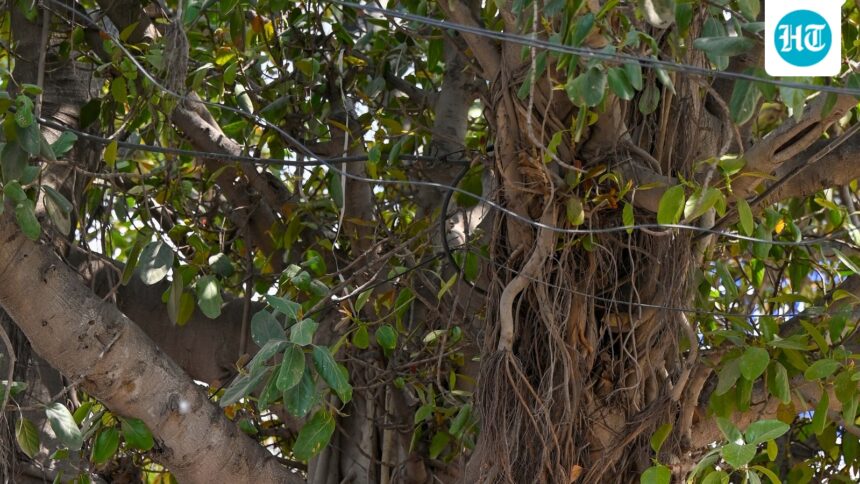
A banyan tree in Munger, Bihar, estimated to be about 700 years old, has been identified as the oldest accurately dated banyan tree (Ficus benghalensis) using radiocarbon dating — a method that relies entirely on scientific evidence rather than oral history or historical accounts, according to a PIB press release.
Read also | Beautiful, dark and deep: the lessons that ancient trees can teach us
Radiocarbon dating and the oldest banyan tree
Banyan trees, with their expansive canopies and complex networks of roots and branches, support diverse ecosystems by providing habitats for birds, insects and other wildlife.
They have also occupied a central place in the social and cultural life of India for centuries. However, determining their ages remains a challenge.
Unlike many temperate trees, tropical broadleaf species such as the banyan lack distinct annual growth rings, making traditional tree straightening methods ineffective. As a result, age estimates have historically relied on folklore, local narratives, or historical documents, often leading to uncertainty.
Read also | “Rooted Guardians”: These trees have stories to tell
Pre-dating banyan tree
The breakthrough came when Dr. Trina Bose of the Birbal Sahni Institute of Paleontology in Lucknow — an autonomous institute under the Department of Science and Technology (DST) — was invited by the Bihar Forest Department to determine the age of the Banyan Munger tree.
Recognizing the limitations of current dating techniques for tropical broadleaf trees, I began to develop a new scientific approach.
Working with Dr. Mayank Shekhar and Dr. Akhilesh K. Yadava, Dr. Bose developed and applied an innovative methodology to estimate the age of a tree.
The researchers extracted alpha-cellulose – the most stable primary component of plant cell walls – from wood samples collected near the core of a secondary stem and from an ancient primary branch. The core was crucial because it represents the oldest wood formed during the tree’s secondary growth stage.
The cellulose samples were then analyzed using high-resolution radiocarbon dating through accelerator mass spectrometry (AMS). The results were calibrated using the latest IntCal20 calibration curve and OxCal software, enabling the researchers to create a robust and reliable estimate of the tree’s age.
The results also upend a long-standing assumption about the tree’s history. The banyan tree was previously believed to have been planted in front of the historic Pura Bunglow, a building dating back to the late Mughal and early British era, about 300 to 350 years ago, where rulers and ordinary citizens would gather for discussions, village gatherings, religious ceremonies and cultural exchanges.
Banyan predates Pura Bunglow
Instead, the study concluded that the banyan predates construction by several centuries. The nearly 700-year-old tree is likely a remnant of the natural forest that once covered the area and would have seen the Burra Bunglow itself built, effectively rewriting the historical timeline of the area.
The study, published in the journal Quaternary Research, provides a scientific framework for the accurate dating of heritage trees. This method can help governments, forest departments and conservation agencies identify and protect trees of cultural and ecological importance by replacing uncertain age estimates with reliable scientific evidence.
The researchers say the methodology can also be applied to other ancient tropical trees around the world, with potential applications in biodiversity conservation, heritage management, environmental education, and studies of past climates and historical landscapes.
The research represents a major advance in dating ancient tropical trees, especially culturally important species such as the banyan tree, and could enhance efforts to preserve natural, historical and cultural heritage throughout South Asia and beyond.