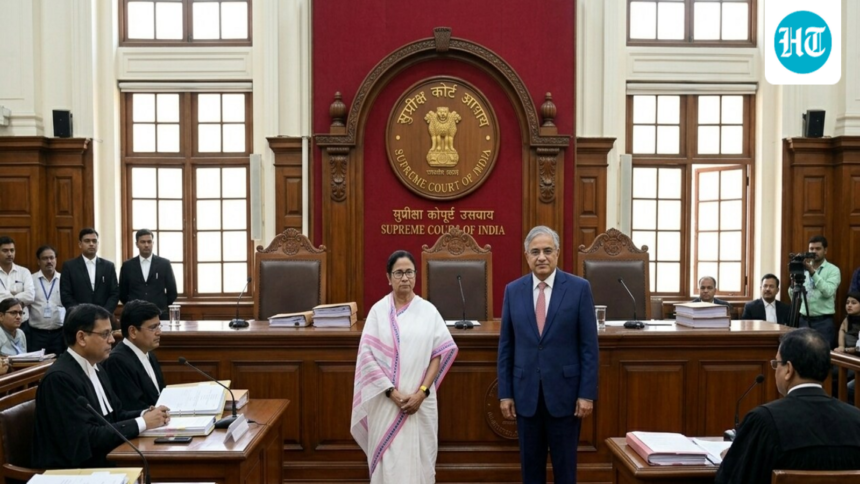
In a setback for the Trinamool Congress, the Supreme Court on Saturday upheld the powers of the Election Commission to appoint central government employees as supervisors of the vote counting process in West Bengal. A bench of Justices PS Narasimha and Joymalya Bagchi refused to pass any further order after accepting the ECI’s request that TMC representatives be there during the counting of votes.

The petition was filed against the order of the Calcutta High Court, which dismissed the petition on Thursday. The Supreme Court said that the Election Commission of India (ECI) is empowered to appoint a counting supervisor and assistant counting officer, either from the state government or the central government.
The Supreme Court’s position was not different from that of the HC.
Here are 3 statements from the Supreme Court bench explaining why the TMC petition was rejected
1. Senior advocate Kapil Sibal, appearing for TMC, argued that disallowing state government employees as supervisors of vote counting is against Article 324 of the Constitution and amounts to questioning the state. The bench said that agents from each party will be present during the counting process and that it does not matter whether the supervisors are nominated by the central government or not, it is up to the personal satisfaction of ECI to appoint the supervisor, adding that the bench “cannot hold that this notification is inconsistent with the regulation since one of them is an employee of the central government but the others are not.”
Read also | EC circular not against rules: Big setback for SC for TMC ahead of Bengal results
“It does not matter whether it is a Central Government nominee or not. That satisfies ECCI personally. Your counting agents will be there, as are the others. Then, there is a counting assistant, a counting supervisor, a junior controller who is an employee of the Central Government. We cannot say that this notification is contrary to the regulation because one of them is an employee of the Central Government. However, the others are not, so they cannot be employees of the Central Government. The entire selection from one group cannot be said to be invalid,” Justice Bagchi said.
2. Senior advocate Dhamma Sheshadri Naidu, representing the Election Commission of India, said that the counting of votes on May 4 will take place in the presence of a candidate from the state government. Naidu said this when the bench said Sibal had concerns about strict adherence to the circular. “We are saying that the state government candidate will be there. This will be followed even before all this,” Naidu said. Justice Narsimha then said: “There is no need for further orders in the SLP. We record Mr. Naidu’s request that the ECI circular be followed in letter and spirit.”
3. The bench noted a clear shift in TMC’s position during the arguments. Senior lawyer Kapil Sibal first attacked the Election Commission’s own circular, saying it cast doubt on the role of the state: “Please see the circular itself… It says there were concerns… They want another candidate for the central government. Isn’t this pointing the finger at the state?” However, when the court observed that “entire selection from one group cannot be said to be incorrect” and that “all of them are government employees”, Sibal changed his stand to say that the circular should be followed strictly, especially in including a candidate for the state government. This is what prompted Judge Bagchi to denounce the contradiction, saying: “This is how I wrote them… You were challenging the circular… and now you say follow it.”