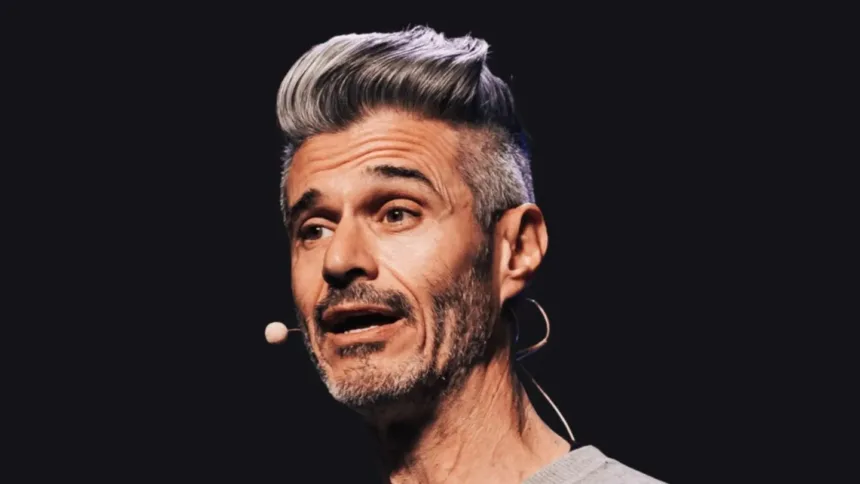
Evan Shapiro raised eyebrows, and delivered laughs, during a keynote address to an industry crowd in Lisbon on Monday at the first-ever StreamTV Europe conference. His topic “The New Normal in Live Streaming” led him to talk about success stories such as bluish And the industry’s major “crossroads,” which he illustrated through what he called “the battle of two Nebo kids.”
Former senior executive at companies such as NBCUniversal and Participant Media, as well as producer (Portland, Brick City), who has made waves in recent years as a “media cartographer,” sharing unconventional schemes and ideas on digital platforms, was referring to the different strategies pursued by Lachlan Murdoch’s Fox and David Ellison’s Paramount.
“Sometimes I may be dark in my predictions, but that’s because I care about this industry,” Shapiro said early in his appearance to warn those who had never heard him speak before. “Yes, there are things wrong with our industry right now, but most of them can be fixed by the people in this room if we make choices about the future and don’t cling to the past.”
Shapiro suggested that the map of the media world he has been constantly updating over the past six years or so “reveals a crossroads at this moment for all of us — one path leads to the past, the other leads to the future,” and everyone in this sector can make choices to take the path to the future. “I’ll give you a case study that proves it: the battle of two Nebo kids, Fox and Paramount. What we have here are two companies that are very similar in their genetic code, both run by family businesses, and both traditional media companies.”
But a few years ago, Shapiro said, Fox looked at both paths going forward and chose to take the path into the future, where 21st Century Fox sold its studio and major cable networks to The Walt Disney Company. They retained the broadcast and cable network [Fox News]”But they reinvested the positive cash flow from those platforms and from the sale into a $1 billion portfolio of creative enterprises,” the media cartographer said. “Paramount, on the other hand, is doing the opposite” with its $111 billion acquisition of Warner Bros. Discovery.
“Fox has become home to a Creator Lab that is really crushing it and showing that creator content and traditional content can coexist on the same platform,” Shapiro concluded, noting investments in companies like Whalar, “a great studio and agency at the center of creative culture where brands meet creators,” Red Seat Ventures, and small drama vertical Holywater and Dhar Mann. He added that Fox’s enterprise value “has skyrocketed.”
“At the other end of the nepo scale,” Paramount bought “Substack [The Free Press] And he gave [it] 60 minutes And CBS News for destruction. Also, “Instead of reinventing late night, and they had some great late night properties there, they replaced Stephen Colbert with Comics unleashed. Instead of investing in innovators and technology to transform their company, they are investing $110 billion in a very old company with no future strategy behind it, and they have taken on $80 billion in debt. This is the familiar fork. This is the convenient fork because we’ve done it before, but this is the traveling Hollywood fork that we know doesn’t work.
In more general comments, Shapiro highlighted Monday on StreamTV Europe that members of Generation Z and Millennials make up the bulk of the population, so media companies should see the world through their eyes and look to attract them, along with others.
For example, YouTube is no longer a platform for young people, but “a platform for everyone,” Shapiro said Monday. “YouTube is television,” he concluded. “You have to be on all the screens.” He said Europe lags behind only the United States in terms of the transition from traditional TV to streaming and social video due to Europe’s higher average age and huge amount of free TV programming.
For too long, cable networks have been the business hub of media giants. “We relied on profits from [pay TV]“In the US, he warned that the same trends are now starting to hit subscription streaming. Pointing to flat subscriber trends, he said production was declining “very quickly.”
In the midst of all this, retail should be the top, second and third priority for those in the industry, Shapiro said. “The cure for this is fandom, closeness and engagement.” Reach, iteration and a “top-down” programming mindset are the old focus, Shapiro said, urging those in the sector to think like creatives. “Referring to the global success across platforms RuPaul’s Drag RaceHe also suggested to the StreamTV Europe audience: “Be more like a drag queen.” After all, drag queens are the original creators, doing everything from selecting and handling the clothes and makeup and beyond.
He concluded that key indicators of passion and quality of community should receive focus rather than KPIs. Shapiro pointed to success stories like Bluey and BBC Studios, which he said is now one of the biggest distributors on YouTube thanks to its penchant for fandom. He also mentioned French broadcaster TF1, which co-creates content with young news creator Gaspard G, whose engagement metrics are superior to those of TF1.
Look for premium vertical programming to become a bigger part of people’s media diet as well, and look to capitalize on that, the expert also suggested to the Lisbon audience.
All of this makes for a winning formula in what Shapiro on Monday called the “convergence economy,” which is about community, loyalty and love.
Alejandro Pinheiro, Events Director at StreamTV Europe, organized by Questex, opened the conference by noting a higher than expected attendance of 1,000 participants and 45 exhibitors. In his opening remarks, Lisbon Mayor Carlos Moedas welcomed members of an industry that, as he stated, is all about storytelling, promoting the Portuguese capital as a natural place for them by saying that “there is no better story than Lisbon.” He stressed that the old nickname given to Lisbon was “the safe haven,” and said that the city had been for centuries where “diversity meets poetry and innovation.”