In the age of social media, casting directors are still able to find industry newcomers with relative digital obscurity and turn them into bona fide stars overnight.
says Lucy Bevan, who has collaborated with Emily Brockman for the second time (the first was on… game of thrones) to cast Knight of the Seven Kingdoms. “As an audience member, you feel like you’re discovering it yourself.”
There are few shows that have been as successful at introducing new faces as HBO’s medical marvel the house. In what they called a “brilliant experience,” due to the show’s unprecedented single-period format, directors Kathy Sandrich Gelfond and Erika Berger — who won an Emmy for their work on the first season — were given carte blanche to star in more than 250 roles on the fictional Pittsburgh ER series.
“Everyone across the board said, ‘Just look for the best possible actors for these roles,’ and that’s a director’s dream come true,” Berger says. Given the show’s immersive, 360-degree shooting style, directors prioritized stage artists who could move seamlessly between the background and foreground of a scene. Sandrich Gelfund adds: “We needed people who were quick on their feet because of the intensity. We don’t have markers, so there’s a lot of movement all the time; you have to be very nimble.”
Even with the proof of concept, Sandrich Gelfond admits that casting for the second cycle, which also included more than 250 parts, was no less intense. For any given role, Berger estimates that their team receives between 2,000 and 5,000 photo and resume submissions. They ask at least 40 actors to submit self-tapes for a guest role — and many more for regular, recurring parts — and then send five to seven tapes to producers to review for further callbacks, either via Zoom or in person in executive producer John Wells’ office.
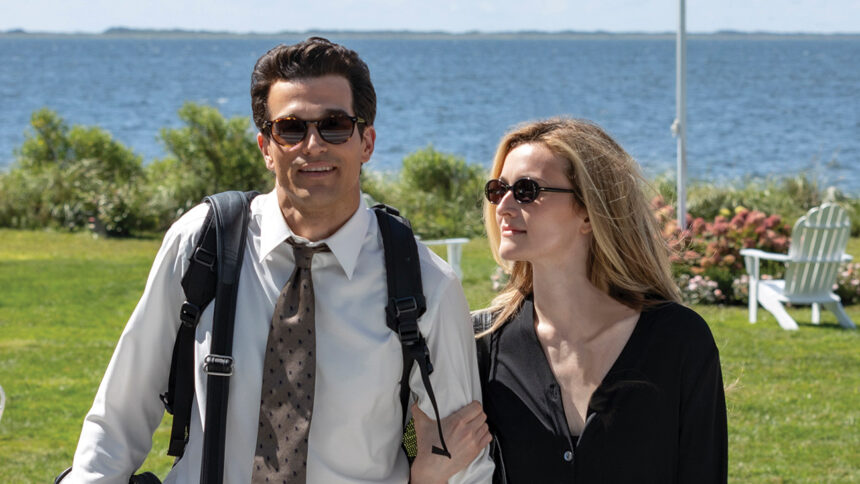
Courtney Bright and Nicole Daniels went through a similarly exhaustive process to find the centerpiece for Ryan Murphy’s latest FX anthology, love story: John F. Kennedy Jr. and Carolyn Bessette. For months, casting directors combed through hundreds of tapes and scoured social media and talent agencies to find their version of the Kennedy scion. “He had to be a man that every woman would fall in love with and every man would want to be friends with,” Daniels recalls of the character’s breakdown.
“We were looking for someone who didn’t exercise excessively, who didn’t have an overly masculine look — just someone who was naturally masculine and had chest hair and a normal muscular build,” Bright adds. It seems that this kind of natural masculinity is difficult to find these days. It wasn’t until three weeks before filming began in New York City that producers cast Paul Anthony Kelly—a Canadian model with little or no acting experience—to play JFK Jr.
Chest hair aside, what sealed the deal was Kelly’s “obvious” connection with Sarah Pidgeon, who had already landed the role of Caroline, which extended off-screen after reading about their amazing chemistry. “Paul had a car, but Sarah didn’t have a car, and we heard he would drive her home instead of her taking an Uber,” Daniels recalls. “Courtney and I were like, ‘Oh, okay, we get it.’ “
Bright notes that the fact that Kelly was completely unknown to audiences allowed viewers to fully buy into the appeal of the retelling of Kennedy-Bissette’s love story. “When you come in and you don’t have any expectations of what you’re going to see, as an audience member, you just have to dig deeper than you normally would, [especially] When you get an actor playing someone who is very famous and has a lot of history.
Chemistry between the co-leads was certainly top of mind for Bevan and Brockman, who optioned the HBO sequel. He owns They were encouraged to cast a wide net to find newcomers to the tournament such as Ser Duncan “Dunk” the Tall and his sidekick, Prince Aegon “Egg” Targaryen. “Dunk had to be just shy of 7 feet tall and the size of a baby,” Bevan says in George R. R. Martin’s short novels. But beyond the physical elements, Peter Claffey and Dexter Ansell manage to capture the irreverent comedic tone of showrunner Ira Parker’s script.

Not unlike their characters’ personalities—Claffey captured Dunk’s charming, naive nature while being “always out of his depth,” and Brockman says Ansel innately had “a natural superiority and a princely nature”—the actors were soon drawn to each other. “We tried to encourage them to spend some time chatting before they came [to read together]Brockman adds. “Dexter looked like a professional,” Peter said. “He was really composed and composed. Peter was terrified of this little 9-year-old!”
Long before he reads a part to producers and executives, an actor spends weeks, if not months, working with a casting director to perfect his performance. “When you’re casting newcomers, you’re not choosing the person you meet on the first day,” Bevan says. “You’re choosing the actor they’ll become by helping guide them.”
Finding a group of lesser-known actors who can improve is a prerequisite for Prime Video’s hidden camera reality series Jury duty. While this season Company decline The setup allowed casting director Susie Faris to find actors tailored to specific parts, and she and her team still review thousands of self-tapes where actors are asked to tell a story in less than two minutes.

The most compelling—but less well-known—representatives were called back for a staged focus group of 10 to 12 people. They were assigned certain stimuli, and were monitored to see how they performed under pressure alongside unsuspecting participants who believed the research study to be real. “The non-actors are not aware that there are actors; the actors are not told who the non-actors are,” executive producer Nicholas Hutton says of callbacks. When cast, the actors were given just one month to learn their fake lives and the history they share with the other characters in the fictional hot sauce company Rockin’ Grandma’s.
Faris points out that the task of finding lesser-known actors doesn’t just apply to younger thespians. In fact, casting directors relish the opportunity to connect veteran Broadway and West End performers with a broader television audience. While Sandrich Gelfond says her creative team has “an ongoing list of bigger people” they would like to join the houseShe believes the show’s “secret sauce” is that “we don’t hire people with strong attachments” to a particular character. “We’ve been very careful, in general, not to hire people we know well from recent medical offers,” she explains. “We moved away from that a lot in the first season, as we wanted to create a unique hospital environment.”

However, there have been opportunities every now and then to sneak in some of the bigger names. Mary McCormack, who played a doctor at a refugee clinic opposite Noah Wyle erit was cleaned again for the house As Chief of Neurosurgery. Dan Florrick as an elderly man who accidentally runs over his wife; Jeff Cooper as motorcycle engineer Duke Ekins; Rusty Schwimmer as hospital clerk Monica Peters. “It’s all these people that people love and haven’t seen for a while, or are just happy to see,” says Sandrich Gelfond.
This story first appeared in the June standalone issue of The Hollywood Reporter magazine. To obtain the magazine, click here to subscribe.