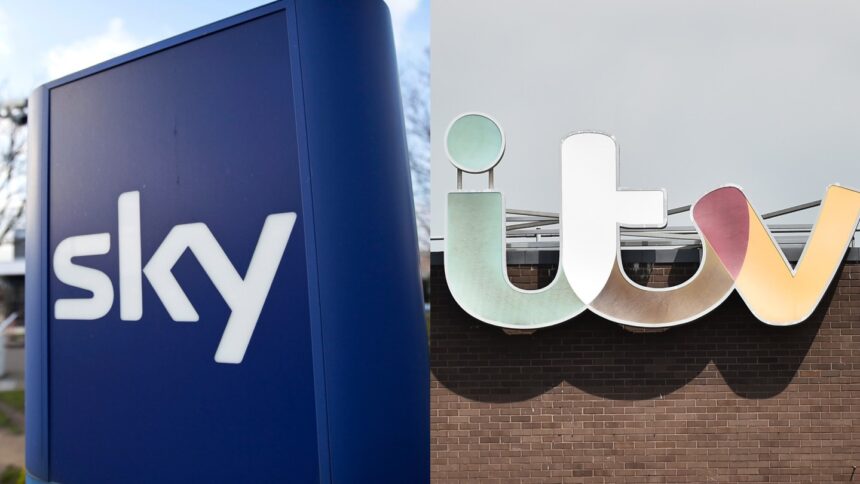
“Sky buys ITV” is an apt headline. This is also not quite what happened.
Comcast-owned Sky has bought ITV’s media and entertainment business: the free-to-air channels, ITVX, the advertising tie-up, the overall goodwill and the path to millions of British viewers.
It is not buying ITV Studios.
This is where the deal becomes more revealing. ITV is selling the part of the business that reaches British viewers every day, while retaining the global production and distribution company that makes and sells programs around the world.
Heaven’s getting to the front door. ITV retains the engine room.
So the deal is not just a story about consolidation in British broadcasting. It’s a story about separating the two things that made ITV extraordinarily strong when they sat within the same company: distribution and content.
That’s why the long-term supply agreement between Sky and ITV Studios may tell us more than the takeover price. The headline figure is the proposed £1.6 billion ($2.13 billion) sale of ITV’s media and entertainment business. But underneath that lies Sky’s commitment to spend at least £2.1 billion ($2.8 billion) with ITV Studios over five years.
This agreement allows ITV to sell its channels and streaming business without cutting those channels off from programming that viewers still associate with ITV. It gives Sky continuity of the show. It gives ITV Studios a large revenue base. It reassures audiences that ITV’s most popular programs will not disappear overnight.
It also points to the larger truth behind the deal.
For years, media executives have argued that content is king. More recently, the phrase has been updated: Distribution is king.
Both claims are only half true.
Content and distribution are only effective when they work together. The broadcaster needs programs that the audience actively wants. A studio needs a reliable way to pitch, test, promote, and pay for its software. ITV’s historical strength was that it had both within one company.
It had the channel, the audience, the promotional machine, the scheduling power, the advertising relationships and the studio. They can commission ideas, test them in front of a large audience, learn from the result, improve them, iterate them, sell them, and when the chemistry works, turn them into long-term businesses.
Love Island and I’m a celebrity…get me out of here! It’s not just successful programs. They are examples of what happens when a broadcaster and a studio operate within the same ecosystem. Both depend on a broadcaster willing to take a certain kind of risk, back the show widely, promote it aggressively, and give it the time and vision to become a national habit.
It’s hard to imagine many other British broadcasters commissioning either show in exactly the same way at the moment of their birth, then giving them the recurring oxygen they need to become cultural fixtures rather than one-season wonders.
Show contest Stalking It’s another version of the same story. When I was Director of Formats at ITV Studios, the show was put on air through a pilot jointly funded by the network and ITV Studios. Both sides had skin in the game. The network can test a new format with its audience. The studio can help build a piece of intellectual property with the potential to export. What started as daytime testing became a durable, repeatable, and globally salable format precisely because the two halves of the business were compatible about risk, testing, and long-term exploitation.
Not every spinoff starts with noise. Some start by testing, iterating and trusting until they become part of the national schedule.
This is what every content creator dreams of: not only making the show, but proving it on the air. The format should be tested somewhere. A brand has to start somewhere. The pitch, the sizzle reel, and the international sales document are all helpful, but nothing nails a television idea like a real audience showing up, night after night, until the show becomes part of the furniture.
ITV Studios had that when I sat inside ITV. It had access to a network that could create, test, promote and iterate shows on a scale that only a few producers could replicate.
Once the network is separated from the studio, ITV Studios becomes a different show. It remains a major global manufacturer and distributor. It has scope, relationships, labels, and value propositions. But it no longer has the same structural advantage: the ability to prove its own ideas through a channel of its own.
So the question is not just what Sky is buying, but also what ITV Studios will become without the ITV network attached.
Is it a company with cleaner, more focused global content, newly valued on its own terms? Or is it a studio that has abandoned the shop window that helped make some of its biggest shows possible?
The answer may determine whether ITV Studios is able to continue creating the next generation of hits, or whether it becomes another supplier in a crowded global market.
What ITV Studios loses in ensuring local reach, it may gain in strategic clarity as a pure global content company. But this clarity comes at a moment when the entire market is being realigned around the same tension between distribution and creativity.
Around the world, TV companies are fighting for control of two rare things: lasting relationships with large audiences, and intellectual property that can move profitably across platforms and borders.
In the US, legacy studios have spent years trying to decide what to keep, what to sell, and what to stream, often discovering that owning the platform doesn’t automatically solve the problem of filling it with content people actually like.
In Europe, commercial broadcasters have consolidated and restructured as they try to defend national scale against global platforms that can outspend them in original acquisitions and commissions.
The pattern is consistent. The power of distribution is more important than ever, but only if it contains content worth distributing. Content remains essential, but is increasingly commissioned, licensed, or acquired by companies that actually own the path to the viewer, or the algorithm that decides what the viewer sees next.
In this environment, free-to-air ITV and ITVX represent something of extraordinary value: a still-significant share of British commercial viewing, a direct advertising relationship with millions of households, and the kind of cultural relevance that algorithms struggle to imitate.
The acquisition of Sky is an attempt to shore up that infrastructure before more viewing, more advertising money and more audience habit leave the traditional system entirely.
For ITV Studios, the new reality is much clearer. It will continue to produce and distribute some of Britain’s most popular formats and dramas. But it will do so without the structural advantage of having an owned broadcast window to prove, improve and promote new ideas at a national level.
The £2.1 billion supply agreement provides a vital bridge. It also highlights the shift: ITV Studios’ biggest client is now tied to the company acquiring its former parent. Success will depend on whether its distinctive intellectual property and production expertise is able to secure strong terms from an increasingly selective buyer base, from the remaining local platforms to Netflix, Amazon and other services hungry for local stories that move on.
At the same time, the deal raises a larger question about the deal that has long underpinned British television broadcasting: what public obligations should be attached to channels and platforms that continue to occupy a privileged place in national life?
ITV has been part of a system aimed at providing pluralism, investment in original UK productions and universal access to high quality programmes. When control of its distribution assets is transferred to a US-owned group, the balance between commercial return and public liability changes.
Commitments around continued free-to-air access, independent news and spending in the creative sector will be important. But they sit within a larger, unresolved debate about what kind of national television culture can be maintained when local institutions are increasingly shaped by global capital, global competition, and global technology.
Here lies the real test.
Compared to the UK’s legacy commercial TV market, Sky and ITV combined look formidable. Compared to YouTube, Netflix, Amazon, Disney, and the broader migration of viewing and advertising dollars away from linear TV, the argument seems different.
Neither framework is considered sufficient in itself. If we define the market too narrowly, regulators risk protecting a version of British television that is already disappearing. If we define it too broadly, they risk overlooking the local power that this combination can create in terms of commissioning, advertising, fame and reach.
From a product point of view, it’s a practical matter. Who has the authority to assign? Who has the budget to support new ideas in a timely manner? Who owns the rights? Who controls the relationship with the public? Who can turn a British idea into a global asset?
These are the questions that the Sky/ITV deal brings together.
It shows how inadequate the word “broadcaster” is. ITV was more than just a broadcaster – it was a national broadcaster, an advertising platform, a streaming brand, a playback engine, a news provider and a local shop window for a global studio company.
Heaven buys some of that. ITV keeps some of that. The supply agreement is sewing between the two.
Television is dismantled and reassembled: channels on one side, studios on the other; Rights here, distribution there; Public obligations here, platform economics there; Public trust here, advertising technology there.
‘Sky buy ITV’ makes the deal sound simpler than it is.
Sky buys the route to the public. ITV retains the business that makes the programmes.
The future will belong to companies that can control, communicate, or negotiate both.