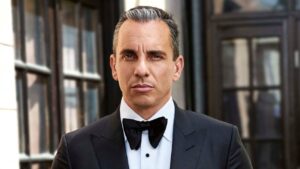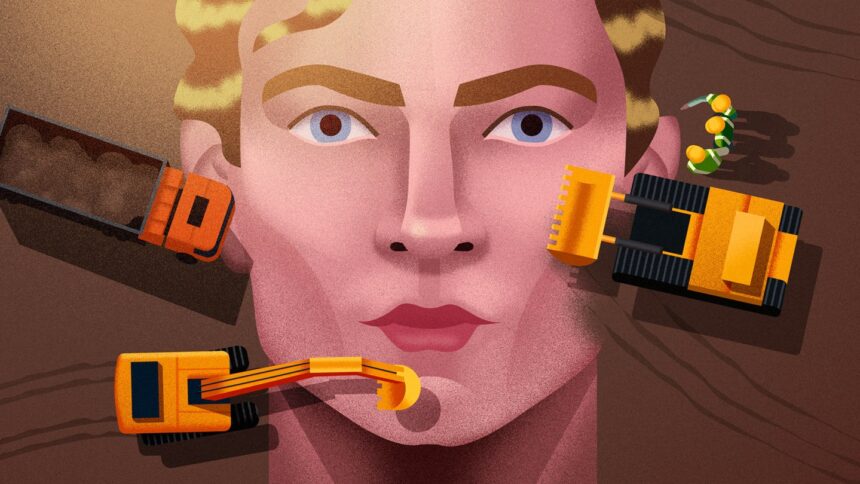
This might make the average person anxious, but one day in facial plastic surgeon Shawn Alemi’s office on Park Avenue, a male patient was wide awake when a surgical blade collided with his jaw. He just wasn’t conscious. He was actively involved in directing the procedure.
To help his patient achieve a stronger, more masculine appearance, Alami made a small incision on the underside of the chin under local anesthesia. He then proceeded to insert a variety of chin implants, one by one. “I ordered 20 different sizes and they were fake implants,” Alami recalls. “And you basically try them on until you find one that has features that you really like. You put one on, and then I stitch it in his chin to close it, and I give him a mirror.” The document appears in different sizes. After several adjustments, the patient settled on the ideal shape, widening the jawline to his complete satisfaction.
“The patient was actually able to participate in the surgery, which was fun and unique,” Alami says.
It’s a striking example of the efforts American men are making to improve their faces in the era of “looksmaxxing” — a hyper-focused subculture that has arisen on the Internet and is dedicated to increasing one’s physical attractiveness. It exists alongside the current, more general obsession with projecting masculinity, advocated by everyone from elite tech bros and members of the Trump administration to Joe Rogan-next-door podcasters and social media influencers. The message for men is clear: strength starts in the jaw.

However, it is not limited to the jaws and chin only. In early June, a high-profile celebrity live-streamed a two-hour rhinoplasty procedure. But it’s still rare for men to be open about cosmetic procedures, let alone document them online. While Hollywood has done much to normalize plastic surgery and other aesthetic procedures, it’s been female celebrities who have gotten into the conversation, from the Kardashians to Phyllis Diller, who spoke publicly in 1971 about getting a facial.

However, lately, it’s become almost impossible to think of a high-profile male celebrity who hasn’t sparked at least some rumors about the work he’s had, whether it’s jaw reshaping (Elon Musk, Bad Bunny, Barry Keoghan, Zac Efron), a facelift (Brad Pitt, Tom Cruise), eye surgery (Adam Levine, Justin Theroux, Bradley Cooper) or fillers (Ryan Gosling, David Beckham). There are male celebrities who look blatantly different (Jim Carrey), while others seem to have subtle glows where no change stands out (Matt Damon). It is impossible to know exactly what happened, and all talk is just speculation. Men especially care about the work they have done. “For men, you can’t have the stigma of plastic surgery,” says Beverly Hills facial plastic surgeon Dr. Babak Azizadeh. “It’s a very difficult thing to tolerate.”
Although they may deny any surgery, Hollywood’s ideal of hypermasculinity still sets the standard for what many patients want. “When you look at popular culture, when you look at celebrities, the vast majority of men are very masculine. And so I think that creates a kind of very desirable aesthetic that a lot of men specifically come in and ask for,” says Dr. Alimi.
In this story, I spoke with four plastic surgeons and one leading cosmetic practitioner about what men are asking for these days. Their consensus? The patient population is expanding faster than ever. But two measures in particular offer a fascinating window into how gender expectations shape these decisions and how the outcomes are perceived. The first is jaw redefinition (which can enhance masculinity) and upper blepharoplasty (eyelid surgery), which when done incorrectly can sometimes make a man’s face appear more feminine.
That strong jaw
As a sign of masculinity, the jawline in Hollywood is clearly visible. Think Henry Cavill. Or Gaston in beauty and the beast. The typical patient looking for a face that more closely mimics their appearance either has what is traditionally called a weak chin or has a lower face that is more oval or V-shaped than plump. Some do not want radical changes, and instead seek more imperceptible increases in large proportions.
“I hear a lot of patients say, ‘I want my jawline to be more masculine.’ “I want it squarer,” says board-certified nurse Natalia Guzman of Atelier Aesthetix in Beverly Hills, adding, “It’s becoming more common for men to come in for procedures. I think it’s more taboo for men now, especially with social media.”

Whether using fillers or implants, doctors typically focus jaw work on two areas: the chin, which can be given more prominence, width, or height (or a combination of the three); And what anatomy books call the conical angle of the lower jaw — or, in layman’s terms, the literal angle of the jaw.
The initial visit to Guzman’s clinic typically lasts 90 minutes, during which she uses the Aura 3D imaging system (equipped with 13 cameras) to evaluate the angles and measurements of the patient’s face. Based on this analysis, Guzman unpacks the strict geometry of the modern masculine ideal: “For the male jawline… the width of your cheekbone to the width of your jawline is supposed to be one to one, so you’re more square. It’s more masculine. For women, we’re supposed to be 1.5 to one, more in a lower V shape.”
To bring a patient’s face closer to his alleged standard of perfection, Guzman prefers to use a filler called Juvederm Volox, which is made primarily of hyaluronic acid.
“For men, I would do about two injections in the chin. And then for the jaw, I would start with about two injections. It comes back after about four to six months; we keep building up slowly. So it’s a process. It’s not just a one-time procedure, which a lot of people think,” says Guzman, who prefers hyaluronic-based fillers because “we can fix it if there’s a problem or let’s say for example the patient doesn’t like it — I don’t inject anything that I can’t get rid of.” “The basis is what we call liquid chin implants.”
Swelling can occur after the procedure for 24 to 48 hours, and results usually last 12 to 18 months.

In Beverly Hills, one of the most prominent facial plastic surgeons is Dr. Jason Diamond, who has long had a large number of male clients seeking out the doctor for his diamond facial sculpting technique. “It’s my injection technique where I inject directly onto the bone to create what basically looks like an implant placement. This is different from the usual fillers that most people widely use, which are under the skin or between the skin and muscle,” Diamond says. “It’s a micro-droplet technique, tiny droplets that can build up into a shape. It’s not a big spray of something.”
“The non-surgical results can be dramatic,” Diamond adds. Surgical outcomes — which carry a risk of complications, including infections and nerve damage — can be more serious. Top doctors these days will create custom jaw and chin implants, which are usually made of silicone and can cost $10,000. There is also a more aggressive treatment to create a Gaston-like chin. “It’s called a sliding genioplasty,” says Dr. Alemi. “This is a surgery where you actually cut the chin bone and move it forward and then hold it in place with a plate. Obviously there’s another degree of invasiveness — and permanence.”

Often, older men choose a treatment to address neck sagging at the same time they are looking for better jaw definition. “I see a lot of… People in their 50s and 60s are bothered by the aging of their jawline because they lose definition. But when I look at the bone structure of these people, it’s not necessarily because they need a chin implant or a jaw augmentation, they need a facelift and a neck lift, and they need to sculpt their deep neck,” Alemi says. (A comprehensive overhaul that includes surgical jawline contouring for males along with a deep facelift and a deep neck lift can start at $80,000.)
What about the current trend of oral exercises, such as chewing on a jaw exercise ball or a special type of gum, which aim to increase the size of the lower jaw? Diamond Pooh Pooh Idea. “The face does not have weight-bearing muscles. They are the muscles that respond to weights and resistance training by increasing their size,” Diamond says. Because the facial muscles are different, it “doesn’t work,” Guzman adds. “It’s just a great way to make money on TikTok.”
The eyes don’t have it
“The trend is really booming,” says Azizadeh, speaking of the demand among older men for anti-aging eye surgeries. In later years, the under-eye area often becomes puffy or baggy, while the eyelids and eyebrows can droop, creating what is known as a hooding effect.
At Azizzadeh’s clinic in the past five years, he says he has seen a 50 percent rise in the number of men coming in to address dissatisfaction with the appearance of their eyes.
However, as the rush to fix eyes accelerates, a cautionary tale emerges beneath the red carpet glow. In Hollywood, where pressures to appear always youthful are intense, a host of high-profile male celebrities have had eye surgeries with mixed results. It seems that many women have replaced their naturally rough appearance with a soft, wide-eyed look that can be considered more feminine. Male celebrities can also look stunned.
To be clear, the problem rarely lies under the eyes. Surgery to treat puffy, droopy lower eyes — known as lower blepharoplasty — is generally a safe area for older men. Docs can lift tissue, remove excess skin, remove fat and erase bags smoothly. “Often we turn down the volume to sound refreshed and less tired,” says Azizzadeh.
The real aesthetic mine is upper blepharoplasty, which is performed to address excess lid in the eye, meaning sagging of the upper eyelid.
“The upper eyelid is actually a difficult and tricky technical procedure. A lot of people in the field of cosmetic medicine think, ‘Well, you just take a little bit of skin and you’re done,'” says Azizadeh. “But the artistic and gender approach is really crucial. And I always say this: A lot of people comment on celebrities and say, ‘Oh my God, this person had the worst plastic surgery.’ But if you really look at them, they’ve had a really bad blepharoplasty.”

“There’s a lot of interest,” adds Dr. David Samimi, an eye and facial plastic surgeon at Eyesthetica (which has offices in Encino and Santa Monica). [in upper bleph procedures]But seeing some less-than-ideal results on red carpets “instills a lot of fear in people who want to accomplish something.” They’re saying, “Wait a minute, if this famous guy looks like this, I shouldn’t do anything because he clearly has access to the best resources.”
So what’s wrong with the eyes of some male celebrities? This procedure is usually an upper part procedure that simply does too much. Either too much skin was removed, the upper eyelid incision was made too high, or too much fat was removed. The eyes can then appear skeletal or simply wide-eyed, which is often seen as a feminine trait.
The ideal point is where the right amount of skin is excised with fat redistributed to avoid a hollow appearance. A talented doctor will reduce some of the hooding that comes with age without completely removing it, since hooded eyes tend to be seen as a masculine trait. Think Brad Pitt’s famous bedroom eyes.
“For men and women, there’s a big difference in how we approach what you want this whole area to look like. What works for women will be different for men,” Azizzadeh says. You need to act really conservative for guys. Less is more. If you don’t, you’ll get the results people are talking about on social media. If your surgeon does it well, no one should know that you had an upper blepharoplasty. It is similar in a way to how men can easily take Botox and retain some lines on their forehead.
Both Samimi and Azizzadeh recommend that men avoid excessive brow raises as well. This is because a very high eyebrow can not only contribute to a deer-in-the-headlights look, it can also appear more feminine. “A man should have a relatively low eyebrow and relatively low eyelids,” Samimi says. He says he has shifted to doing less surgical brow lifts. Instead, fat grafting (harvesting fat from elsewhere in the body) is preferred and used to fill out the brow area, including the temples. “It’s more definition for the brows, restoring lost volume in the upper third of the face,” he says.
Azizzadeh advises taking a slow approach. “Often, men go in for blepharoplasty, and the surgeon’s reaction is, ‘Let’s draw your eyebrows too,’ because that’s what we often do with women. But for men, don’t make the mistake of doing too many things. Maybe we do your eyes first, and then next year we’ll draw your eyebrows at a different time. So it’s a very gradual development, and they look like this. They didn’t do anything. (According to the doctors interviewed for this article, the costs of eye procedures range from 9,000 to $20,000 for an upper eyelid, $6,000 to $25,000 for a brow lift, and $5,000 to $9,000 for brow contouring using fat grafting.
Ultimately, the booming market for men’s surgical procedures proves that men are just as vulnerable to mirror pressure as anyone else. “A lot of people do it because they want to perform their best. Honestly, it’s no different than someone who wants to go to the gym to get bigger shoulders and six-pack abs,” Diamond says.
But men seem to have a narrower goal to reach, which is a very contradictory goal. By definition, strong masculinity involves a certain amount of roughness or asymmetry, while cosmetic perfection requires smooth edges. The sweet spot lies somewhere between the two.
This story appears in the July 2026 issue of The Hollywood Reporter entitled “The New Face of Hollywood.” Click here to read more.