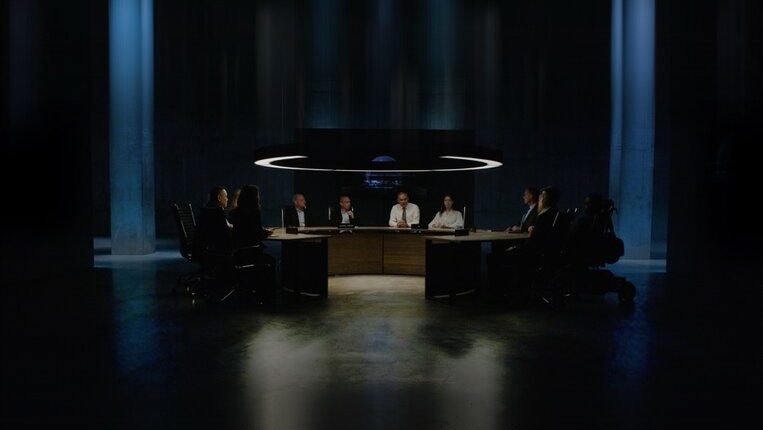
Artificial intelligence, its future, and its potential regulation are among the hot topics on many people’s minds these days. Now, there’s a movie that allows you to watch some of the world’s brightest minds engage with artificial intelligence in wargaming, strategic exercises used in military and other contexts to test and improve tactical options and expertise by putting decision-makers under pressure by simulating aspects of a conflict. The documentary is directed by Oscar and BAFTA award-winning director Elena Andreicheva High intelligence He has captured the big screen experience.
The new film by the producer and director (short film Learn to skate in a war zone (if you’re a girl)TV series Drugs, Inc) makes its world premiere on Sunday 15 March in the F:act Prize section of the Copenhagen International Documentary Film Festival, CPH:DOX, whose 23rd edition runs until 22 March.
“The future is all there is to play for,” he highlighted in his press notes High intelligence. “Global leaders – from military strategists to philosophers – join AI leader Mark Warner in a bold war game that explores how AI could reshape power itself,” they explain. “High intelligence Reveals what happens when the brightest minds confront the future they helped create.
Warner is the CEO of College AI, which he founded “to help organizations make better decisions using human-driven AI,” the company’s website notes. The CPH:DOX website notes that the AI entrepreneur and father “has spent most of his life developing artificial intelligence.” “Now he spends most of his time wondering if this is a good idea.”
Other minds featured in the film include the likes of General Patrick Sanders, former head of the British Army, former World Bank economist Patricia Gilley, Skype creator Jan Tallinn, Lucy Lim, a research scientist on Google DeepMind’s Borders and Safety team, retired US General Stanley McChrystal, US economist Pippa Malmgren, and philosopher Yuval Noah Harari.
The film is directed by Andreicheva and produced by Sean Richard, Mandy Zhang and Paula Comley. High intelligence Features cinematography by Harry Truman. Bradley Richards, Angus Sutherland, and Frank Fromento edited the document. Outlook Filmsales is handling sales. Watch a trailer for the doc here.
Ahead of the world premiere, Andreicheva spoke to THR About the genesis of the film, putting figures of power brokers and thinkers in a room to address possible and potential future scenarios related to AI, the debate on AI as tool versus agent, and their takeaways from the experience.
“Normally, I spend a lot of time developing my own stories, but in this case, it was the opposite,” the director recalls. “Mark Warner, who’s in the movie, and I went to university together. We were actually lab partners. So, we’ve been friends for a long time. In one of our meetings, I remember he started talking about how he was very concerned about what was happening with artificial intelligence.”
The topic came up again later. “After his son was born, he called me and said, ‘Okay, I’ll do something,'” says the director. “I think the best way to do that is to do it as a war game, where you can try to find the right answers to some questions about what we’re supposed to do.” “Do you think this might be an interesting document?” And I turned it over in my head a few times and said, “Oh, yeah.” So, in this case, unfortunately, it was not an original idea coming from the depths of my mind.
like High intelligence The War Games scenes unfold with scenes of Warner with his wife and son Tommy, who becomes a human mirror of sorts for the AI, advancing the narrative that the way the AI learns is not only much different from humans, but rather more accelerated.
“This showed up very early,” Andreicheva says. THR. “I didn’t understand exactly how the AI was learning and I wondered: What is the problem that Mark sees?” So, while explaining it to me, Mark mentioned Tommy, who is a little younger than my kids. At some point, we arrived at this analogy of how AI learns. The thing I really hate is the idea that something is so complicated, so we can’t all understand it anyway. It’s the idea that AI is a black box, so let’s not bother. I don’t buy that. I don’t think this is true. “This technology will change our world.”
The director also felt that the “crazy monster” in the War Game scenes needed to be interrupted by family scenes, “those quieter moments where we learn a little bit to understand how this entity might develop and the point at which we might become anxious.” Here comes the child analogy. “The reality is that you can be very directive, and you can teach your kids things, but there comes a point when they start doing things on their own. This is the analogy to make people understand that with AI, we also don’t have complete control. And learning happens in a strangely similar way.”

How did you do? High intelligence Getting a lineup of big-name talent? “Their level of expertise is really great, but it was a lot of touch and go there for a while, if people showed up,” the director says. “The film team and Mark and his team worked together and put our heads together and tried to get as many people online as possible.”
One of the most memorable scenes in High intelligence It sees experts discussing a future scenario related to artificial general intelligence, a situation in which artificial intelligence matches or surpasses human intelligence across cognitive tasks. “The teams representing the leaders of the People’s Republic of China and the United States, two entities vying for AI supremacy, felt things were escalating a little, but perhaps they could still get this under control,” Andreicheva recalls.
Harari is shown in the film arguing that AI is not a tool, but an agent, even an alien agent. “This debate is about the fact that it’s not a tool if you want real intelligence, if you want AI to actually be able to be useful,” the director says. “It has to be online, and you have to give it a lot of data and a lot of capabilities. If you want an AI to use its intelligence in a really broad and useful way, you have to give it a lot of freedom, and at that point, it becomes very difficult to lock it down. But it can never be good if you keep it in this little box. So my idea was that we need to think about this early.” [than many people may realize]. It is a matter of timing, not the specific method of control.
In fact, “I think that was really one of the lessons some players learned in the game,” too, says Andreicheva. THR. “A lot of governments assume that they will be able to stop the use of AI. I think it is naive to think that you can just stop the use of AI. [use a so-called kill switch] Or ask him nicely.” This is also one of the reasons the document maker shared what she hopes High intelligence It will also make its way to people “in the corridors of power.”
What are the big fast foods from High intelligence Andreysheva’s experience? “I was so focused on making the film and hearing all this stuff that it took a while before it worked,” she says. “I had my first AI nightmare about a year and a half ago. It was about metal claws. Anyway, I was thinking that we can’t put [the] Amnesty International [genie] Back in the bottle. I think this would be a huge turnaround, but it’s hard to tell the direction at this point.
The director hopes the fans High intelligence You will also come away with an idea that you took away. “What I can do is think a little more about the future,” Andreicheva says. THR. “I can think of ironing How things can change and what that means. I can ask important questions, such as: Do we want a world where we don’t work and robots do things?