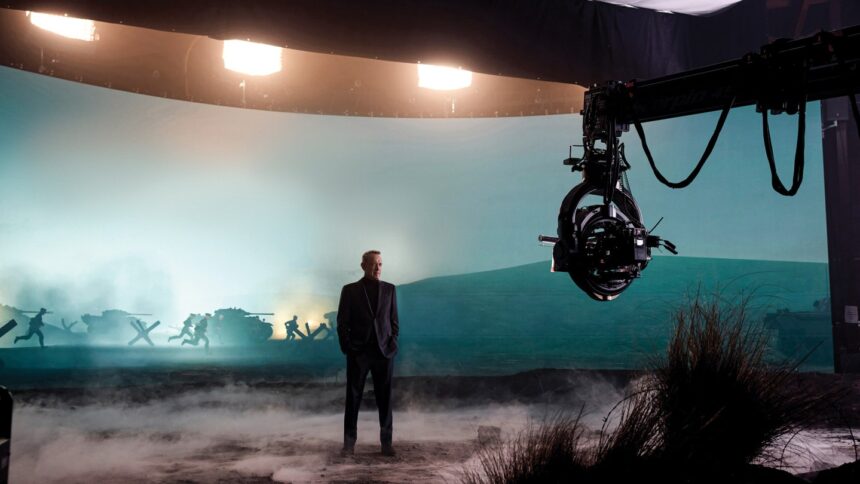
World War II is to the History Channel what hurricanes are to the Weather Channel and what sharks are to the Discovery Channel. But on Memorial Day, the powerhouse will launch a docu-series more ambitious than any of the stand-alone World War II History Channel docs that Tony Soprano has grown accustomed to overdoing. World War II with Tom Hanks He brings all the gravitas of the titular narrator, the undisputed chief chronicler of the conflict in America thanks to roles in films like… Saving Private Ryan and Saluki hunting dog And the HBO trilogy he produced: Band of brothers, Pacific Ocean and Air masters. Executive produced by Tom Hanks, 69, and Pulitzer Prize-winning historian Jon Meacham, 57 and the author of several acclaimed presidential biographies, the 20-part project covers every major theater of war, from the Nazi invasion of Poland in September 1939 to the Japanese surrender in September 1945. Created in collaboration with the National World War II Museum in New Orleans, the project is the first documentary series to tackle such a comprehensive work. Global Perspective Since 1974 Masterful The world is at war On ITV, narrated by Laurence Olivier. By broadcasting in 2026, World War II with Tom Hanks He takes advantage of the clarity that time can bring to history, in the form of snapshots and narratives that have come to light over the past eighty years. It also comes at a time when the US-led post-war world order is beginning to disintegrate, Holocaust denial and far-right politics are on the rise, and the lessons of the war are in danger of being forgotten. Hanks and Meacham joined THR For a Zoom conversation about the war, which Hanks described in the first episode as “the biggest event in human history.”

How did you meet? Have you worked together before this project?
Jon Meacham We have mutual friends like Tim McGraw and his wife Faith Hill. We all met right after the president [George H.W.] Bush died. And I remember we spent about an hour trying to outdo each other with goofy tales. This has now produced 20 hours of foolish tales.
Tom Hanks You know? A lot of stories I got from Studs Terkel The good warwhich were nothing but the memories of the men who were there. I read it not long after high school. And I distinctly remember thinking, “Oh my God, what would I do in the same circumstances?” And John is great at these kinds of stories. I’m glad to know a story he didn’t know about. Makes me feel like a million dollars.
Mitcham John Stewart You once called me a “Dork Wikipedia”, and I insist I take it as a compliment.
Tom, your fascination with the war and that period seems to have begun long before that Saving Private Ryan Or even A league of their own. What is the origin?
Hanks Oh yes. My father was in the Navy, and he didn’t see any real danger from that, but his life was interrupted by that for four and a half, five years. I was 10 years old, and I was with him in a Safeway supermarket. And my father looked at a man and said, “Brian Gallagher?” Brian Gallagher looked at him and said, “Bud Hanks?” They haven’t seen each other since they were in the South Pacific together in World War II. And I just saw these two guys – they’re gods to you when you’re 10 years old – and they had a conversation at that time that was in such a deep code that it was not unlike the moments that I’ve heard over and over again from countless veterans, who say, “Well, this is something you have to understand.” You try to get these people to talk about their war years, and for a long time, they won’t, because, Hey, I was just a guy.
How do you explain the fact that you keep going back to World War II as an actor and producer?
Hanks I’ve been wrestling with this lately. I have been asking myself at night, in those moments of the soul, why do I return to them again and again for this combination of poetry, solace and enlightenment? I expected that it should be today. It should be more about the concrete choices we face here in 2026 rather than looking at what those powerful men did in the 1930s. Along with all that comes are the concrete decisions that every human being had to make at that time to participate, which are not unlike the kind of concrete decisions we have to make today about participation. The types of personal choices that had to be made in World War II were as stark and clear as the difference between freedom and slavery. There were two forces that said we were racially superior to everyone else, or that we were theologically superior to everyone else, because of what was in our blood. Does this exist anywhere today? Well, yes. So, in that regard, it’s always about some kind of personal choice that we have to make regardless of the nature of the war.

John, just before you joined the call, Tom was talking about his constant reading of World War II for fun and wondering what that says about him. How do you balance recounting such a traumatic event with a desire to entertain?
Mitcham Maybe “fun” is the wrong word. Horace once defined poetry as literature that both delights and instructs, and the word “delight” in Latin just means “transform,” right? It takes you out of the world of work. So, I won’t feel guilty if that’s what you’re asking. My first encounter with war was with my grandparents – both of whom fought – and then, at a ridiculously young age, I read Herman Wouk’s novels. Winds of war Besides War and memoryAnd continue reading it every three or four years. Tom, do you know him?
Hanks I didn’t know him. But, you know, he continued to write well into his nineties. He has continued to publish these books. I ended up reading a lot of Hermann Wouk. He was a gifted novelist across the board.
Mitcham However, Wouk calls these two novels together “historical romances.” This is, to some extent, what I think of literature, art, and war. It is a dramatic depiction of the most extreme dangers we have ever known. literally. Perhaps it is more illuminating than conversion. History at its best is illuminating.

Tom, are those questions you’re thinking about?
Hanks I don’t think there’s anything we’ve done that glorifies war, although, frankly, it’s a very cinematic film. You know, one of the things about Band of brothers or Pacific Ocean And everything we do feels like a fun camping trip. There are times around the campfire and, you know, a good cup of hot cocoa.
Mitcham If it wasn’t for those damned Japanese!
Hanks But there was a guy who was one of the original members of Easy Company, because we went up and added actual old men, actual veterans themselves, to the top of every episode of the show. Band of brothers. And he put it this way where I just thought, “Well, what would I do if I was 19 or 20?” He said, “Hey, we were being attacked. This wasn’t like Vietnam or Korea. They were trying to kill us from the beginning. And what was I supposed to do? What we were all supposed to do. There was something I could do no matter what.”

This series premieres in Y Anniversary and is presented as part of the celebration of the 250th anniversary of America’s founding. John, do you sense any tension between commemorating the victory of democracy over the forces of fascism, as it is often portrayed, and acknowledging that America’s record in promoting peace, freedom, and democracy is checkered at best?
Mitcham I think you’ve put your finger on it: there’s a difference between celebration and commemoration. Look, why we were targeted on December 7, 1941, and the reason behind it Hitler The declaration of war against us on December 11 was due to a tradition that arose from what happened 250 years ago. The Declaration of Independence was an affirmation that the rule of law and individual sovereignty would create a world where politics was not a perpetual battleground for the strong to control the weak, but rather an arena where we competed against each other. We will have competitors and opponents, but we will not have enemies. This was anathema to the march of dictatorships in the twentieth century. I am now preparing a biography of Eisenhower – and in 1964, he returned to Normandy with Walter Cronkite on the 20th anniversary of D-Day. And it’s sitting on the wall over there in the great cemetery above Omaha Beach. He thinks about what it all means. “You know, Walter,” he says, “those guys bought us time to get this right.”
We have to wonder whether America today – especially under a president who looked at the graves in Normandy and described them as “suckers and losers” – would make the same decisions today in the face of these anti-democratic forces. Do you have faith that it will be?
Hanks amazing. The reason I say yes is because we have this extraordinary built-in mechanism that not only allows us to choose our leaders, but allows us to get rid of leaders who haven’t done their job well. But the question is: Have we learned the lessons of World War II enough to let them permeate our moral decisions and choices today? I think it’s, you know, 50-50? you tell me. We are now also dealing with the rise of revisionist history, where people make money by saying there was no Holocaust in World War II. This is all just a hoax. How does that happen? Well, the reason it exists is that we have freedom of the press, we have freedom of assembly, and I have confidence that that works more for good than for evil.

In making this documentary, did you learn something about the war that you didn’t know before – or didn’t know the full extent of it?
Mitcham For me, seeing the pictures of the Eastern Front was… Maybe I should have seen them before, but I didn’t. Do you wonder why the Soviets resented us? Watch this. I think the scope and scale of what the Soviet Union did from June 1941 until the end is mind-boggling. [It is estimated that more than 20 million Soviet people were killed in the war, including approximately 10 million soldiers, compared with around 400,000 U.S. military casualties.]
What about you, Tom?
Hanks Unfortunately, I didn’t get to see the entire series, so I can only react to the moments when I was in the recording studio and what I was saying. But I would say there are two things that stand out. One was how powerful the Japanese Navy was. They were huge, and their ability to control the vast Pacific Ocean in the blink of an eye caused much fear on the American mainland. After Pearl Harbor, they assumed that Seattle, San Francisco, and San Diego would be invaded and that we would lose. The other side was the Holocaust. There was a lot of footage in here that I hadn’t seen before, or that I’ve now seen in its entirety, as it was thrown in for a judicious edit before you really saw what happened.

John, what do you make of the often heard criticism that the West knew about the concentration camps long before it recognized them but did nothing?
Mitcham So there are degrees of knowledge. There is no doubt that as early as 1942, Winston Churchill and Franklin Roosevelt signed a declaration warning Germany against following this path, this path. If you look at the newspapers of that era, there are a lot of stories. There was a word back. The Holocaust Memorial is excellent on this. I think we failed in dealing with the refugee policy, and one wishes there had been more rescue attempts, but the prevailing view of the military authorities was that the way to save everyone’s lives, including Jewish lives, was to defeat Germany, and any action, any diversion of resources from that central mission was a mistake. The moral good of this conversation, and the reason we hold Churchill, Roosevelt and others accountable, is to remind ourselves that even the most heroic people of the past could have made a mistake, and we must be eternally vigilant about the mistakes we make in our time.
Hanks I think the lesson we should learn from this is what would we do now, under the same circumstances, with the same kind of information?

Is this the last word for you on World War II or will you keep coming back to it and wondering why?
Hanks Oh, every time I read a book, I think of something else I want to pick up to try and turn into a movie or miniseries.

This story appeared in the May 20 issue of The Hollywood Reporter magazine. Click here to subscribe.