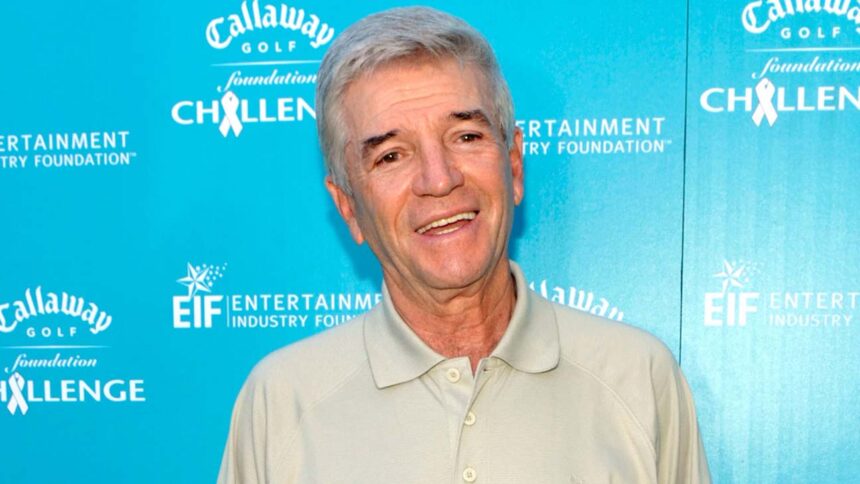
Tom Dressen, the upscale comedian who opened for Frank Sinatra for 14 years, pushed for money at the Comedy Store and participated in a pioneering interracial act with Tim Reid, died Wednesday. He was 86 years old.
A family spokesman said Dressen died at his home in Los Angeles Hollywood Reporter. The cause of death was not revealed.
The Pride of Chicago, Dressen has appeared in hundreds of television appearances during his more than 50 years in show business, including dozens in The Tonight Show Starring Johnny Carson and on evening shows hosted by David Letterman, his dear friend from the 1970s, at The Comedy Store in West Hollywood.
They were always thought-provoking but never controversial, and few were better at telling a joke.
“I don’t know if you know this or not, but in 1871, in baseball, men started wearing the cup to protect the family jewels,” Dressen joked during a party at the Laugh Factory. “In 1971, wearing a helmet became mandatory. It took 100 years for men to realize the importance of the brain, too.”
After primping audiences for the likes of Liza Minnelli, Smokey Robinson, Gladys Knight and Sammy Davis Jr., the always elegant Dressen began sharing the bill with Sinatra in 1983 and shared a private camaraderie with the Chairman during the singer’s twilight years.
As Driessen explained during a 2014 interview with Desert sunIt was a combination of serendipity and quick wit that brought him to the highest level of performance.
Robinson’s comedy opened at Lake Tahoe and he was running down the hall to see Sinatra headlining next door when Holmes Hendrickson, Harrah’s vice president, stopped him and introduced him to Mickey Rudin.
“I recognized the name as Frank’s lawyer, W [Hendrickson] He said, “Tom is going to do a great opening act for Sinatra,” Driessen recalls.[Rudin] He said, “Hey kid, if I gave you a week with Frank, would you want more than $50,000?” I said: Mr. Rodin, put it this way. If you gave me a week with Frank, I would do it You Do you want more than $50,000? “I love this kid,” he said.
Soon, Dressen opened the Sinatra Gallery in Atlantic City, never imagining the impact it would have on his life. “I thought: ‘Yes, I’ll go for one week. I’ll have my picture taken and put up in every bar in Chicago, and that’ll be the end of it,'” he said.
“On the second night, Frank and his wife Barbara took me to dinner, and in the middle of dinner he put down his knife and fork. He said, ‘Boy, I like your stuff. I like your style. I’d like you to do a few more dates with me if you’re interested.” I said, ‘Yes!’ and it turned into 14 years, 45 to 50 cities a year.
The two developed a deep friendship, and Dressen often visited Sinatra at his compound in Palm Springs. He served as a pallbearer and spoke at the artist’s funeral in 1998 and for years hosted the Frank Sinatra Celebrity Invitational Black Tie Gala.
“If he loved you, he worshiped the ground you walked on,” Driessen said. “In many ways, he was like a father figure to me. I didn’t have a father who cared much about where I was and what I was doing. But Frank would give me advice and advice, and then he was a friend in many ways. I thought the world of him.”
Before he met Sinatra, Dressen led a campaign that changed the course of comedy.
For years, stand-up was concentrated in New York and Las Vegas, but that all changed in 1972 when Carson brought in Tonight show From Manhattan to Los Angeles. Suddenly, The Comedy Store on Sunset Boulevard was the place to be.
The Comedy Store, run by Mitzi Shor, who acquired the club as part of a divorce settlement with her husband, Sammy Shor, has become a college for comedians. Since she was giving them such a valuable opportunity, she thought there was no need to pay them money. Dressen, in the process of establishing his career, disagreed, however.
“You pay the waiters, you pay the waitresses, you pay the guy who cleans the toilets,” she told Mitzi. Why don’t you at least pay the comedians?” Dressen told Richard Zoglin in an interview for the 2008 book. Comedy on the Edge: How Stand-Up in the 1970s Changed America.
He spoke with Schur about one of the female comedians who was on stage on New Year’s Eve. “He said, ‘It was amazing. I killed them,'” Dressen said. “Then he said, ‘Tom, can you lend me $5 for breakfast?’ I told Mitzi that story, and she said, “Well, he should get a damn job.” So I said, ‘Mitzi, he has a job.’ “He worked with you on New Year’s Eve.”
When Shore refused to cut its earnings from comedians, Dressen, drawing on his days as a teamster in Chicago, organized a strike in 1979. Letterman, Garry Shandling and Jay Leno were among those who marched in front of the club waving signs that read “No Money, No Funny” and “Yuck Stop Here.”

After six contentious weeks and a tension-filled standoff that saw an anti-strike comedian drive his car to the picket line, Shore collapsed. “Mitzi called me 10 minutes later and said, ‘Let’s settle this now,'” Dressen said.
The Comedy Store began paying performers, New York clubs followed suit, and venues across the country began offering more to comics. Dressen’s leadership has been instrumental in transforming the stand-up business.
Dressen was born on September 11, 1939 in Harvey, Illinois. His father, Walter, was a trumpeter who met his future wife, Glenor, when he joined a band led by her brother-in-law, Frank Polizzi. Polizzi also owned a neighborhood bar, and Dressen’s mother worked there as a bartender.
Dressen grew up poor, one of eight children. His father worked factory jobs to make ends meet, but he drank and gambled most of his paycheck. But in the end, Dressen learned that the man he thought was his uncle was actually his biological father.
As Rick Coogan of Chicago Tribune “Driessen was 12 years old when he said to Polizzi: ‘I think you’re my father,’” he wrote in 2019. I look like you. I look like your son. And I don’t look like anyone in my family.” It was quiet and then Polizzi said, “I’m your father.” But I want you to know that I had affection for your mother and your mother loved me. I’m saying this because I don’t want you to think we were having a one-night stand.
When he was 17 and attending Thornton Township High School, Dressen enlisted in the U.S. Navy and received three meals a day for the first time in his life. After service, he moved between jobs in construction and bartending and got his union card at a loading dock in Chicago.
While he was selling insurance, one of his brothers urged him to join the civic group known as Jaycees. “That’s when life started to change,” he said. “I used to hang out in bars where everyone would whine and complain but they wouldn’t do anything about it. The Jaycees were decent guys.”
The group recruited Dressen Wreid, a black marketing representative who had recently moved from Virginia to Chicago, to talk about a drug education program for grammar school students. The duo realized that the more fun they had, the more children would respond to their message. And then they formed a comedy act.
Tim and Tom made their debut in 1969 at a South Chicago jazz club, and as the first interracial comedy team, they subverted racial stereotypes. In one of their routines, “47 and Drexel,” Reed taught Dressen about “being black.”
“Hey, you have to pass the test before I release you to the south side of a city,” Red told Dressen, ordering him to speak like a brother. “Look here, Leroy,” Driessen replies in an exaggeratedly cheerful voice. “Does the bus stop here?”
“What do you think about this, Amos Andy?” Reid answers. “Does the bus stop here?! You will die of natural causes – someone will kill you naturally.”
Tim and Tom worked in the Playboy Clubs, opened for George Clinton and Shanna Na and appeared in 1971 David Frost Show. But they will face resistance.
“The fourth time we went on stage, a guy put out a lit cigarette in Tim’s face. And another guy beat the hell out of me. A year later, at the University of Illinois, I got hit in the face with an ice bar outside in the snow,” Driessen said.
“If we worked at a black club where there was a black man who hated white people with a passion, he wouldn’t be mad at me. I’m angry with Tim because he’s going to be Uncle Tom. We worked at a white club where the redneck hated black people, and he wasn’t mad at Tim, he was mad at me. As time went on, the frustration was too great. There are some people who benefit from segregation of the races. They ended up breaking up the act. “They did not break off the friendship.”
After the split, Dressen performed a solo stand-up and Reed found stardom as velvet-voiced radio DJ Venus Flytrap on the CBS sitcom. (WKRP in Cincinnati). (Driessen would guest star in the 1982 episode.) The duo’s story was told in Ron Rapoport’s 2008 book, Tim and Tom: An American Black and White Comedy.
Meanwhile, Driessen laughed it all off American platform and Soul train to Jim Nabors Show and Dean martin celebrity roast; It was a staple of game shows such as Hollywood Squares, Match game and Pyramid $10,000; He played himself in the 1998 HBO film Rat pack; And appeared on the big screen in They call me Bruce? (1982), Space balls (1987) and Man on the moon (1999).
his biography, Still Standing: My Journey from the Streets and Saloons to the Theater and Sinatra — with an introduction by Letterman, who wrote that Dressen “has entertained every president from Trump to Oprah” — was published in 2020.
It appeared just last week on CBS Unleash Comics with Byron Allen.
Survivors include his two daughters, Amy and Jennifer, from his marriage to Marilyn Sobok from 1958 to 1984, and seven grandchildren. His son Tommy predeceased him.