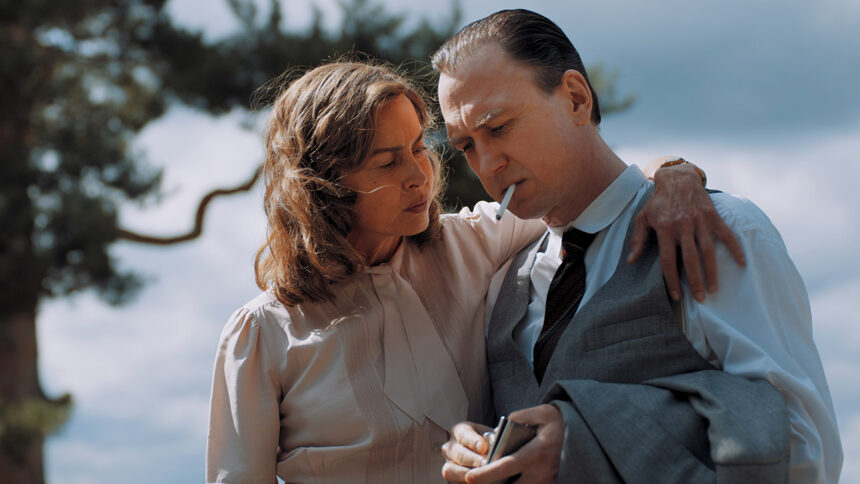
Adapted from Jenny Erpenbeck’s acclaimed novel Himsuchung Directed by legendary writer Volker Schlöndorff (Tin drum), Visit It summarizes one hundred years of German history by focusing on the events unfolding in just two buildings on two adjacent lakeside plots of land near Berlin.
While excerpts of archival footage show the rise and fall of the Third Reich and then the rise and fall of the communist-controlled German Democratic Republic, this expanded economic mini-narrative features a particularly strong cast that includes Martina Gedek (The lives of others) and Lars Edinger (death) Like some visitors and residents who experience the four dimensions of the story. Like two of Schlöndorff’s greatest works, Tin drum and Lost Honor by Katarina Bloomthis succeeds in showing how political forces directly impact personal lives, but it does so without feeling preachy, allegorical, or obvious—a testament to the refined cinematic and literary taste that always characterizes his work.
Visit
Bottom line Back to the form.
place: Cannes Film Festival (Premiere in Cannes)
ejaculate: Martina Gedek, Lars Edinger, Susanne Wolff, Ulrich Mathis, Detlef Bäck, Michael Mertens, Maria Matschke Engel, Angela Winkler, Josephine Platt, Ludwig Tripti, Matthias Hungerbühler, Stella Denise Winkler, Wiegand Wiegand, Ava Weisbrod, Billie Bo Winkler, David Bennett, Nina Lilith Fölch, Sarah Bartknecht, Romy Messner, Asta Wilmen Winkler, Sean Douglas, Camille Moltzen, Yvonne Moltzen
Director/screenwriter: Volker Schlöndorff, based on the novel by Jenny Erpenbeck
1 hour and 58 minutes
Much of the film, which narratively notes a near-Aristotelian unity of space if not time or movement, was filmed in and around Albert Einstein’s actual summer home in Caputh. It is an elegant Bauhaus-style structure (the real architect was Konrad Waxman), where the physicist took his family for the summer holiday before they had to flee the Nazis and emigrate abroad. This adds a whole extra textual layer to the story, because in VisitEinstein House is a house built by the Nazi architect Edinger. (He’s described simply as “The Architect” in the credits, one of several characters with similar generic handles, while the others get proper names.) The Architect manages to put the property deeds in the name of his smarty-pants-wearing socialite fiancée (Susan Wolfe), a legal maneuver that has major repercussions later.
Meanwhile, a German Jewish clothing manufacturer (Ulrich Matisse) owns a more modest and traditional summer cottage, built a few meters below the shoreline from the architect’s modernist spread. At first, this puts the manufacturer, his wife (Josephine Platt), his daughter Elisabeth (Stella Denise Winkler), her husband Dr. Ernst Kaplan (Matthias Hungerbühler), and their daughter Doris (played first by Billie Bow Winkler and then by Ava Weisbrod) roughly on equal footing with the Nazis next door. You can tell by the slightly evil politeness smile on the Architect’s face (underneath what is truly one of the ugliest haircuts in cinema) that he’s not happy about this. Fortunately for him, the “Aryanization” laws came into effect in 1933 and he was able to buy neighbors’ land cheaply when the state confiscated all their property.
Schlöndorff, guided by his source material, which in turn relies on letters found by a real girl named Doris Kaplan, treats the manufacturer’s family tragedy with generous compassion. Doris’s grandparents are sent first to the East with a strict packing list and a small suitcase, never to be heard from again despite the fact that Doris sends them letters as often as she can, each one with a carefully placed stamp showing Hitler’s face. Doris and her family are then sent on the train, swallowed whole by the Holocaust. A more sentimental story might have had at least one character reappear later, but instead there are only echoes of them here, ghostly reminders of their existence in double shots of characters affixing stamps to letters years later.
This lack of emotion continues throughout the war, as the architect is shipped to the Eastern Front and his wife must find a way to survive her home being occupied by Soviet soldiers, until the final section. In this final chapter, the famous left-wing writer (Gedek) works on her party connections to gain sole access to the house for herself, her journalist husband (Michael Mertens), her son (Ludwig Tripti), her daughter-in-law Erika (Nina Lilith Fölsch), and their young daughter Maria (played at different ages by three young actors, Sarah Bartknecht, Rummy Messner, and Asta Wilmaine Winkler).
It is Maria who finds Doris’s letters hidden in the dilapidated shed next door, and her awareness mostly dominates the latter part of the film – which, as is unexpected in anything set in the GDR, is only slightly more boring than the earlier events. A sweet summer kid who loves jumping into the lake with her hunky local boyfriend (Yvonne Moltzen, Camille Moltzen, and eventually Sean Douglas) and quietly questions the authority of the Eastern Bloc, it will be Maria who sees the house finally slip from her family’s grasp when the wall crumbles, setting up for a downbeat and languidly flat ending, like the sound of construction crumbling into dust.
As the credits roll, you get the impression that this may not be the 87-year-old Schlöndorff’s best film ever, but if he chooses to retire now, pulling out wouldn’t be such a bad thing. It is work worthy of craftsmanship and seriousness.