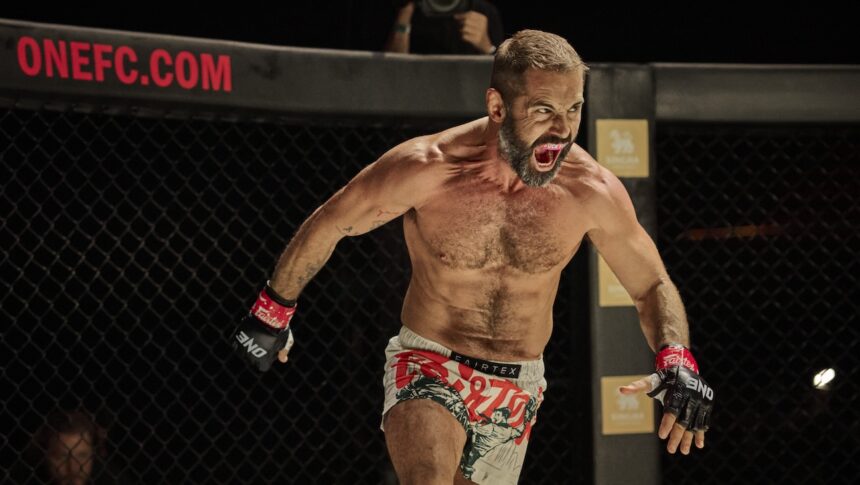
in A monsterAustralian director Tyler Atkins (Bush and Rocketalso known as Ocean Boy) sets out to do something more ambitious than simply staging bone-crushing fight sequences. His first film in the mixed martial arts arena is as much about family, identity and masculinity as it is about staying inside the cage.
A shot between Australia and Thailand, A monster Combining deep action with the emotional core of a working-class fighter torn between who he is and who he expects to be. With Russell Crowe as a battle-hardened trainer (Sammy) and Daniel McPherson as the conflicted fighter (Patton James) at his center, Atkins focuses on the human cost of violence – and the strength required to endure it.
Talk to The Hollywood Reporter AustraliaAtkins reflects on the film’s unconventional production and his personal philosophy that shaped its themes. A monster It opens in US theaters on April 10, and in Australia on April 23.
First of all, congratulations. This was a complex shoot, how long did it actually take?
Thank you. It’s hard to answer because it was somewhat unorthodox. We shot in three different blocks. The first was about 10 days – all the gym stuff and the Russell Crowe scenes. Then we went to Thailand for a week, and then we filmed the drama over four weeks. So, about seven weeks of shooting, but spread out over four or five months. It was pretty wild – different units, different locations.
What attracted you to a fight film? He – she‘Not a clear path for you.
I’ve already paused the text several times. The film was originally set in America and I didn’t get to see the film, and if I couldn’t see the vision, I wouldn’t have. But the producer encouraged me to re-read it, and Luke Hemsworth said something that stuck with me – you don’t always get a 10 out of 10 script, but if you see elements you connect with, you can elevate the script.
I love mixed martial arts. I love stories about men protecting their families and communities. I’m very interested in partnership and tolerance, these topics really spoke to me. So I reshaped the film around what I’m passionate about.
It’s like a fight movie, but the family story is the real driver.
Completely. Wife and daughter – that’s what drives everything. I leaned hard into it. It’s about a man trying to provide for his family but not being allowed to be who he is.
There’s a powerful moment when his wife realizes she has to let him be that person – even though it scares her. Fighters can die. They can suffer from brain damage. But she realizes that suppressing his identity is not the answer either. That moment was really important to me.
The opening scene is stunning, with the brutality and glory of the sport on display almost immediately.
That was very intentional. In mixed martial arts, one person wins, another loses – and the difference can be one punch. I wanted to show that contrast right away.
Then you have Russell Crowe’s character who takes a terrified fighter and prepares him to walk into the cage. There’s something almost spiritual about it – like a preacher sending someone into battle. We added war drums to the score to give it a primitive, ritualistic feel.
What conversations did you and Daniel Macpherson have about the character?
We’ve been working on that character for years. Dan trained in mixed martial arts — Muay Thai, jiu-jitsu, boxing — and we really built this guy from the ground up.
He’s one of those forgotten guys. A working-class man from Port Kembla (NSW) who could build a house and fix an engine – that kind of man. I wanted to explore what I call “divine masculinity.” Not aggression or toxicity, but a man who controls, protects, and gives. That was really important to me.
You touch on masculinity in a way that seems very intentional.
Yes, I think we’ve lost the conversation about what a good man actually is. It’s not about money or status. It is about integrity, responsibility and protecting others. That’s what I wanted to put on screen.

What‘Is it like Russell Crowe directing?
He is a master. You’re not really directing him, you’re collaborating with him. We drafted the script on his farm, and on set he knew exactly what he was doing. You might make a little observation here or there, but he brings it to life in a way that’s incredible to watch.
Have you been looking to other movies for inspiration?
definitely. Requiem for the Heavyweight It was great – it’s got a lot of heart. And of course rocky – This is the outline of the underdog story.
I also like emotional movies like Paper moon and On the waterfront. This is what I was chasing – heart and soul. But at the same time I wanted to A monster To feel authentic and real.
You had a big curveball with your cinematographer right before shooting.
Yes – seven days before we started, our partner had a serious health issue and had to leave. We couldn’t delay — the movie had already collapsed twice before — so we had to move forward.
I spent two and a half years working as an assistant, basically teaching film school while filming. This gave me confidence. We brought in Tomaz LaBanca, who had never shot a film before, but had a keen eye. I just said, “Let’s go for it.” And peace be upon him.
The world of the film feels very specific, especially Port Kembla.
That was crucial. Port Kembla is part of the character – it’s an old steel town, very raw, very real. Shooting it in a place like Sydney wouldn’t have worked. We fought hard to maintain this authenticity, because the environment shapes this man’s identity.
Looking back, what are you most proud of?
We stuck to the vision. It was a tough shoot, and there was a lot of pressure, but we were committed to making something real – something from the heart. I think this comes through.