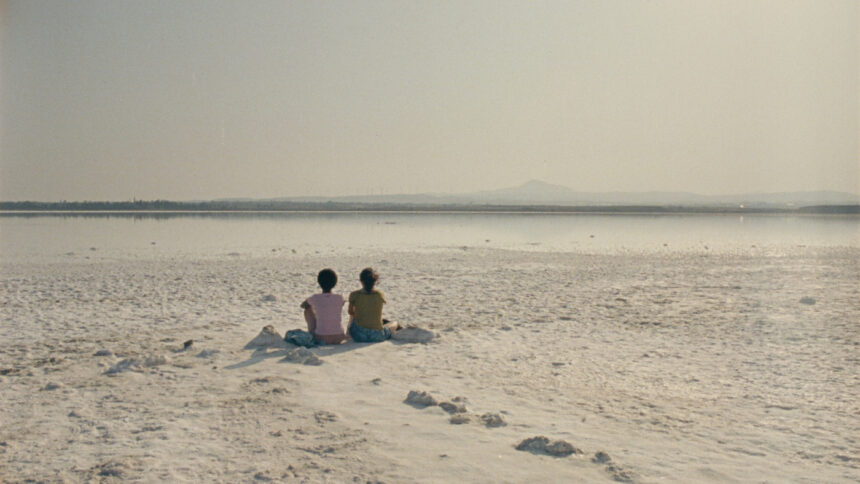
There is a lot to admire lion on my back, A Cypriot story of two women, one a recovering addict (Elena Kalinikou), the other a teenage Senegalese refugee (Sokhna Diallo). But despite the evocative atmosphere, great performances and stunning cinematography, Greek Cypriot director Tonia Micheli follows up on her critically acclaimed debut Stop Filled with very few dramatic clichés. However, its positive message about female friendship and families – and mostly English-language dialogue – will likely help it push through to more festivals after its premiere at Karlovy Vary’s main competition.
We first meet Mariama (Diallo) as she celebrates her eighteenth birthday in the women’s shelter where she has been living for some time, her only home since arriving in Cyprus on a flimsy boat, seeking refuge from forced marriage in Senegal. But for all the singing and dancing at the little Christmas party, it is also a sad occasion because Mariama will have to make her own way in Cyprus now with little help from the state. Homeless When the landlords she approaches close their doors on her, implicitly out of racism, Mariama keeps coming back and climbing the fence to stay close to her friends at the shelter.
The lion is at my back
Bottom line Girls have a little fun here, no matter how much they want to.
place: Karlovy Vary Film Festival
ejaculate: Sokhna Diallo, Elena Calinico, Procopis Agathoclius, Herodotus Miltiadus, Marina Mandry, Paris Erotokritou
exit: Tonya Mishaali
Screenwriters: Tonia Micheli, Diane Jones, Simona Nobile
1 hour and 46 minutes
Her plight is observed by Stella (Calinico), a cleaner in her late 30s or so, who not only works for low wages but also has to take regular urine tests to prove she is not using drugs. Stella shares an apartment with a group of younger women who openly use substances around her, a temptation she must struggle with even though so far she only takes a cannabis-based tincture every day to deal with stress. However, it would show up on a drug test, so Stella offered Mariamma a deal: a futon for her to sleep on in her laundry room in exchange for a pure urine sample from the younger woman.
Although she has a stony and intimidating face when she first meets her, Stella has a softer side as well as reasons to be very bitter and rude. She had a daughter, but the child (now about seven or eight), to whom she has been denied access, has been raised by Stella’s mother since Stella went to prison. We learn in passing that Stella was once a prostitute, working for a filthy pimp known only in the credits as “The Suit” (Prokopis Agathokleous). He desperately wanted to have Stella back in his stable, especially since she had been so good that day at being a submissive at the sex parties he organized, where clients could lead her around on a leash and urinate on her for fun. Now, desperate to raise enough money to put down a deposit on an apartment that she can allow her daughter to stay in, Stella is tempted to get back into the game one last time. But will she be able to handle it sober?
The climatic sequence in which we see the nature of Stella’s sexual act is extremely intense Requiem for a dream-Coded, filmed in bright fluorescent lighting with tight close-ups of the victim’s distressed face as techno music blares. Meanwhile, cute Mariama seems to have wandered into a Dardenne Brothers movie when she gets a job working for a butcher but must put up with leering and hints of sexual violence from co-workers. The one exception is Pantelius (Herodotus Miltiadus), a co-worker who some viewers are accustomed to seeing films in which bad things inevitably happen, and may immediately distrust as too good to be true. Worse still, the “suit” takes notice of Mariama and wants to make a deal whereby Stella’s “debts” will be paid to him in full if she brings him the nubile young woman so he can benefit from her plunder.
It’s all a bit depressing, even considering the scenes in which the women tentatively bond with each other, and there’s very little humor to make it so. StopThe darkness itself is more bearable. The two lead actresses at least have chemistry with each other, while the less experienced Diallo maintains her chemistry, despite getting the role at the last minute after another actor had to withdraw. Kaliniku has a burning presence, even if her heartfelt story is as old as Greek tragedy but without the poetry.