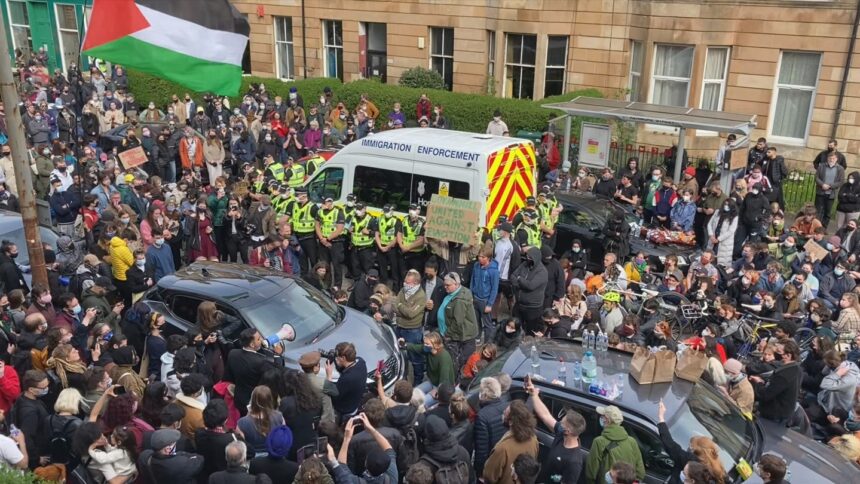
A film that tells the story of “one of the most spontaneous and successful acts of civil resistance in Scotland in recent memory” deserves a title filled with urgency. Documentary filmmaker Felipe Bustos Sierra found one: All to Kenmore Street.
Executive produced by two-time Oscar winner Emma Thompson, who also has another surprising role (more on that later), it recently opened the 22nd edition of the Glasgow Film Festival following its world premiere at Sundance. It screens on Wednesday at CPH:DOX, Copenhagen International Documentary Film Festival, before debuting in cinemas in the UK and Ireland via Conic on Friday 13 March.
All to Kenmore Street It tells what at first seems like a David and Goliath story. In May 2021, a dawn raid by the British Home Office in the Pollokshields area of Glasgow, one of Scotland’s most diverse neighbourhoods, prompted locals to rush to the streets to stop the deportation of two neighbours. “As news spread early in the morning of what amounted to holiday celebrations for many local residents, a handful of protesters swelled into hundreds of people, flooding Kenmore Street and making it impassable to an immigration enforcement truck” seeking to remove the two Sikh men of Indian origin, the summary notes. “The eight-hour standoff made international headlines as the community organized itself in an extraordinary act of peaceful solidarity.”
The film uses crowd-sourced footage from that day, along with archival film and “specially designed scenes” shot by cinematographer Kirsten McMahon, featuring actors “literally relaying the testimonies of contributors who wish to remain anonymous” (again, more on that later).
Bustos Sierra is a Chilean-Belgian film director based in Scotland. His first document of 2018 Nay Pasaran It tells the story of how a boycott by Scottish Rolls-Royce factory workers helped end General Augusto Pinochet’s regime in Chile in the 1970s and won Best Film at the BAFTA Scotland Awards.
All to Kenmore Street It is produced by Ciara Barry of Glasgow-based production company Barry Crerar, in association with Bustos Sierra’s Debasers Films. Screen Scotland’s Mark Thomas served as executive producer alongside Thompson. The film also features an original score by Mogwai’s Barry Burns.
“All to Kenmore Street “It beautifully and powerfully shows the innate and profound morality of our people while also highlighting the behaviors and institutional structures that belie this,” Thompson says in the press notes for the doc, which she describes as an “urgent film.”
Bustos Sierra spoke to THR On shining a light on solidarity in a divided world, reclaiming the peaceful protest he missed by making a film about it, casting Thompson, Kate Dickie and another Scottish actress in his doc, and what’s next for him.
When and why did you decide to make this film, and why did you feel it was so important to you?
It was out of personal curiosity because I lived 10 minutes away, and I received the same message as most people there that morning. It was a message with a picture of a pickup truck and a few people around the truck. Looking back, it was very difficult to see a positive outcome to that photo. There are many cases where the police response to protests or criminal incidents has been extremely violent.
I grew up with solidarity movements. And I saw the footage that went viral the day 10 million people saw the truck doors open. There was something on my mind. I couldn’t believe that this happened, that this was real, that it was so joyful, and that I missed it when he was so close to me.
How did you end up getting all the shots we see in the film?
I was following the situation on social media. So, obviously, social media became our number one source for finding shots and building the backbone of the film visually.
The next day, I was in the streets talking to people. It was coronavirus at the time, and lockdown was very strict in Glasgow, so there wasn’t much opportunity to do any real filming of proper interviews and sitting down with people in their flat. So I started going for walks around the local park for several months. This gave us a lot of time to not only talk about the mechanics of the day and how the day evolved, but also to figure out the bigger questions, like: Who has time for this kind of stuff in our lives? You know, we’re all trying to keep a roof over our heads, work somewhere that doesn’t put us down, have a voice in some way, and keep our family together. But in this case, you have this idea that people are giving up everything for two people they know nothing about, just because they’ve been arrested, and they find that abhorrent.
So those first few months of not being able to make a film allowed us to make the film what it has become, because it created a lot of space to think about it, how to make it and what to ask for.

How did you get all the footage from today for the doctor?
Part of it was the organic process of getting to know people who were on the streets. Most of them were filming that day just for social media, because its purpose at the time was to attract more people to the protests. I think no one was really filming with the idea that this was for posterity. So editor Colin Mooney and I spent months going through that frame after frame, saying, “There’s this person filming! How do we get to that person?” Or ask someone who has an angle at the same moment that might be better. We did it in batches as we got more funding.
We ended up doing a Kickstarter campaign. So most of the footage was crowd-sourced. We are very lucky that a couple of photographers who live in the area went shooting with their smartphones and then realized there was something bigger going on. And they just came back and came back with them [professional] Cameras. So we have about 20 minutes of broadcast quality footage.
[Spoiler warning: The next question and answer contain spoilers about some of the people featured in the film.]
All to Kenmore Street It is executive produced by Emma Thompson. She also plays the role of a man who decides to lie down under the truck to prevent it from leaving. Then I saw Kate Dickey and Kira Lucchesi too. How did they get involved?
As you can imagine, the ‘Fan Man’ has become a bit of an obscure figure in Glasgow. When I talked to him, he had this problem. “You were useful for 15 minutes, weren’t you? My strength was being in the right place at the right moment when the two men were holed up in their apartment. It was a split-second decision. I’d go there and stop the truck and give time for more people to come,” he said.
Eventually, the guys were released, and there was a lot of joy around him, and he became this larger-than-life character. People just put people on a pedestal. And he was like, “I don’t want to be on a pedestal. I think anyone could have done this. It could have been a nice old lady. It could have been a 12-year-old boy. It could have been anyone. I don’t want my identity to be known and made bigger than it was.”
Then there was this [off-duty] The nurse who took care of him brought him water and helped him continue doing all these movements and exercises so that he would not go into shock. When I met her, she said: “I’m a nurse, I’m a public figure, and I want to be able to do this kind of thing again. I think if people knew my face, that might make it more difficult.”
So it was very clear that I wanted to capture their testimonies in the film, show their personalities and give a sense of their defiance and hurt, as well as humour.

I had an existing relationship with Emma Thompson. She had seen my previous film, which was about Solidarity for Chile from Scotland, and she sent me a really lovely message about how much she appreciated it. So we’ve been in conversation ever since.
And one of the things I really loved about making this movie was the element of surprise that kept coming, and E.J People found ways to buy time, occupy space, and distract. So the presence of Emma Thompson was the WTF element that gives it the humor. This reflects the history of civil disobedience in Glasgow, which is full of people of color finding solutions to their problems.
There is a certain level of intimacy sometimes at a protest between people who don’t know each other. So it was beautiful [express this sort of] An intimate moment between Emma and Kate, where it feels like that’s the only thing that matters in that moment. I think that’s something we would have missed. Kate lives in Glasgow and is from Glasgow, so was well aware of the protest as it was happening. Keira is also an actress in Glasgow. So it’s all very local.
Yes, I haven’t been to Glasgow in years, but the film felt deeply rooted there, while at the same time touching on universal and timely themes.
Yes. The film has been in production for four and a half years, and it will soon be five years since the protest. We felt that it might lose its resonance the further we moved away from it. But of course, unfortunately, we are fully aware that the topic of immigration will still come up again.
There was this feeling in the UK, in Scotland, that policing was sometimes overdone in a way that maybe we’re not used to, but that’s clearly nothing compared to what Americans have to put up with with Immigration and Customs Enforcement and the proliferation of weapons.
I think that in the era we live in, everyone assumes that a movie has a sad ending. But the people in Glasgow didn’t know there would be a happy ending, and they showed up anyway.
What feedback have you received from Glaswegians about the film?
One man told me, “I was at the protest, and I loved the movie. And I realize there’s a lot of the day that I missed, even though I was at the end of the street. I got to know a lot of people.” So I thought some people are able to see themselves. It’s a bit like “Where’s Waldo?”
Do you know what movie you will work on next?
There is another protest action, based in Scotland, that I look at through the lens of imagination.