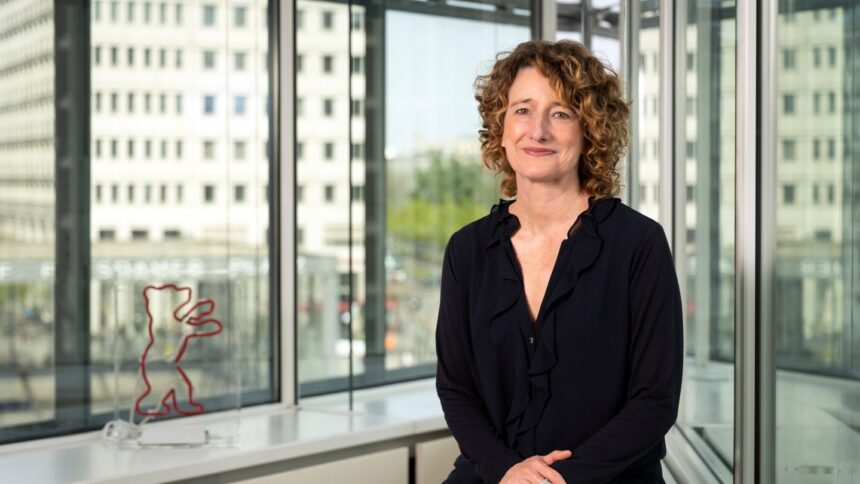
The uproar sweeping the Berlinale and its director, Tricia Tuttle, now threatens to permanently damage one of the world’s most important showcases for independent international cinema.
The point of tension, as is often the case in cultural institutions today, is Israel and Gaza. The arguments, as is increasingly the case, unfold within mutual media bubbles, each fortified by its own truths, its own anger, and little appetite for reciprocity.
At the center stand the Berlinale, one of the industry’s major platforms — along with Cannes, Venice and Toronto — and Tuttle, who takes over in 2024 after a successful stint running the London Film Festival and who has tried to champion Berlin as a space for free expression and pluralistic debate.
He did not protect her.
On Thursday, Tuttle was summoned to attend a special meeting of the Berlinale’s supervisory board, at the invitation of German Culture Minister Wolfram Weimar, with many in the media speculating that she would be expelled following controversy over pro-Palestinian speeches at Saturday’s closing ceremony, one of which criticized Germany as an “accomplice to genocide.”
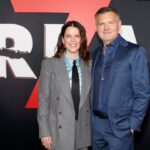
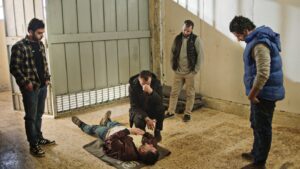
Conservative German tabloid newspaper Build, Citing unnamed inside sources, Weimer claimed that Tuttle was in his sights because of this statement made by Syrian-Palestinian director Abdullah Al-Khatib, who won Best Feature Film for his drama. Records from the siege. The newspaper also pointed to a photo taken earlier in the week showing Tuttle with Al-Khatib’s team, many of them wearing keffiyehs and one carrying the Palestinian flag. The standard photograph of the festival has now been reworked as evidence.
The meeting ended without a decision being taken. In a brief statement, the German Culture Ministry, the Berlinale’s main public funder, said discussions “concerning the direction of the Berlinale” would continue.
Tuttle’s future remains uncertain. They can still be removed. She could resign, leaving the ministry to manage the fallout. Or it can stay, buoyed by open letters of support from Berlinale staff and from hundreds of directors around the world. If she goes, it’s a good idea to find someone willing to take her place.
“Who wants to run the festival knowing the restrictions and also with watchful eyes that see any mistake leading to immediate implementation?” German director Tom Tykwer said in a television interview on February 25. “This is not the idea of free art and a free state.”
If its loudest critics are to be believed, the Berlinale is both a platform for anti-Semitic and anti-Israel propaganda, and a tool of the pro-Israel German state that censors pro-Palestinian voices. Both accounts are ridiculous and have nothing to do with what actually happened at this year’s festival.
Accusations of anti-Semitism hinge largely on the preacher’s rhetoric and the now-infamous photo. However, before the awards were handed out, a very different charge dominated progressive social media: that the Berlinale was silencing artists critical of Israel.
Short clips from the press conferences – including jury president Wim Wenders saying, “We have to stay out of politics” – sparked outrage online. A February 17 open letter, signed by 81 Berlinale alumni, including Tilda Swinton, Javier Bardem, Mark Ruffalo and Brian Cox, accused the festival of “censoring artists who oppose Israel’s ongoing genocide against Palestinians in Gaza and the German state’s key role in enabling it.”
The extent to which artists are censored has not been clearly stated. In practice, the festival stage proved that it was not silent. Two days after Wenders said she was staying away from politics, Finnish director Hanna Bergholm wore a watermelon-shaped pin in support of Palestine at a press conference for her film Nightburn He referred to the “genocide” in Gaza. During the awards ceremony, several winners were honored – including Mary Rose Aosta, who… Someday a child Won the Golden Bear Award for Best Short Film for screenwriter Genevieve Delaude de Sales (Nina Rosa), and Jury Grand Prize Silver Bear winner Amin Alber (Salvation) – He invoked Gaza and called for “the liberation of Palestine.”
Anyone who accuses the Berlinale of anti-Israel bias has conveniently ignored the launch in Berlin on February 17 of the FutureNarative Fund, a new co-production initiative between Germany and Israel attended by major public funders, broadcasters and studios. The February 20 Film Festival screening Letter to David – full versiona documentary by Israeli director Tom Shoval, paying tribute to actor David Cuneo, who was taken hostage by Hamas on October 7, was released last November. An earlier version of the film premiered at last year’s Berlinale, the first directed by Tuttle.
Cheval has publicly supported Tuttle, saying she did an “extraordinary job under impossible circumstances.” So did more than 700 filmmakers from across Europe and the world, who put their names in an open letter supporting and calling for “artistic freedom and institutional independence” at the festival. Signatories include Sean Baker, Todd Haynes, Kleber Mendonça Filho, Ari Folman, Nancy Spielberg, and (again) Tilda Swinton.
talking to hollywood Reporter, Cheval expressed concern that the controversy dominating this year’s Berlinale could lead to the core purpose of holding a film festival being hollowed out.
““You go to a festival to see a film, you see art, and you’re not going to discuss politics. Of course, films are political. They’re political films,” he said. Art is political. But to reduce everything to this point is to create a skewed perspective.” The danger, he said, is that the conversation consumes cinema itself: “The Berlin Film Festival has just happened, and you don’t talk about films. You only talk about discussions.
Throughout the festival, Tuttle dismissed allegations of censorship as “rooted in misinformation” and “incredibly harmful.” At the awards ceremony, she acknowledged the charged atmosphere, but said the heated debate was proof that “the Berlinale is doing its job, and cinema is doing its job.”
Tuttle emphasizes that the Berlinale must remain a pluralistic place – allowing artists to speak, audiences to listen, and difference to emerge without political censorship or criticism. Her critics, at opposite ends of the spectrum, see bias where she sees balance.
What happens next will determine the tenure of more than one director. It will test whether one of the world’s leading film festivals can continue to serve as an arena for competing voices or whether the pressures Berlin is now under will redraw the boundaries of what can be said and by whom.