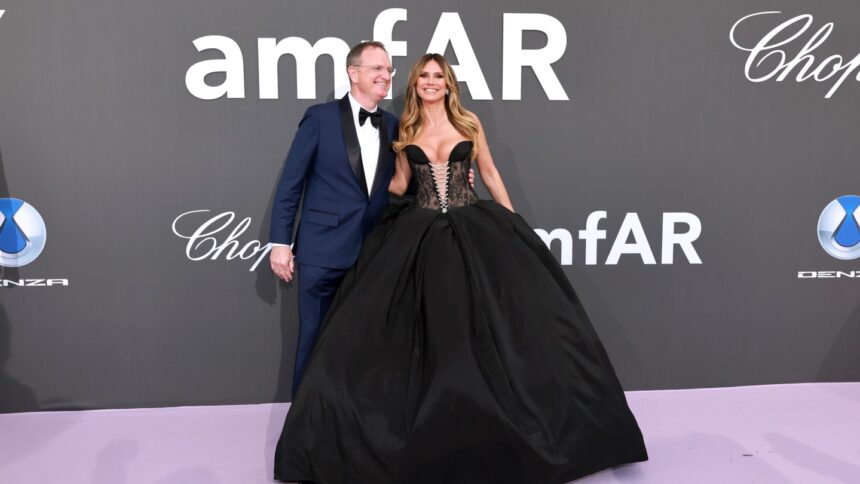
The first rule of amfAR is not to talk about how you got to amfAR.
By this, I don’t mean how I got to the amfAR gala, i.e. how I got a seat at the Cannes Film Festival’s most glamorous annual event, which for my delighted colleagues in the back left corner of the room involved donating works of art or an electric car for auction, or knowing a wealthy media mogul had extra invitations, or paying €17,000 per dish. Once there, one can enjoy a beautiful evening of free-flowing champagne; Performances by Robbie Williams, Zara Larsson and Lizzo; Attend Rami Malek, Eva Longoria, Heidi Klum, reality TV great Maura Higgins and host Geena Davis, auctioning off rare Warhols and Marilyn Monroe photographs and a chance to help raise millions of euros for AIDS research.
No, the dirty secret that no one ever talks about is the actual transportation to and from the concert itself, all the way at the Hotel du Cap-Eden-Roc on the tip of Antibes, a 30-minute drive from downtown Cannes. For those lucky enough to have a car and a driver, or who are already staying in one of the most exclusive hotels on the Mediterranean (or even better, on one of the mega yachts moored offshore), it’s easy. To everyone else, including this freelance journalist without an expense account, this approach reads more like a military-level obstacle course designed to test your cunning and will.
And here one begins to wonder why we are covering this wonderful and excessive party at all, at a time of global recession and war in Gaza and Iran. But as model Coco Rocha told me later, while wearing a white feather-covered dress and a very tall white feather hat, “I don’t think people realize how much money is being raised tonight… I imagine that one day someone will walk in and say: ‘We’ve found a cure for AIDS.’” Thursday night’s fundraising total reached 17 million euros, or $20 million.
She continues: “So it might be confusing to people on social media why everyone is so overdressed… but maybe I can put on a crazy hat and someone from my daughter’s generation Alpha will stop scrolling on TikTok and say, ‘What is amfAR?’ and look it up. That’s a win.”
I begin my journey two and a half hours before dinner, when, in dramatic Hollywood fashion, I miss the last early press shuttle from Cannes and have to hop on a local train to Antibes, battling beachgoers and day-trippers in my requisite black-tie dress and heels. I would soon learn that drivers on the taxi app Bolt (used more prominently in the south of France than Uber) take prepaid ride requests more like starting points for negotiation than actual paid gigs. The first driver out of the three would only take me part of the way because he had just returned from where I was going and the trip was too annoying to bear. Great sign.
He dropped me off at a police checkpoint that in previous years had served as the starting point for the world’s funniest 5K race, where traffic-angry partygoers would spill into the streets and weave between bumpers, dropping feathers and sequins. Seconds after my driver got off, the police informed me that walking to amfAR was now prohibited for “security reasons.” Perhaps the bold ones were wearing abayas and trying to blend in with the walking guests? We must toast to their ambition!
A new driver picks me up, but seconds after I give him the car pass to cross the checkpoint right in front of us, he turns around and speeds off in the opposite direction. It didn’t sound like an attempted kidnapping so much as a GPS misinterpretation, but after 20 minutes of Google Translate conversations, I realized he was a Romanian immigrant who had been spooked by the police presence and was afraid they would take away his driver’s license. He dropped me unceremoniously on the side of the road and I stayed to find a third car, a nice French Uber driver who drove past the checkpoint only to have traffic stop and then panicked because he had someone waiting to pick them up in the next beach town. We endured the twenty minutes it took to drive two blocks, only to hit the next traffic jam, which was, of course, everyone at the party waiting in line to be snapped on the red carpet. I jump behind some employees and find a secret detour. Don Quixote, eat my dust!
When we finally stepped outside onto the grand grounds of the Hotel du Cap, it was just gowns and ties all the way to the sea. The auction’s big-ticket items are on display outside and are closely guarded, such as Terry O’Neill’s 1971 portrait of Brigitte Bardot that will sell for 100,000 euros ($116,000), or a set of 10 Andy Warhol Marilyn figures that will fetch 2.8 million euros ($3.25 million) in the biggest sale of the night.
Heidi Klum is there in a black dress with an impossibly corset top, charming everyone and looking completely different than she did at the Met Gala just weeks ago, when she covered herself in latex and spandex to become a marble statue and embody the “fashion is art” theme, earning our endless admiration for the total commitment. I saw her in the street while looking for her car, presumably trying to get out of that thing. “I was there, melting!” says Klum, who explains that the outfit was taped to her and it was a process getting in as well as getting out of it. Wearing a corset is a noticeable improvement. “I can’t breathe for other reasons, but my skin can breathe.”
Next to her is her husband, German musician Tom Kaulitz, and they explain that amfAR was their first date in 2018. She wore a white dress that she didn’t know was a wedding dress, but it must have been a sign because they were married a year later.
Also wandering the grounds is auctioneer Simon de Pury, inspecting the merchandise. “I always have a nervous breakdown before every auction, even though I’ve been doing this for 100 years,” he says. “Every time it’s like I’ve never done this before, because you have these nightmares when you think, ‘What if no one bids?’
Before each auction, he eats an apple, a superstition that dates back to an auction he held in a castle in Germany for the Thurn und Taxis family. They had bowls full of apples everywhere, and he ate them, and the auction was a complete victory, which he thought was because of the apples.
He also recognized the excess of partying in difficult times, but noted that people who attend these events do not become less wealthy. “Obviously we’re very fortunate and privileged, and I think even in times like this, we have a greater responsibility to give back, to be generous, to try to make a difference in that way.”
Party surplus is part of the equation. Make people have a little fun and have a good time, and they will spend more than they intended. It is as if a man comes and says to me jokingly: “You are the man I hate the most! I hate you!” Last year, he spent more than he wanted to on a piece of art, but he couldn’t help it. De Pury was looking at him from the stage, and before he knew it, his hand was raised.
Inside the massive dinner tent, an army of waiters pace back and forth while auction items are sold fast and furious: a €700,000 ($811,917) Denza made in collaboration with Chopard that also comes with a watch and a luggage bag designed for the trunk; 650,000 euros ($696,900) for a pair of Chopard earrings featuring two large diamonds and 310 smaller diamonds.
Kyle Clifford, AmfAR’s new CEO, makes a compelling case for why fundraising is necessary; He is the first openly HIV-positive person to run a non-profit organization. “This is an organization whose research has helped keep me alive for 40 years,” he says.
Rami Malek and director Ira Sachs, whose film “The Man I Love” is about New York artists during the AIDS crisis, sit at a table across from Lizzo, who is a surprise guest and sings “Don’t Make Me Love You.” Malek is there with his twin brother, who has a goatee and dreadlocks, and they make an interesting contrast, between the clean-shaven movie star and his look-alike who just walked off the set of a Harmonie Korine movie.
Platters of food swirl around as auctioneers stand near the excited bidders Red things that look like lightsabers and they raise them in the air whenever someone raises the bet. De Pury shouts things like: “All you’ll be left with is eternal regret!” and “All I can see are glow sticks and darkness,” and berates the men in the room for not spending “their pocket money.”
Models step out for an annual fashion show hosted by former French Vogue editor Corinne Roitfeld. This time they all portray musicians and movie stars, such as Madonna and Sophia Loren. The man who bought the entire 19-piece collection for his wife won a “very small” jump, in De Pury’s words, from €200,000 to €210,000. De Pury was even happier when the price for his live-action role in the final season of Emily in Paris reached €375,000 ($435,500) and then series creator Darren Star offered him a second role for double the money — so happy, in fact, that he broke the wooden mallet he’d been using for 20 years when he hit it on stage. He is even happier when someone buys one of just five Audemars Piguet watches designed by artist Georges Condo for 1.45 million euros ($1.68 million).
The audience went crazy when British singer Robbie Williams asked them to dance “Because I’m amazing!” He performs four beats, ending with the song “Angels,” which he dedicated to his daughter. When he told her that he was performing at a place called Cannes for a non-profit organization doing very important work, he said from the stage: “She said, ‘Wasn’t anyone available?’” The evening concludes with an energetic and exciting performance from Zara Larsson.
As guests headed to an after-party overlooking the sea, I bumped into de Pury, cradling the broken remains of his trusty hammer of 20 years. “You did well,” he told me. It was the passion to do Emily’s bidding in Paris that did it. He showed me his bandaged finger and told me the story of how he kept the auction going while he sucked his finger and tried to get the blood off his white suit. He’s ecstatic about the night’s flight, adrenaline still coursing through him. There’s more dancing and drunken pizza eating. I’ll somehow find my way to Cannes via a shuttle to the parking lot, a Bolt driver who accepts my ride and then tries to double the price when I get in the car, and another driver who is kind and tells me throughout the trip, via Google Translate, that I’m beautiful and he wants to take me out for ice cream.
I come home thinking of De Bury’s hammer, broken but now in new shape, where it will likely spend its days displayed on a beloved mantle. Not a bad way to spend a lifetime or end a night. And it was all for a good reason.