Leave that to Larry David, who championed pickleball Curb your enthusiasmto ride the wave of Mahjong. During a YES Network commercial in March, David called Yankees broadcaster Michael Kay into a tailspin when he couldn’t find the game on TV, finally telling him: “I’m not going to watch it. I’m going to play mahjong! I don’t care.” Kai suspiciously asks, “Are you playing mahjong?” -Opening up to David’s line that went viral: “What, are you really good at mahjong?”
Turns out, David and his wife, Ashley Underwood, are quietly learning the IRL game in Montecito, where Meghan Markle is hitting the tiles with her “mahj squad,” made up of fashion designer Tracy James Robbins (Brian Robbins’ wife), cosmetics entrepreneur Victoria Jackson and former WME agent Jennifer Rudolph Walsh. Godmothers Bookstore in Summerland, owned by Jackson Welch, offers mahj games and classes.
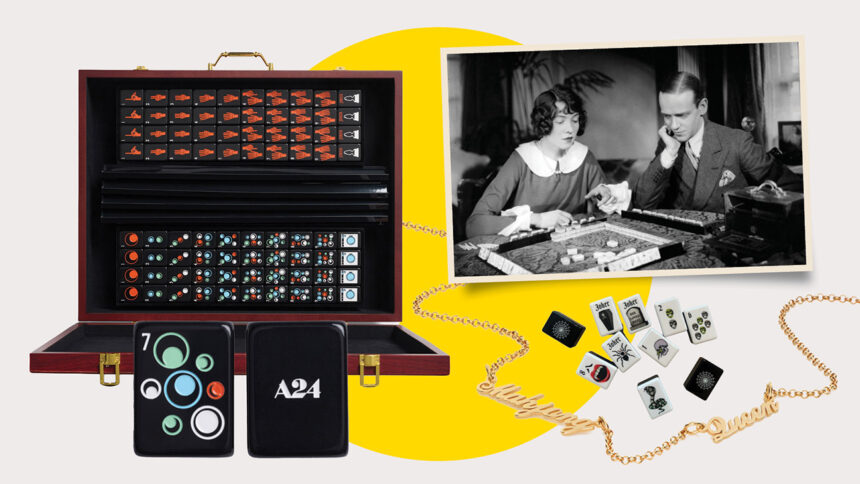
Dating back to 19th century China, “old style” mahjong made a resurgence in the 1920s after Standard Oil CEO Joseph Park Babcock returned from the country after a decade and teamed up with Abercrombie & Fitch to sell imported sets. Then he taught Douglas Fairbanks how to play. Soon President Warren G. Harding and First Lady Florence Harding were tapping on the White House tiles. In 1926, brothers Fred and Adele Astaire were photographed at a mahjong table in London, headlining a musical show. Lady, be good!
Now mahjong is having another great Hollywood moment. Although the game never really went away, the recent explosion in its popularity seems tied to a post-pandemic yearning for social connection, along with influential stars spreading their passion for the pilgrimage and collectible beauty of the tile sets themselves. Some wonder if all the American hype for mahjong is disrespectfully expanding the game a little too far from its Asian heritage.

(If you’re really good at knowing the rules, it’s a lot like gin rummy but with tiles instead of cards. In traditional Asian mahjong, players create flexible sets of tiles, while American mahjong follows predetermined hands. There are more than 40 different types of play globally. American mahjong was standardized in 1937 and added eight “wild cards” for the joker.)
“I think after COVID-19, it had a huge explosion because it was literally a meeting,” says veteran producer Susan Todd.Bad moms), which has been organizing athletics since 2003 and plays home to Bel Air Bay and Jonathan FC. “It’s like once you start, it’s required. It’s sharing actual airspace together. It’s also this thing now among all the hot girls who have novelty hobbies.”
Then there is the tile installation. “People collect tiles like they collect Birkin bags,” says Todd, whose quartet includes Monica Lewinsky, MGM Television chief Lindsay Sloan and trend forecasting consultant Jane Buckingham. “When we started playing, there were two basic companies you could buy tiles from. Now, getting a certain level and a certain amount of tiles has become very common. Crisloid sets that sold for $2,000 to $3,000 are going on the secondary market for $15,000 to $20,000.”
Mahj to Go co-founders Lynne Spillman and Heidi Brooks, who oversee open play and tournaments at San Vicente Bungalows, have been spotted slapping their trademark tiles around town with Reese Witherspoon and Cindy Crawford. Blake Lively famously delivered her Oh My Mahjong set to a Manhattan court in February so she could practice amid her legal battles with Justin Baldoni. One Hollywood mahjong teacher shares what might be the most coveted seat in town: “All the moms in Malibu have been vying for years to get into Julia Roberts’ mahjong group!”

A growing business in tile sets, mats, and merchandise by primarily white-owned American companies that replace traditional Asian symbols with every imaginable motif (flowers, food, holiday icons) has led to allegations of whitewashing. As did the Hallmark Channel movie All’s fair in love and mahjongwhich landed on May 9 to negative online backlash due to its lack of Asian representation in the cast.
But the backlash has not dampened the growth and development of the game, which remains popular across cultures. Carrie Coprinas, Bicoastal’s Chinese-American Mahjong instructor, first learned American Mahjong 20 years ago at a Starbucks in Brentwood Village. She now counts Sarah Jessica Parker (whom she calls “the OG glow and edgy”) and Jessica Seinfeld among her students. “The Chinese invented paper, the compass, and gunpowder, and everyone uses them,” says Coprinas, putting claims of cultural appropriation into perspective. “This game has its origins in China, but in 1937, Jewish women made their own version of it, and that’s what we all play. And I’m Chinese.”
“The beauty of mahjong is that it’s 70 percent luck and 30 percent skill. So, if I teach you tomorrow, you can beat me, even though I’ve been playing it for decades,” Cuprinas says.

In June, Coprinas and public relations expert Carol Bell will make their debut A pilgrimage in the wilderness Podcast. Among the first guests were Just Jared founding fashion designer Jared Eng and Eileen Foliente, the former membership director at San Vicente Bungalows, who opened the buzzing Mahjong Megachurch club in November. Through invitation-only services at Eng’s Beverly Hills home, the group has made its mission to teach the traditional “old-style” Taiwanese version of the game to a wider audience. When he confronted Eng Hacks Stars Hannah Einbinder and Paul Downs, at a recent concert, unleashed a rallying cry of “Mahjong, Mahjong, Mahjong!”
Maria Shriver and Hoda Kotb first learned from Oh My Mahjong instructors at a November retreat in Los Cabos for Shriver’s nonprofit Women’s Alzheimer’s Movement. “I’m trying to get better!” Shriver says THR. “We know from studies that it’s good for brain health, which is why I tell every woman I meet that if they don’t know how to play Mahjong and care about their brains, they should learn how to play!”
Most swear their mahjong groups are all about fun, but Ng sees a little jostling: “It’s a little Hollywood, like ‘Who’s in the room?’
This story appeared in the May 20 issue of The Hollywood Reporter magazine. Click here to subscribe.