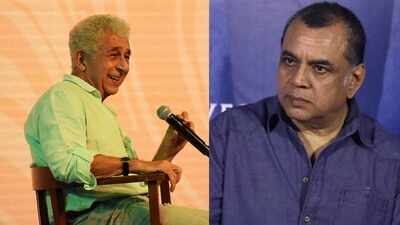
Paresh Rawal, who served as a member of Parliament for the Bharatiya Janata Party (BJP) from 2014 to 2019, and veteran actor Naseeruddin Shah, have long stood at opposite ends of the political spectrum. While Shah frequently criticized the ruling party and its policies, Rawal consistently expressed his deep admiration for him as an actor.
Summarizing his past respect, Rawal said: “Even Nasr al-Din Shah’s enemies admire him. There is something about him that does not allow you to take your eyes off him.”In a recent conversation with Vicky Lalwani, Rawal spoke candidly about his admiration for the Shah, his influence on his craft, and why their ideological differences never got in the way of mutual respect.The discussion began with Rawal revisiting his role as a visually impaired man in the film ‘Aankhen’.
He revealed that he watched Shah’s performance repeatedly in Sparsh while preparing for the film.“I watched Sparsh several times during the film Aankhen. I have never seen any actor portray a blind man as beautifully as Naseeruddin Shah did in Indian cinema. There is a sparkle in the eyes of a blind person. It may sound like an oxymoron, but what I mean is that his expressions were perfect. He moved away from the stereotypes and caricatures that have been created around such characters.”
Speaking about their relationship, Rawal explained that even though they are not close friends in the traditional sense, he has always had great respect for Shah. “We’re not the kind of friends who visit each other’s houses. We talk on the phone sometimes. I can’t be too casual with him because I have a lot of respect for him. He’s not the type of person who opens up to everyone, and he makes that very clear. Besides being a great actor, he’s also a great human being.”
“Rawal also admitted that the two have sharply contrasting political beliefs, but said these differences never affected their bond. “We may have different political ideologies, but we have never argued about them. I once said in an interview that if Naseeruddin Shah, Aamir Khan or Shah Rukh Khan raise concerns, I will listen to them. I will not directly reject what they say. I will try to understand their point of view. If I feel they are wrong, I will tell them.”Recalling the first time he saw Shah and the late Om Puri, Rawal said he was mesmerized by their presence even before he saw their work.“Naseeruddin Shah and Om Puri were not the traditional good-looking heroes. A friend from IFTDA, Subhash Dhanjay, would often tell me about this actor from NSD (National School of Drama). I became curious, and one day he took me to where Naseer lived. That evening I saw Naseeruddin Shah and Om Puri standing in the parking lot.
I hadn’t seen their work at the time, but I was impressed. They had something magnetic about them.
Once you see Naseeruddin Shah, you simply cannot take your eyes off him. The same applies to Om Puri.He added that their acquaintances developed later while working in the theater.“I was hypnotized by him. I was always trying to understand what made him so great.”Rawal went on to recall that his first opportunity to work alongside Shah came in the film ‘Lori’. “The first film we worked on together was Loori. It starred Farooq Sheikh, Naseeruddin Shah, Shabana Azmi and
Swaroop Sampat
. I had a very small role. Director Vijay Talwar knew that I would happily do even a small part if it meant working with Naseeruddin Shah.
This is where I officially met him. I had a few scenes with him and thoroughly enjoyed the experience.For Rawal, recognition from Shah was always more important than industry awards. “I never looked for validation through awards. Once the director says ‘cut’, I move on. But when Naseeruddin Shah called me after watching ‘Mumbai Meri Jaan’ and said, ‘Jio yaar jio, kya kam kya hai,’ that was the biggest award of my life.”Rawal also defended Shah over the criticism he faced after he expressed concerns in 2018 about the safety of his children in India.“People adore Naseeruddin Shah. Even his enemies admire him. He has that quality. Sometimes people end up saying certain things. Don’t judge him for one statement. It’s unfair. It’s not in our culture to target someone’s children because of what they have said. You are performing at Prithvi Theatre.”
If someone really wants to hurt you, they can. But that’s not how our society works.”Rawal was referring to statements made by Shah during a conversation with Karwan Mohabbat in 2018, where the actor spoke about choosing not to raise his children with a religious identity.“I had a religious education… but Ratna [Pathak Shah, Naseeruddin’s wife] He did not receive any religious education. We have chosen not to give religious education to our children.
So I fear for my children… because if a crowd of people gather around them and ask them are you Hindu or Muslim, they will have no answer. He said: They have no religion.Earlier, in an interview with ‘The Lallantop’, Ratna Pathak Shah explained why she and her husband continue to share warm relations with colleagues like Anupam Kher and Paresh Rawal despite their different political views.“I was born in a family where my father came from an RSS background and my mother was a communist.
There were constant arguments and disagreements at home, yet we all lived together happily. Disagreeing with someone’s opinion does not mean hating them. The idea of canceling anyone who disagrees with you is very new. “It’s not our culture.”She added: “They make Indians fight with each other like children in the school playground, the same way bullies treat weaker children. Do we want to become like that? No. I will not become like that, and I will not allow my children to become like that. Anyone I can influence, I will tell them that we cannot become bullies. We must become cultured human beings. This is our culture.”