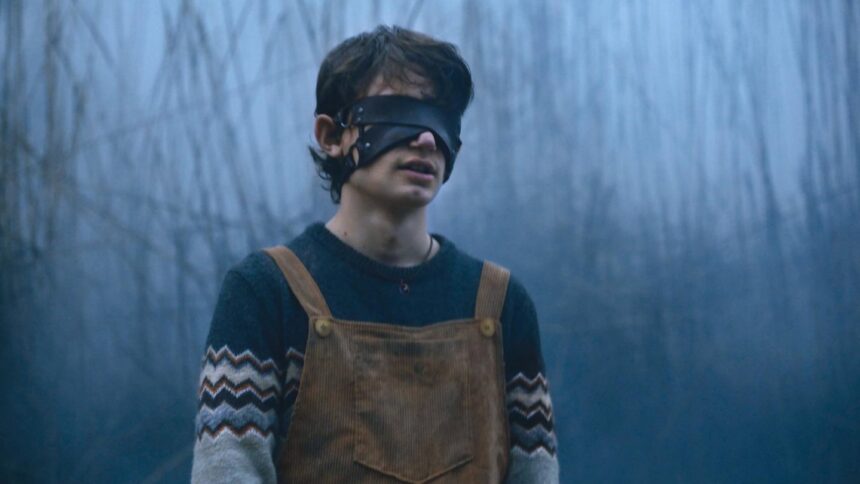

“The boy with the light blue eyes” – Courtesy of Argonauts/SXSW London
Greek director Thanasis Neofotestos for The Boy With the Light-Blue Eyes, his debut at SXSW London – a popular horror allegory about otherness, gay identity, and the randomness of being born differently.
In the remote mountain village at the heart of Thanasis Neofotestos’s volatile debut film, superstitious locals chant: “No evil, yes good!” It’s a ritual meant to ward off strangers – and… The boy with light blue eyes The stranger in question is a boy with unusual blue eyes that indicate him as a threat to everything the village holds sacred.
The shape-shifting Greek, which can also be read as a quirky coming-of-age story, has its world premiere at the SXSW London Screen Festival 2026 on Thursday 4 June. Starring Giorgos Karidis as Petros – a boy forced by his strict grandmother and the village mayor to hide behind a mask – the film was written by Neofotestos and Grigoris Skarakis, photographed by Djurdji Arambasic, and edited by Panagiotis Angelopoulos. Gersh handles U.S. sales.
A cinematic metaphor for exclusion, the longing for vision, and the desire for love and freedom. The boy with light blue eyes He uses a symbolic visual language based on mythology to tell a story that is rooted in a specific place but unambiguously universal. Neophotestos spoke with THR About the personal experiences behind the film, its 12-year journey to the screen, and why The Evil Eye is more than just a tourist trinket.
What can you share about the inspiration and journey of the film?
I have been working on this project for almost 12 years. It started in 2015 as an idea, and it all started because I grew up in one of those places [you see in the film] In Epirus on the border with Albania. The mountains in Greece are very different from what everyone knows about the islands. So I grew up there. My grandmother was from a very small village of 10 families or something like that. She’s dead now, unfortunately, but she was very superstitious. She was a strong believer in things like the evil eye, which we call “kaku mate”.

Can you tell me more about the “evil eye” and its importance?
It’s now a very touristy thing in Greece, but the legends come from before the time of globalization and before people assimilated with other cultures, when Greek and Eastern societies were mostly dark-eyed and dark-skinned. At that time, a person with blue eyes was immediately considered a stranger or a foreigner. He was not seen as belonging to them, but rather as a threat, someone to be afraid of. They believed that a strange person with blue eyes, which is always beautiful, could give off bad energy to others if they looked at them. This energy can cause jinxes, curses, or even death.
My grandmother believed this very much, and she used to tell me so. “Please don’t bring me a blue-eyed wife.” But I’m a gay man.
While watching The boy with light blue eyesfeels the underlying theme of queer identity…
Yes, these are the two stories I’m telling – about superstitions and what it means to be different, and how random what makes someone different is in every society. I come from a very conservative family that didn’t accept me until my late 30s. In fact, they accepted me through my stories. First, they watched my films, then we talked about my homosexuality.
Petros is his alter ego. But he’s not different because he’s gay. He’s different because he has blue eyes. I wanted to talk about how random it is to be gay in my family and in society. I was born like this, just as Peter was born with blue in his eyes.
I wrote the film with my writing partner, who is now my husband. We got married last year, and my family was there, which was very lucky. We wanted people to understand this randomness and how being gay is not a choice.
Petros’ mother looks like my mother in real life. In the film she tries to hide from his eyes just as my mother tried to hide my sexuality from the family. When I was young, they used to ask me to play basketball. I wanted to go do ballet.

There is some violence in The boy with light blue eyesBut I feel like it is mostly felt through words and behavior. How did you deal with the use of violence?
I never use violence to provoke. Everything that happens in the movie happens because Petrus needs to grow up, so I feel like it’s organic to the story. All the violence, or all the trauma and anxiety, exists because I am a traumatized person, as a gay person.
I was bullied in high school, which is a very traumatic event. I feel this shock when it comes to a teenager – Petros is 15 – for whom it can be a horror story, and my cinematic language helps with that.
Please tell me more about your cinematic language.
It is an impressionistic point of view story. All this from Petros’ point of view. I never used anything in the film that Petrus couldn’t hear or feel or see. So whatever happens around Petros, it’s about how Petros feels in the end. I welcome the audience who come to feel Petros’ struggle in adulthood and growing up. That’s why there are also some elements of magical realism in the film. It’s not fiction, but it’s not reality either. It’s Petros’ point of view.
You mentioned violence. This may be Petros’ view rather than reality. I have been doing psychotherapy. If you start recounting your trauma many years into your teens, you may start to feel like people are dying around you. I felt like I was suffocating, and people were trying to gouge out my eyes or take away my sexuality, trying to restrict me. That’s why this violence happens, because it’s Petrus’ point of view.

It doesn’t give details on when the film will be set, but it sounds like it could happen at any time – and also anywhere…
I’m a thousand. Because I grew up in the 90s, I wanted that feeling. It’s a timeless film story, but together with Daphne Kalogianni, my production designer, and my costume designer, Cristina Lardico, we took inspiration from the ’90s. You see it in the colors and [objects] – There’s an old camera, an old TV somewhere in the film, and there’s a microphone, so there’s a feel of Petrus’s bedroom in the ’90s.
How did you choose your young actor?
Giorgos was like Petros in the beginning. He was very shy, very introverted. But after one month of filming, he became Petros, and you can feel by the end of the film that both of them have changed. They had a very similar arc. In fact, it was also Petros’ voice that changed, and that was very moving.
THR Newsletters
Sign up to get THR news straight to your inbox every day
Subscribe subscription