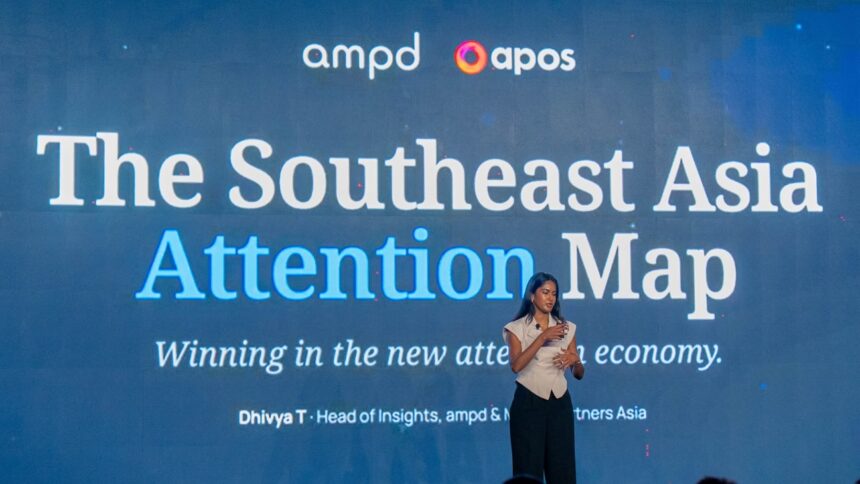
For all the money and content flowing to Southeast Asia, premium video captures a strikingly small slice of the region’s attention — only about 8 percent of the time people spend on their screens. That was one of several surprising takeaways from a presentation by Dhivya T., head of insights at ampd, the data arm of Media Partners Asia, organizer of APOS, who spoke at the Bali conference about how streaming and new mobile-first formats are scrambling to see how Southeast Asia actually uses screen time, and what that means for many of the companies courting them.
According to ampd data, premium VOD users in the region spend about five hours per day on mobile entertainment, with only 8 percent of it streaming — and once their TV screen is included, premium content still only averages about an hour per day. What’s even more surprising is that this share barely moves regardless of the hour — premium video remains steady at 7 to 8 percent each part of the day.
“There is no peak time anymore,” Divya said. Consumers are grazing on social media, messaging, video, premium drama and micro-drama side by side, all day long, with no category having a place in it, she said. She stressed that the important point is not for broadcasters to develop a strategy on how to grow the 8 percent.
“Partition is not a quota to be won, but a need to be met,” she said.
Ampd’s research also found that even long, committed viewing rarely requires full attention, as a third of distinct sessions typically launch a second screen, usually a native app. Divya said that the phone is no better than the TV. Instead, the two operate at the same time, “the committed screen and the disturbed screen, stacked together.”
I divided users’ screen habits into two categories: fast attention versus slow attention. Flash interest — on social media, messaging, and short video — is “served to you,” a collection of quick hits selected by the algorithm. Slow attention is committed, relaxed viewing that the consumer chooses for himself.
“Speed wins the most minutes in the day,” she said. “Slow wins over deep.”
Divya suggested that audiences and brands are now being built in the fast world – and that deeper, meaningful engagement must have its roots there as well. For example, highlighted Back roomsA24’s horror film adapted from a 4chan meme and directed by 20-year-old YouTuber Kane Parsons, which became the studio’s biggest opening ever before going on to gross more than $260 million worldwide.
Divya said the same pattern was seen in Southeast Asia, where the Thai film was released on Netflix Dear killer She rode her co-star Beveren’s reach to 13 million followers on Instagram; And where the viral Indonesian X-threads produced theatrical hits Dusun Might The phenomenon of horror KKN di desa binari.
As she puts it: “Built for the fast world,” but “based on premium.”
This pattern, Divya argued, is why the mini-drama has suddenly become a new and growing streaming format — and the subject of various deals at APOS this week. By combining distinct storytelling structure, serial arcs, and suspense into mobile-first delivery and monetization through pay-per-episode, the format does something new: it builds an audience and charges them into the same layer of fleeting attention. “It collapses oppression,” she said.
Microdrama is “the new top of the funnel for premium films” – a way to capture attention with polished stories, monetize them instantly, while steering the most engaged viewers towards the longer, more premium release. “The fast class is no longer just about building awareness,” she said. “It becomes the place where you start earning.”
“Winning the conversation and culture is key to building deeper engagement, and monetization follows,” she added.
For the studios and streamers in attendance, the presentation also identified winning content, market by market. When a domestic industry has real scale, local stories often trump dominant Korean imports, Divya said. The domestic titles are in Indonesia and Thailand, while the Korean and American titles are still ahead of Malaysia and the Philippines. Among the titles moving within the region, Thai content has the furthest reach, attracting 6.4 million viewers elsewhere in Southeast Asia across all markets and spanning genres from crime and thrillers to horror and romance that kids will love. She added that Indonesian horror is also traveling – strongest in the Philippines, via Netflix – while the Philippines itself looks like the region’s next potential growth market, with proven domestic successes at home but not yet making it abroad.