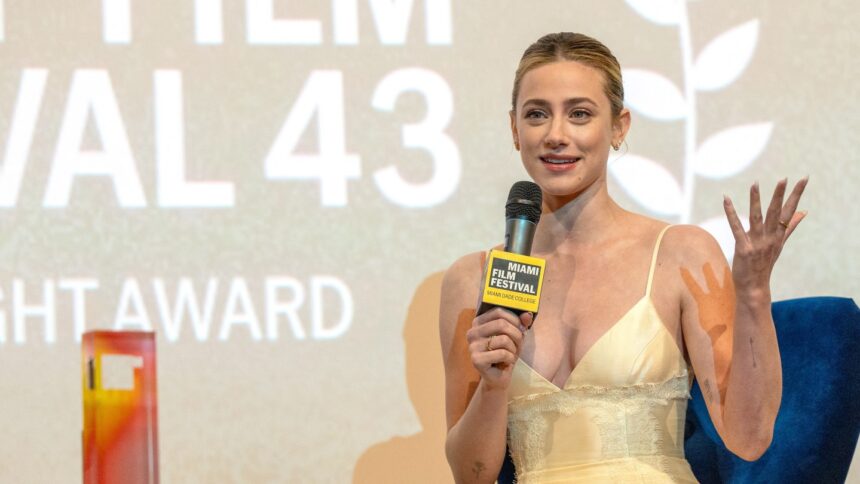
“I didn’t feel like we were creating something that fit exactly into the box,” Lili Reinhart said of her Mubi series. Hull and Harper She received the Art of Light Award during the Miami Film Festival on Monday night. “It was messy and emotional and sometimes uncomfortable, which was the goal. We were trying to tell a story about grief and codependency and love and family in a way that didn’t simplify or exploit any of it. This project reminded me how powerful it is when we allow people to be seen in their full humanity, and not just the polished version, not the easy or lovable version, but the real version.”
Created, written, directed and produced by Cooper Reiff, who plays Hal on the series, opposite Reinhart’s Harper, this eight-episode comedy-drama is as uncomfortably real as the couple wanted it to be, as brother and sister face years of dysfunction in their relationship following news that their father (Mark Ruffalo) will become a father again with his current partner, Kate (Betty Gilpin). The roots of their disturbing sibling dynamic can be traced back to childhood with the loss of their mother, with the duo’s story told through disruptive behavior and flashbacks in which Rife and Reinhart also play 7- and 9-year-old versions of their characters.
After the awards were presented, Reinhart, who is also an executive producer of the show, spoke Hollywood Reporter On the realities of making and selling indie series and why you’ll never play a 9-year-old again.
Cooper said you were the first person he thought of for the role of Harper, saying that casting the character was a matter of “who do I want to follow into this dark tunnel of self-exploration and one’s pain and trauma.” How did he approach you for this role and did you share the same feeling of instantly feeling that you could be Harper?
I got a call while I was on vacation in Hawaii and I was upset because I was getting a phone call on vacation in Hawaii, but it was the best phone call ever. It was my manager who said Cooper wanted us to meet about a show he was doing, and it was kind of annoying that you would be playing the nine-year-old version of yourself. So we went out for coffee in LA, and he kept his cards very close to his chest for this card. He really didn’t provide me with much information up front. He kind of wanted me to find out for myself. So I think he sent me the demo first, which was about 30 pages, and then he sent me the 300-page demo at once, and I was so blown away by that. I’ve seen two other films of his, House of shit and Real smooth cha chaAnd I loved the tone of his work. It felt human and accessible. And after doing something like Riverdale And thinking about what I wanted to do next in my career, this was the perfect tone. I’m always happy when someone sees me in a role that’s not just Betty Cooper. I think that’s just a face value of what people might see me as, and that’s okay. But for a director to see me as something other than that, I find that very interesting and exciting. So the approval was very quick for me.
Tell me about how you play the 9-year-old version of your character and the adult version. What was it like for you in those scenes in front of real children?
Well, as a woman growing up in Hollywood, I’ll never play 9 again (He laughs). No, it was very exciting, kind of like depression Pen 15As you wish. Cooper was playing a real 7-year-old. Young Harper is 9 years old, but she’s a little older than the 24-year-old version of Harper remembers. So it’s not exactly true that when I was nine years old, a little “stumbled” is the word I used. Cooper said it should be older actors playing younger ones because you’re basically watching the same actor and you’re seeing the same eyes and you’re seeing the character’s inner child so you can get a lot of compassion and empathy for their current current experience because you’re really seeing what they were like when they were kids.
You and Cooper spent a year together before filming. How special was this experience for you with the role, and how do you feel that time helped enhance your performance?
We got to know each other a year before filming the show. We went on like a spiritual retreat together, which was so perfect because I think with spirituality, you’re always trying to heal your wounded inner child, and that’s the whole purpose of the show. We were actually going through a breakup, and I said — it was kind of an empty gesture — “Do you want to come with me to Mount Shasta?” It is a very spiritual city in California. And he was like, “Yes.” And I was a little like, “Yes“So we went there together, and yeah, it’s rare that you know someone for that long before you shoot something. And while we were shooting, it was still very intimate. Not only was my partner in the scene, he was very close to it. Some directors are a little bit out of touch. They’re in a tent, they’re remote, they’re in their little room and you can’t have a lot of conversation with them, frankly, which seems a little crazy, but Cooper was there, and I appreciate the access I had to him. I find that rare, so I really liked it.
What went into your preparations?
I read a book called Girls without mothersa kind of explanation of a child’s experience and the role they have to play when they lose a parent or when they take on the role of a parent, whether it’s through the death of a parent or their emotional absence. And if you keep watching the show, it’s clear that you’ll see why and how Harper took on this role in her life. Aside from that, I had little time to practice with Mark and Cooper. At my first rehearsal with Mark, I texted Cooper and said, “I hope Mark doesn’t think I’m the worst actress in the world.” Rehearsal is so hard because it’s really like the bottom of the performance. It’s like a rough draft that you put in the blank to hear the words out loud. It’s not even a small part of what ends up happening, so sometimes when you only have one rehearsal, you’re like, “Oh my God, that wasn’t representative of what I’m going to bring on the day,” but Mark is the nicest guy in the world. And I think he texted me after practice and said, ‘You’re going to be great.’ Very dad energy.
Betty Gilpin’s character adds a lot to the series, in the sense that she’s the only one who sees Harper and the weight she carries from her father and brother, but Harper also has, I think, a healthy space for herself as well. Surprisingly, when you were trying to sell the series, some studios wanted to take away her character and maybe the father as well.
We faced a lot of challenges trying to promote the series overall, as it was very slow for people. I think it was 10 episodes and then it was made into eight. Originally, the show starts with a long montage of Kate, the stepmother and father, and we had to change that. I think in this world full of TV shows, studios don’t respond to slow storytelling. They don’t want to slow down the burn. They want to get right into it. So we were like, “Let’s sing a Sabrina Carpenter song.” You’re doing things you never thought you’d do – and I love that song – but you’re changing the look of the show, frankly, to sell it. At one point, when we thought the show wasn’t going to sell, I was pleading with Cooper, “Can we make this a movie?” It’s like: “No, it’s a show.” So it takes different forms to fit the world we live in now, which is sad, but it’s also amazing to be in places like the Miami Film Festival because it’s a place where things like this can be appreciated. I don’t feel like, “Oh my God, are people bored?” When this screening airs at a film festival. “You’re the ones who will appreciate it the most,” I say. I think it’s even more difficult when people are sitting on their couch and looking at their phone at the same time and trying to connect to a show that requires that kind of your attention. If you look away for a minute, you’ll miss something.
You’ve said before that you’re an independent girl at heart. How do you feel about the scene now and the opportunity for content creators as more independent broadcast TV shows emerge?
I love the indies. I support independent film. I’m always excited and blessed to be a part of them. They are difficult. It’s really hard to make a movie or show that you’re not sure if Whether someone will see you or resonate with them. I’m connected to 10 of them and maybe 2 of them will fire. It’s just kind of reality. Get financing, get financing, film something, it’s a miracle when you can film anything. However, the best scripts I’ve ever read are all independent or never produced, which is sad, but that’s why I will forever try to push these directors I’ve worked with in the last couple of years — I think four first-time feature directors — and I plan to continue to do so. I love to champion new voices and people who haven’t had their chance yet, and that’s how you can find the next great filmmakers of our generation.
What would you say to this room full of emerging filmmakers and aspiring industry professionals about the way forward?
It’s no illusion that it’s really hard to make an independent film, but I find that the best screenplays find their way. They do it, even if it’s because one actor reads it, interacts with it and has the ability to make it happen, or find a great product and stick with it. The advice I would give is not to get discouraged by the amount of time it takes because it will undoubtedly take several years. I don’t want to give the minimum because that might be frustrating. It just takes time, but we’re all in it together. I believe that the more projects you have in the pipeline, the better because you never know when one will be implemented in time and when it will be able to move forward. So I think having your hand in a lot of things is the best way.