In 1986, a fiberglass sculpture of a head-diving shark appeared on the roof of an ordinary-looking house in the English town of Headington, as if it had come out of nowhere. According to the artist who made it, John Buckley, and the owner of the shark-ridden house, Bill Hine, the work was intended to protest the recent bombing of Libya, nuclear power and nuclear war, among other things.
However, art has a funny way of multiplying meanings, often beyond what its creators intended, and the Headington Shark is a case in point. The filmmakers behind the comedy-drama Learn to breathe underwaterwhich recently premiered in Karlovy Vary (and also screened the Galway Film Fleadh near where the film was shot), jumps on the concept of a shark across the Irish Sea to make a different point, perhaps about the absurdity of death.
Learn to breathe underwater
Bottom line He swims in circles.
place: Karlovy Vary Film Festival
ejaculate: Rory Kinnear, Maria Bakalova, Ezra Carlyle, Niamh McCann, Margaret McAuliffe, Vanessa Efidora
exit: Rebecca Fortune
screenwriter: Richard Brabin
1 hour and 35 minutes
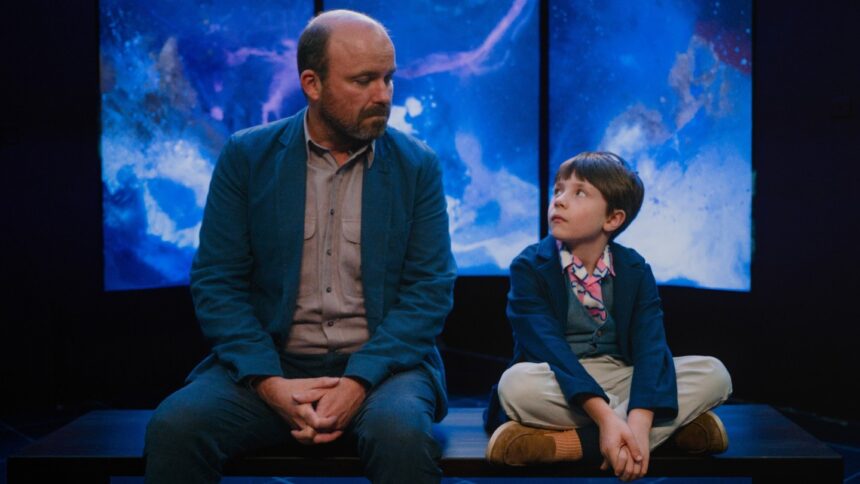
This uneven, more than a little happy but ultimately well-intentioned assemblage posits a bereaved artist (Rory Kinnear) who builds a metal predator on his roof after the death of his wife, right through the ceiling of his young son Leo’s (Ezra Carlyle) bedroom. Bulgarian babysitter played by Maria Bakalova (Borat Subsequent Moviefilm, trainee) joins this strange local administration in order to move the story towards subtle change and eventual closure.
Something doesn’t quite work here, but it’s not easy to tell whether the problem lies with Richard Brabin’s script or Rebecca Fortune’s direction, which seem to be going in opposite directions. The screenplay, Brabin’s first produced script, contains many amusing lines, often spoken by grade-school-aged Leo, a serious young boy whose literal approach to the world and tendency to get stimulated by touching his fingers together when stressed suggests an undiagnosed neurological condition. When Bakalova’s Anya asks what he and his father like to eat, for example, Kenner’s Peter answers that they’ll eat anything. “But it has to be food,” Leo says helpfully.
Young Carlisle’s deadpan delivery really makes moments like this sing. Likewise, small snippets of stop-motion animation work, as if to illustrate the strange and wonderful world inside Leo’s head, add a sense of eeriness, reminiscent of the early work of Paddington Director Paul King likes his film a similarly dark comic Rabbit and bull.
Unfortunately, the narrative here doesn’t maintain its forward momentum, the flights of fancy start to dry up, and the back half of the film descends into clunkiness, with a completely manufactured conflict between Anya and Peter seeing Anya move out and things fall apart. At this point, it looks like the error might lie with Fortune’s command of the tone, but another pass of the text certainly wouldn’t go amiss.
What’s less controversial is the quality of Keener’s performance, a fine study in initially comic understatement that morphs into a finely circumscribed portrait of barely stifled pain. The scene in which he plays his late wife’s piano and begins to cry silently is heartbreaking, and another reminder that Kinnear is criminally underutilized in both British and Irish cinema. Considering that he’s constantly being hired to play tough or weird supporting characters (see, for example, his British officer in TV shows). Say nothing) or in the case of a horror feature menall tough, weird male characters that aren’t Jesse Buckley, but this movie proves he can pull off a lead role effortlessly.
Since most of the action takes place inside Leo and Peter’s home, special attention was paid to the production design, overseen by May Davies, which brilliantly uses color and costume to illustrate where Peter’s head is in any given scene. The chaos ebbs and flows like the tide, reflecting the chaos of the spaces where artists live, homes often on the cusp between strange and unbearably chaotic.