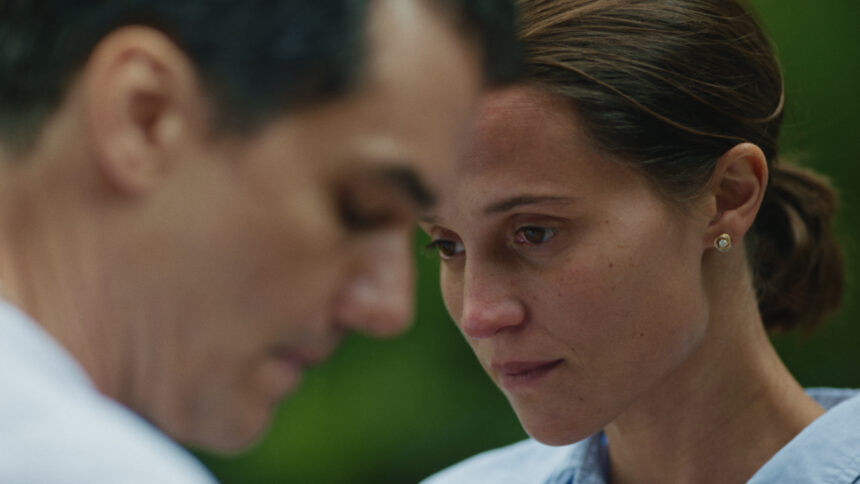
It often takes 1 second while watching Last daythe debut feature film from writer-director Rachel Rose, shows exactly what we’re looking at.
An extreme close-up of the fur at the end reveals it to be a deer. The white light bouncing off a smooth surface turned out to be the hood of an SUV. A blur of red and white slowly comes into focus as a display of canned meat.
Last day
Bottom line A pair of strong performances.
place: Tribeca Festival (Featured Narrative)
ejaculate: Alicia Vikander, Victoria Pedretti, Wagner Moura
Director and screenwriter: Rachel Rose
Rating not available, 1 hour and 39 minutes
Until these images resolve themselves, we’re lost, out of sync with a world we should know but never seem to quite understand—unlike the novel’s protagonists, Julia (Alicia Vikander) and Taylor (Victoria Pedretti), mothers who don’t seem quite at home in their lives, either. Loosely inspired by Mrs Dalloway, Last day It delivers a look at the perils of modern motherhood that is most powerful for the precision of its eye and the sensitivity of its performance, even as its narrative leans toward ambiguity.
The film, which premieres in Tribeca, borrows the basic structure of Virginia Woolf’s classic. (In this, Last day He’s not alone on the festival circuit – Neon premieres in Cannes Clarissa The action moves to modern-day Lagos.) In a busy suburb outside New York City, Julia sets out to run some errands before her annual Fourth of July party later that night. At one of her first stops, a bakery, she meets Taylor, an exhausted mother on the day of her own mission, but doesn’t interact with her.
Julia picks up the wallet that Taylor dropped in the parking lot, and mentally adds “return wallet to address on driver’s license” to her to-do list. but Last day He is not interested in this direct intersection of their lives—so much a glimpse of it is hardly a passing blip for both women—as he is in the ways in which they compare and contrast on a thematic level. Known for her video installations, Rose relies more on stunning images and sound than driving storytelling to cast her spell, resulting in an experience whose impact is more easily felt than explained.
For Julia, a promising writer who has not written anything since marrying and having a child more than a decade ago, this Independence Day becomes a bridge between the ghosts of her past and the possibilities of her future.
She has a chance encounter with her novelist ex-boyfriend Peter (a vivacious Wagner Moura), which sours when they return to what feel like often-recurring arguments about the choices they’ve made regarding career and family. A meeting with her literary agent, Eileen (Maren Ireland), is an uncomfortable reminder of how long it’s been since she’s tried to create. A visit to her father’s apartment, now for sale, brings up renewed grief over his recent death and bittersweet memories of the mother who abandoned her.
By contrast, Taylor’s day, which takes her and her newborn from the pediatrician’s office to the local library to the grocery store, feels like she’s stuck in an unbearable present. We get only the barest hints at her history for most of the film, and no reasonable sense of what she envisions for herself. Even the brief flashbacks cut during an emotional moment for Taylor belong not to her but to Julia — as if Taylor has become so disconnected from her existence that she doesn’t have any of her own memories of being a new mother singing her baby to sleep.
What is clear, from the first moments of Pedretti’s extremely raw performance, is that this is a woman in crisis. Costume designer April Napier places Julia in a firetruck-colored sweatshirt, which, amid New York’s elegant, tree-lined streets, seems almost as incongruous as the sirens that occasionally pierce the idyllic soundscape. But Pedretti holds Taylor in the hesitant, almost tentative pose of a woman who would disappear into the ether at once.
When Taylor speaks, her words smack of desperate concern. But Pedretti is the most devastating of all Taylor’s moments no Response: Not when her husband is called into work in her time of need, not when the security guard asks her to recheck her groceries, and not when her psychic tells her she just needs to be patient with her new medications. These people (mostly men) seem to accept her obedience as proof that she is okay, or at least not bad enough to cause any problems. As for us, it reads cumulatively as the emptiness of a woman who has absolutely nothing left for her.
This tendency toward under-reaction, socialized into these women by a society with limited interest in their true feelings, is also key to Vikander’s finely tuned performance. When her husband’s younger colleague calls her an “adult,” or Ellen cheerfully declares her “respect” for stay-at-home mothers (“I couldn’t do that!”), Julia maintains a façade of perfect social grace. But we can feel the anger or frustration boiling underneath us, having gotten to know a less guarded version of her during more private moments.
However, it is different for Julia than it is for Taylor. Although Julia may have resigned herself to the miserable life of an upper-class wife and mother, she feels enough excited when Peter suggests she could have kept writing if she wanted to, to feel embarrassed when Elaine asks what she’s been working on—and, late in the film, to succumb to dread as fireworks fill the sky.
Over and over again Last daythe characters struggle to make sense of their current states. “I’m very surprised at where I’m at,” Julia admits to Peter. “It’s my fault. We’re trapped and I can’t get them out,” Taylor’s husky voiceover goes in the middle of an emotional spiral. Even their surroundings are not immune to this confusion. In the first scene, a baby deer stares at its dead mother on the side of the road, looking around as if trying to piece together what happened.
Last day He has no answers to these implicit questions, or at least no neat answers. What he possesses is the curiosity to observe his characters’ disillusionment, the empathy to engage in their complex feelings—and the imagination to find understanding toward the transcendence inherent in the mundane.