It’s 5:45 a.m. on a Tuesday morning, and the Home Depot store on Sunset Boulevard in Hollywood is already crowded. I’m standing in Corridor 18—deep in the wood section of the cavernous space—to evaluate the gypsum compound installations. I was sent here to get a 50 pound bag containing “40 Minutes”, a can of “Red Dot”, a can of “Green Dot”, a roll of drywall tape, and a roll of “Frog” tape. To be clear, I don’t know what any of these things are.
The last time I woke up early for work, I was on set bar cooper (the Emmy-nominated sitcom she co-created for AMC), trying to convince our star, Rhea Seehorn, that one of the jokes I wrote for her character would be funnier if she said the phrase “anus face” instead of her preferred choice, “anus face.” (Rhea eventually agreed to this, and to her credit, there is no end to it.)
In the intervening months, Hollywood has endured actors’ strikes, writers’ strikes, an escalating production exodus, and a contraction in content precipitated by the economics of streaming and the rise of creators on media platforms like YouTube and TikTok. I lost my job at a production company, and my show was cancelled. After a 30-year career in Hollywood where she held executive positions at companies such as Anschutz Entertainment Group and Phoenix Pictures – where she wrote, produced and directed award-winning films and television programmes opinion and Afternoon delight -I am now a construction worker.
Like bankruptcy, as Hemingway quipped, my construction career happened gradually and then all at once. I spent the first year after my layoff clinging to the Hollywood dream. My old company, Whitewater Films, hired me to write a sports comedy. Reckless people – About an old hockey player who is forced to play for a cartel in Mexico City. Everyone loved the script. Ian Jeffers (grey) and wrote a supernatural pilot about special operations forces in post-World War II Germany tracking down Hitler’s nuclear weapons. Everyone loved the script!! I wrote a horror movie, VegetablesI planned to direct. OMFG. Everyone loved the script!!!
Unemployment collected. I started a YouTube channel (Cross-eyed chefAnd I wrote my memoirs, Subah Ritz. But increasingly, my calls to Hollywood went unanswered, and it became clear that despite all the kind words about my work, I couldn’t pay the rent (and my 18-year-old son’s college tuition) on praise alone.
It’s been a quick and frustrating descent, but one I think I always expected. Over the years, Hollywood’s grim reaper had actually gotten to many of my colleagues — forcing them to pull their children out of private school and move home. My phone number wouldn’t come up one day. Furthermore, Hollywood has always made me feel like I have no real value. As an executive, you sit at your desk trying to catch falling knives, wondering which one will deliver the killing blow. You have almost no control over it. Being a writer is even worse. What’s more, the city made it clear to me that I didn’t have the right things. As a studio head once told me in a job interview, “Affection is worthless in this town, Nick.” What if I wasn’t friendly? When I lost my job and my show, it emphasized the way Hollywood has always made me feel. It’s worthless.
Fortunately, during that first year, my brother-in-law — a master cabinet maker and general contractor in Los Angeles (and one of the all-time great guys in the Dudedom complex) — contacted me about overseeing the renovation of a house in Los Feliz that he had purchased as an investment. He was planning to refit the gut, and wanted me to keep an eye on it, handle some administrative work around town if I allowed it, and make sure the crew had all the supplies they would need for the work planned for the day. I knew nothing about construction, other than a few projects I had done on my house, so I said yes.
Every day after writing for a few hours, I would step out of the active world of my characters and inciting events—coffee meetings and trackpads—into the masculine world of construction. I won’t kid you. It was scary. Sahri’s team consists of men from all over the world with experience in carpentry, construction, painting and electricity. They can dump 90-pound bags of concrete onto the bed of the truck as easily as I use it to sip latte. They speak the language of Romex wires and five-and-a-half-inch double panels. I can’t tell the difference between a jackhammer and a skill saw. I stumble onto the job site—a minefield of unfinished concrete footings and drainage ditches—dressed in my khakis and deer gear like a burlesque dancer navigating the ruins of the London Blitz.
From the beginning, a large portion of my job was sent to Home Depot. People of color won’t go there these days because ICE has effectively been suspended Habeas corpus order For anyone who looks like they might be undocumented. But someone on every construction crew must endlessly haul supplies from the lumber yard to the site. This job fell to me, and I sucked at it. After each tour, Ramon, my construction foreman, would address me in broken English because I had bought the wrong thing. Even when he sent me pictures of exactly what he wanted, I always got it wrong somehow.
“You need to check again,” Ramon pleads. “You need to ask for help!” I try to accept his criticism graciously, but it’s not easy. “My show was nominated for an Emmy!!!” I want to scream. But when I express my frustration, I have to listen to the entire crew taunt me in Spanish that they know I can’t understand. I suppose if I had hoped to feel less valuable, taking an entry-level position in a blue-collar industry where the preferred language was not my mother tongue might have been the wrong move.
Clearly, however, I had not made every mistake, because three months into the job, my brother-in-law called me to the job site one morning, offered me a promotion, and assigned me to take a crew to a famous Hollywood music venue to scrape and repaint the monumental landmark in anticipation of its official unveiling and celebration of its 40th anniversary. He also asked me if I would be willing to help him oversee the rehab of the Neutra Jewelry Box in Bel Air, a two-bedroom Spanish townhouse in West Hollywood, and the gut renovation of an Eichler split floor in Thousand Oaks. I was in no place to turn down this opportunity. My wife — Emmy Award-winning costume designer Mary Schley — shattered her spine in a skiing accident in December, so no one in this household was earning any income for some time. Naturally, I said yes.

Music venue paint is bad right out of the gate. I don’t know what I’m doing, I don’t even know what I’m looking for. It reminds me of my first visits to filming locations when I was walking around the video village praying and no one asked me to do anything. Even the language barrier in the build reminds me of what it felt like to wander past the camera truck and listen to the handlers chatter strange phrases about c-stands, singers, apple quarters, and Duvtyne. I try to use the same strategies I used back then: pay attention, stay positive, and be patient, knowing that it will all make sense in the end. However, I kind of miss the fact that our plaster team – as they scrape and patch the walls of the place – leave droplets under every surface they touch.
One afternoon – after my team had left the site – the man running the club’s VIP room told me there was plaster on his stairs. “Get a mop and clean it.” He tells me. “Now! Toby and Leo are coming.” I don’t have a mop, so at five o’clock on a Tuesday evening I find myself on my hands and knees in the blazing Los Angeles sun, using my own T-shirt to scrape grout from the club’s crumbling steps. “I met Leo once,” I thought to myself, “at Edward Norton’s birthday party at the Wattles Mansion. Courtney Love invited me. And look at me now!”
I want to scream in frustration. I want to cry. I’m so angry that Hollywood has brought me to this level of despair. All services provided What I gave when I was in a position to do so went unrequited in my darkest hours – my direct requests for help were treated as the comical pangs of a spoiled child. Why is no one answering my calls!? How could you find me at the end of my 30 year career cleaning floors? Why wasn’t I taken seriously by my colleagues? Was I too arrogant? Did I not sleep enough?
I feel like an idiot for always believing in myself, and I want to take my idiot bucket and scoop Hailey Bieber juice right out of the hands of every arrogant development executive in town. But on some level, I also feel like this is exactly what I deserve. It is my penance for my incompetence, my apathy, and my failure to attack work with the required psychosis on the assumption that my privileges would somehow help me. Hollywood tells me where I belong.
And it turns out that where I belong is where this story began — in aisle 18 at Home Depot at sunset at 5:45 a.m.
After I’m done shopping, I’m loading my supplies into the trunk of my car when I hear a sad voice offering help. I assume he’s one of the many day laborers looking for work, so I say, “No, thanks,” without looking up. But then I felt a hand on my back, and when I turned around, I was greeted not as a worker, but with the toothy smile of an old TV writer friend.
“What do you do?” he asks incredulously.
I was surprised. “That’s what I do now, for a living,” I stammer. It’s the first time I’ve revealed to anyone in the industry what my life has become. I feel embarrassed, and I feel my lower lip trembling as if I’m going to burst into tears. But when I look up to meet his gaze, I see something I’ve never seen before when I talk about my projects, shows, or career. I’m not even sure what it is.
“Good for you,” he said, looking at me as if he were seeing me for the first time. “This is what my father did when he was growing up!” And I realize that the look on his face is something I rarely see in Hollywood. It’s respect.
As I retreat from Home Depot, I experience a kind of spiritual rebuilding as I feel the many parts that make up myself — father, comedian, husband, Deadhead, tennis geek and now “construction worker” — flow back into the strange mixture that is Nick Morton. Perhaps I was no less for this unexpected turn my life had taken – for my determination not to go broke waiting for a call that might never come. Maybe, even while running around in this wild city, working with a team of guys from all walks of life and meeting the kinds of people you tend to ignore when you hide in your Hollywood bubble, you’ve become something more.
When I arrived at the job site, my crew was oblivious to the beautiful transformation I had just undergone. The grout compound is not correct, and I did not get the correct tape. I thought the “frog” tape was just euphemism for green drywall tape.
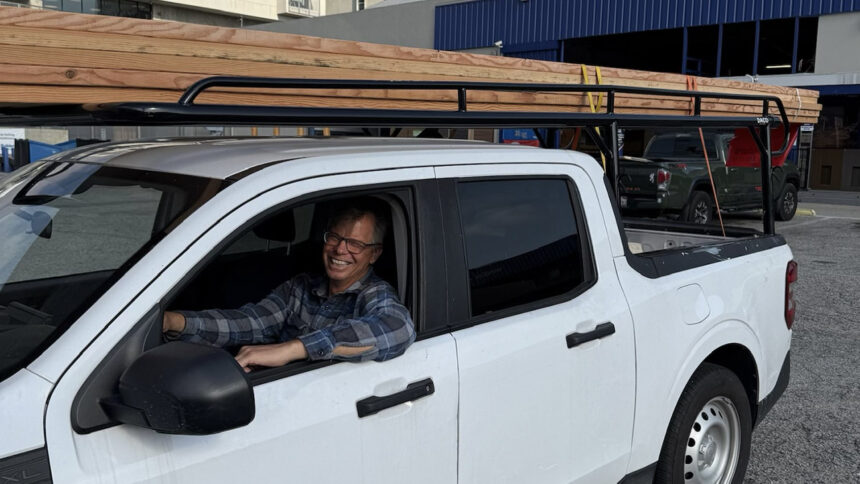
I don’t know if I’ll ever master my new construction job. I’m sure I’ll never understand what I did wrong to make me fail at my previous job, writing for Hollywood. All I know is that after six months of building, my skin is clear, I’ve lost 12 pounds, and I’m sleeping like a teenage boy. I learned a lot about re-rods, sewers, ties, and slurry from Simpson. I can strap a thousand pounds of lumber to the roof of my truck without a second thought. I developed a serious group of men, and I didn’t take anything from anyone.
Although there’s no glory in this business — there’s no red carpet gala waiting for us at the end of the year — there’s no bending or scraping, either. I’m not begging for a chance to prove my worth. Some days, when I’m headed to Bel Air in my beat-up old truck, mariachi music blaring from the radio, the grille of my old F-150 scratching the street bushes and sending wafts of sweet lavender wafting into my car, I wonder why I’m asking for more.
Sure, I get paid by the hour, but I’m in demand here. I appreciate. It’s a feeling I rarely get in Hollywood, and sometimes it’s enough to make me think I’ll never come back.