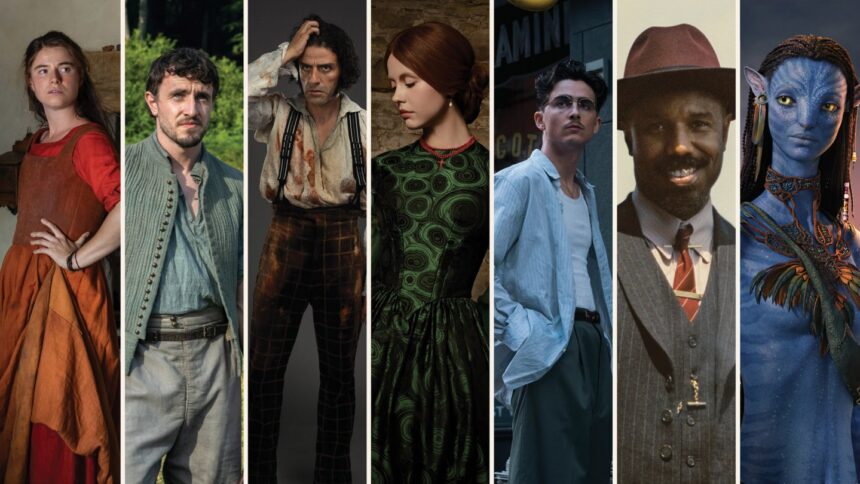
From 16th-century Elizabethan England to Pandora, these artisans share how they brought their creations to life.

This year’s Oscar nominees for costume design sweep us on design journeys to 16th-century Elizabethan England. HamnetEurope and the Arctic in the nineteenth century FrankensteinMississippi Delta in 1931 AD SinnersNew York City in the 1950s Marty Supreme and a 22nd century fantasy world on the moon Pandora Avatar: Fire and Ashes. In their own words, the costume designers behind each film share the stylistic choices that brought these time-bound stories to life, from the “no alterations” rule on set to testing each item of clothing on visual effects models.
Malgosia Torzanska, “Hamnet”

Image credit: Malgosia Turzanska/Focus Features (2); Agata Grzybowska/Focus Features (2) The first conversations between me and director Chloé Zhao were about focusing on the human and personal side of the love story and tragedy of Will (Paul Mescal) and Agnes (Jessie Buckley), as opposed to William Shakespeare and Agnes Hathaway, so I started from the inside out of the characters.
We used the traditional Elizabethan technique called pinking, which is small cuts in the skin, on Weil’s diptychs. The scratches become bigger wounds as he descends into grief and despair, like little silent screams, until the moment we cover him in the cracked mud of the ghost’s gaze at the globe play in the film’s final moments.
Blue-green-gray color connects the will with water. We took the type of iron oak ink that Shakespeare used and diluted it to grayscale. His fingers and clothes were stained with it. All of Shakespeare’s children wear gray quilted clothing as protection to blend into the background and not provoke the abusive father. Instead of a dagger, Will wears a pen (ink tubes and quill) slung across his belt.
Moving away from the strict traditional depiction of nobility, she looked to depictions of peasants and farmers. Illustrator Sebastian Franks creates incredibly dynamic portraits of people that show layers of clothing with movement. This caused Will’s sleeves to be rolled up and the collar to open. Agnes did not wear any padding. She was loose and free in linens and a bra of barkskin, a Ugandan fabric made from tree bark, representing how she belonged to the forest.
Kate Hawley for “Frankenstein”

Image credit: John Wilson/Netflix; Frank Ockenfels/Netflix; Courtesy of Netflix Elements of religion, nature and mythology were all present in the script that Guillermo del Toro had been working on for years, in the language he was creating. Overall, he wanted a melodramatic, operatic atmosphere of melancholy – the emotions you would get from a Caspar David Friedrich painting in Mary Shelley’s new world set in the 1850s.
I had pictures of anatomy, blood cells, fractal patterns, and x-rays on my mood boards. The idea of transparency created layers. We looked at wax models of the 18th century. Guillermo talked about Elizabeth (Mia Goth) being from the world of the Beetles and the world of William Paley Natural theology. We simulated a female hip bone to create an image of butterflies and insect wings in a pattern resembling Victorian damask wallpaper. My first major breakthrough was the heightened sense of color to bring it out of a world known for its melancholy, dream-like tone. Victor (Oscar Isaac) possesses fleeting, ephemeral images of Elizabeth and his mother as distant memories. The hijab also affected that. Because of the single-source lighting and candlelight, getting the colors right was an act of artistic alchemy.
Miliako Bellizzi, “Marti Supreme”
Image credit: Atsushi Nishijima/A24(2); Courtesy of A24 Josh Safdie and I are very real people, so we wanted to make sure the world and characters felt as real as possible. We’ve referenced the photography of New York City in the 1950s by Ruth Orkin and Weegee. There are about 5,000 people in the film, so the sheer size was a challenge. Silhouettes of suits and polo shirts were important. We have made hundreds of polo shirts for table tennis teams from 16 countries. Marty (Timothée Chalamet) was an eccentric, so we wanted to give him nuances from what any other kid of the era was wearing. The sleeves are slightly larger, and the pant legs are wider. Marty’s navy gabardine jacket construction with red piping was the pinnacle of everything I love.
One “aha!” The moment was finding tank tops in the original dead stock box set because that’s something you can’t recreate and needs to be duplicated. People collect T-shirts that look like Marlon Brando, and I always look at them in movies because I know how hard they are to find. Kay (Gwyneth Paltrow) was a dream character. I mentioned great old Hollywood stars like Grace Kelly and Marlene Dietrich, as well as Edith Head and Adrian’s fashions from when she was a star in the 1930s.
Ruth E. Carter, “Sinners”
Image source: Courtesy of Warner Bros. (3) Ryan Coogler’s vision to honor his uncle James, who loved blues music, became the nucleus of the story, set in 1931 in Clarksdale, Mississippi. We brought the red and blue of Smoke and Stack (Michael B. Jordan). I pointed out Ralph Lauren’s work clothes, the beautiful panels of blue denim and Eudora Welty’s photographs of farmers at their handiwork. This is the story of making something out of nothing. I made a “no edits” rule so that everything is perfectly imperfect.
The Smoke Stack twins were working for the Irish and Italian mob in Chicago, so I saw the booking photos. Michael B. Jordan was preparing for both roles, and I gave him a clear description. Smoke wears a four-pocket jacket with a briefcase underneath, no tie, and a denim flat cap. His style is rural working class. His clothes are a little bigger. Stack had a three-piece pinstripe suit with close-to-body tailoring, a fedora hat positioned perfectly on top of his head, a pocket watch and a four-fingered knife. He’s a ladies’ man. Michael says the shoes helped improve his performance: the open toe box of the Smoke gave him a different gait, while the Italian Stack was narrow.
Deborah L. Scott, Avatar: Fire and Ashes
Image source: Courtesy of 20th Century Studios (3) Na’vi fashion is inspired by indigenous people around the world based on their environments Fire and ash It is a burning volcanic landscape. Oona Chaplin’s farang (Oona Chaplin) feather headdress, as a sign of her status as the clan’s toadstool, was the first specific item director James Cameron wanted for her. Body paint, scars and piercings define the Ash People. The gift of working with Jim is that I get to manage all these aspects that complement the whole character. I am the only department that builds the final products for every piece you see in the film, from costumes to hand props and hairstylists, as well as live action performance capture suits.
With the craftsmen at Weta Workshop in New Zealand, we build each piece, from the apron to the necklaces, And even human size and delivered to Weta FX. They scan it and their artists start designing it. We then virtually fitted samples onto a 9-foot blue body, creating the costume a second time in a virtual fitting room. We film tests for each piece related to dancing, swimming or flying and hand them over to the animators and simulators so they understand how the costumes move, because that is the caliber and demand that Jim has. As a scientist, proof of concept is very important to him.
This story first appeared in the February standalone issue of The Hollywood Reporter magazine. To obtain the magazine, click here to subscribe.


THR Newsletters
Sign up to get THR news straight to your inbox every day
Subscribe subscription