Cocomelon It is a juggernaut of educational content for children, with Cocomelon: The Movie It’s scheduled to hit the big screen in February 2027 thanks to Universal Pictures. and Blippi It is also a favorite among children and parents alike.
But Moonbug Entertainment, the kids IP powerhouse behind these two and other brands acquired by Kevin Mayer and Tom Staggs’ Candle Media in 2021, doesn’t just talk about the popularity of its shows. It also raises alarm bells about the expenditure gap affecting family content and children.
Daniel Hewitt, co-founder and global head of business and partnerships at Moonbug, was at Cannes Lions last week to meet with existing and potential partners. Make time to talk to him Hollywood Reporter About the popularity of children’s content, how that’s not reflected in its advertising power, and what’s next Cocomelon film.
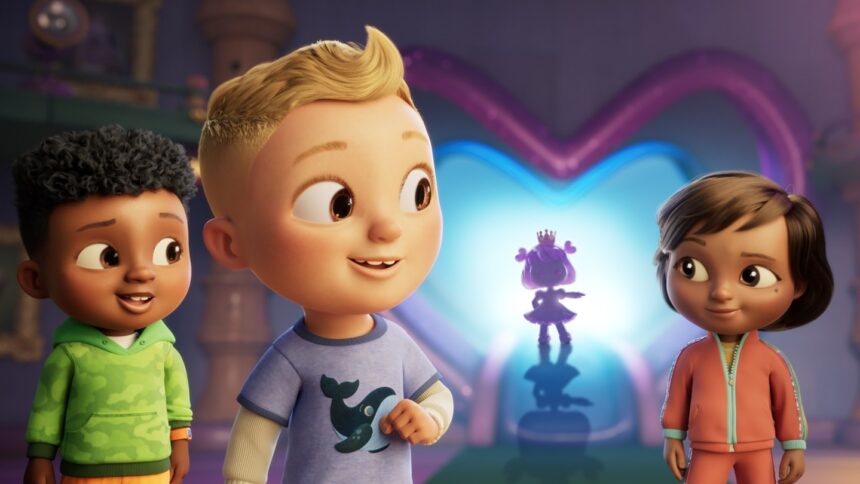
He says constant innovation is key, as are the recent spin-off series Amy’s amazing closet is an example of this. “We just took a great character out of a world Little angel For the new show Amy’s amazing closet“Which is really exciting,” Hewitt says. “But the reality is that the children’s and family media environment is really challenged in terms of investment in content. “That’s why I came to Cannes Lions because we’re calling on the industry to recognize this media sector and help rebalance the disconnect and imbalance.”
He points to a gap highlighted by the data. “25% of total screen time in North America is focused on kids and family content, but it represents only 4% of advertising investment,” the executive says. THR. “It’s a dilemma.”
How does Hewitt explain this? “Cable TV networks for kids and families were incredibly valuable, with huge amounts of ad spend across all different categories, because they provided a great, safe environment for the brand, and it worked,” he explains. “And that family viewing hasn’t changed. The change has come through advertising and data technologies in the world of compliance and the Children’s Online Privacy Protection Act (COPPA),” which regulates the collection of personal information from children under 13.

Such protections are “incredibly important, valuable and necessary, but the implications of COPPA are that the bulk of media in terms of pure consumption, kids and family, is completely removed from modern advertising practices and technologies,” Hewitt says. “The reason I’m in Cannes is to advocate and campaign for advertisers to re-engage, reflect and understand why they show up. Because when they do, they succeed, they’re effective, they’re great.”
Everyone who has children or friends with children knows how important content is to them and their parents. But Moonbug’s CEO says advertisers and others sometimes think of parents as a niche audience. “Parents are not a niche audience at all. About 60% of millennials are parents,” Hewitt says. THR. “Nearly 30% of Gen Z are parents. In the United States, there are 40 million families, and that’s not a niche audience.”
Moonbug has conducted and released studies to delve deeper into this audience. Among the latest findings: “Mom guilt,” a common cultural shorthand for parental pressure, is real, but fathers endure more. For example, a recent Moonbug study, “The Next State of Parenting,” found that 53% of fathers compare their fathers’ style with what they see online, compared to 37% of mothers. He highlighted: “Yet much of the marketing aimed at parents is still heavily skewed towards performance, achievement or aspiration. Very little says: ‘You’re doing enough.'”
“Hollywood and the advertising industry need to wake up because those 40 million families have a very different media consumption pattern and behavior that is dominated and dictated by children. Parenting is also more stressful and stressful than I can imagine at any time in history,” Hewitt concludes, so brands have a role to play.
Speaking of toys: Cocomelon A new stadium was opened – The Big Screen. How does the upcoming film, produced by Universal’s DreamWorks Animation in partnership with Moonbug and Flywheel Media, fit into Moonbug’s traditional digital-first strategy? “There’s been a ton of interest, and the fact that the team at DreamWorks Animation has been so excited about it is amazing. Everything we’ve seen looks amazing. It’s an incredibly validating moment for us, because I think it’s the embodiment of everything we’ve been doing, as a company, day in and day out.”
Hewitt concludes it Cocomelon: The Movie: “It will be a wonderful expression and evolution of the universe Cocomelon. This will surprise families in many different ways, but not at the expense of showing up every day the way families need us to.