He was called the anti-paperboy.
Steve Vitolo first came from Boston to Los Angeles as another writer with a dream, starting out as an assistant when he began noticing a disturbing trend on set. “On that one show, we kept printing a revised script every night for over 100 people, 50 pages. So, every night, there were literally 5,000 sheets of paper that would be out of date by the next day,” he recalls, as he was assigned to deliver the script.
That was more than a decade ago, when every new line of dialogue or director’s note resulted in huge amounts of paper being wasted – and others around him also paid attention to the problem, without much of a solution. Which prompted Vitolo to continue writing For offers including blackish and Hot in ClevelandTo ask: “Why do we write texts digitally and then print them on paper? Who uses paper now? We all use computers.”
So Vitolo — who already had a love of technology and a background working on websites — co-created Scriptation (and now serves as its founder and CEO). The software allows actors, directors, writers and crew to take notes and mark up their digital scripts with those annotations easily migrated into revised versions. The app also enables people to add photos, voice memos, and many other personal features to their documents – making it attractive even to those who don’t necessarily make a choice for sustainability but are drawn to the ease. It has always been this two-pronged approach, looking to solve both production and environmental problems and reaching beyond just an environmentally conscious society.
The company was launched in 2016 and gained traction during the coronavirus lockdown, when people had a moment to learn new technology. It took a while, trying to transform an entire industry one by one — what Vitolo described as “this comprehensive thing” — but the word slowly spread, and today it has 25,000 monthly active users in more than 50 countries.
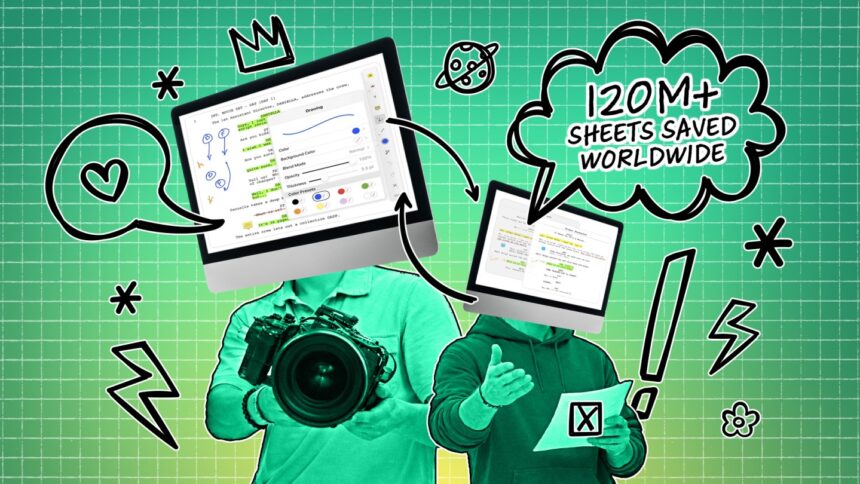
From April 2023 to this April, Scriptation users removed more than 120 million sheets of paper from production batches worldwide, according to Vitolo; This equates to a total of 48 million papers last year alone Preserving more than 5,700 trees, conserving more than 5 million gallons of water and avoiding 3.3 million pounds of carbon dioxide emissions. On a personal level, every Earth month, starting in 2024, Scriptation will send users a Green Impact Report (similar to Spotify Wrapped) to estimate their personal water, waste, and carbon savings.
And there are new innovations coming, as Scriptation this spring launches Playback, a feature that allows users to listen to text read aloud with customizable voices (via artificial intelligence). This comes at the request of executives who want to review texts on the go and save themselves from reading on paper at home.
Word of mouth and listening to industry feedback has been key to Scriptation’s success in Hollywood, with Michael B. Jordan, Kathy Bates and the teams behind it. Hacks, Ayman and Saturday Night Live As gushing supporters.
Hacks Co-creator Lucia Aniello — who, along with her co-showrunners Paul W. Downs and Jane Statsky, has long been committed to sustainability on the show — says she learned about scripting through her assistant director and was drawn to the program’s organizational advantages and the fact that “I always felt like there was a lot of paper waste” on sets. “There will always be something nice about having a physical text in your hand, but with the endless revisions required, it seems irresponsible to type it out every iteration,” she adds. “Let’s save the trees for the first and last drafts, in my opinion!”
Jennifer Fang, director and member of the DGA’s Sustainable Future Committee, became aware of the program from a VFX supervisor on one of her groups and was impressed by the way “everyone was walking around with their iPads taking notes; they looked so cool, and everything was so clean and cohesive.” Although she acknowledges the extra step of having to make sure the iPad is charged every day, Fang uses it in her projects – Which includes episodes of Boys and Flight attendant — For years, he adds, “If you see all the paper distributed in any given production office, it can be a lot. You can save reams and reams and reams of paper by going paperless in production.”
Scripting has also spread its gospel through Hollywood guilds and various other industry organizations, organizing educational webinars and giving presentations. Last year, the company launched a brand ambassador program with 40 entertainment professionals and partnered with Green Rider, a UK-based movement that seeks sustainability on film sets.
The Green Rider campaign was co-founded by actress and writer Danusia Samal (The Great) is a convention — largely focused on travel, energy, waste (where text comes into play), food and storytelling — that “is sent into production when the job is offered or as part of the deal process,” Samal explains. It’s not a formal contract but an approach to using the talent’s influence to make sustainable changes on set. Olivia Colman, Benedict Cumberbatch, Bella Ramsay and Dragon HouseEmma D’Arcy is among the stars to have signed, and Green Rider is looking to expand into the US soon after discovering a way to make sustainable commitments more solid.
Although it has improved over the past decade, it has been a challenge to rid Hollywood entirely of paper.
“Anyone out [the industry] It would be like, “Why are we still using paper texts?” “But it’s very popular, and that’s honestly our biggest competitor — paper,” Vitolo says. “It’s the way it’s done, and the industry is a little slow to evolve. He was [visiting] Children’s shows, children have paper scripts; It’s like, “But they’re the ones who talk on their phones all day!” “
In 2022, Script launched a pledge – with the participation of several major stars and directors – to make Hollywood paperless by 2030, and its founder is confident the industry can achieve this, although he sees some still using paper scripts as a “crutch” and resisting the push to learn new technology.
“If people are set in their ways and their workflow, you don’t want to say, ‘You have to do this,’ because that’s bad too,” Vitolo says of his approach. “It’s like, ‘Here are all the reasons why you should do this,’ and you just have to make them feel like this is the obvious choice.” There’s still a battle trying to move people away from their scripts that they hold so tightly to. But we are working on it, and I am not against exposing them.”
This story appears in “Hollywood Reporter”Sustainability issue for 2026. Click here to read more.