Imagine a remote area of Alaska finally being connected to the internet, and you can witness it! interested? If so, are you wondering what this change will mean for the islanders? Director Ian Purnell has covered both fronts with his debut film Arctic Linka documentary of epic proportions in more ways than one.
The film has its world premiere on Monday 16 March in the main competition program of the Copenhagen International Documentary Film Festival CPH:DOX, whose 23rd edition runs until 22 March.
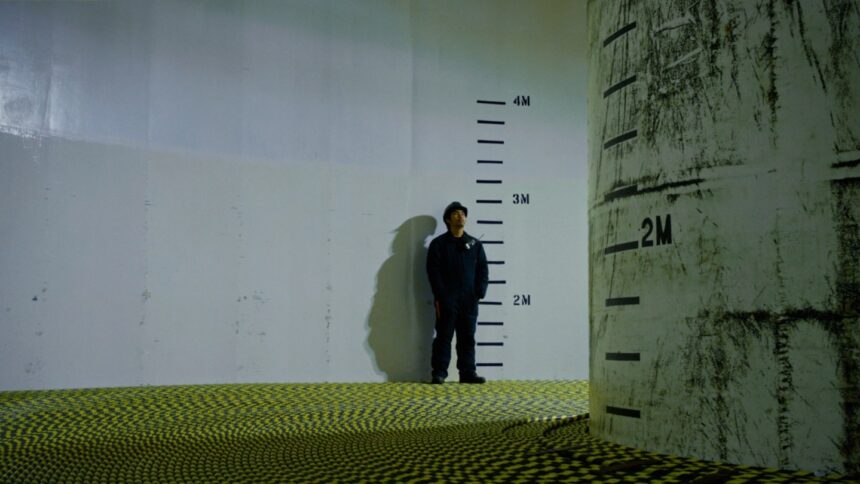
Remember how we mentioned the doc was epic? “In the Arctic Ocean, a massive ship drifts as thousands of kilometers of fiber-optic cable slide from the deck into the dark depths of the sea,” the film’s synopsis reads.
If you need further proof of the scale of the project, let’s just mention that the director has been working on it for almost 10 years. The CPH:DOX website highlights this Arctic Link: “Everything is massive – from the massive cables to the massive visuals and sound design – but the human scale never disappears from view.”
The looming digital change coincides with the ship’s Filipino crew members drifting into isolation, with their cell phones their only connection to home, if they are working.
“When I first discovered a map of the world’s submarine cables, the Internet suddenly took physical form,” Burnell said in a director’s statement. “I felt a strong desire to trace these hidden roads – to see how the network disappears under the sea and to meet the people who build these connections. I wanted to understand this infrastructure that usually remains invisible, and I realized that I could only engage with it emotionally and not in a purely technological sense.”
Produced by Franziska Sonder, Arctic Link Featuring cinematography by Mary Zaher. The editor is Chris Wright, while the sound and music come from Tobias Koch. Ensemble Film is handling sales.

Check out the trailer for Arctic Link Here, which addresses the question of whether the Internet will become a savior or a monster. It actually starts with a statistic that might surprise you: 99 percent of Internet traffic goes through submarine cables.
In a conversation about Arctic LinkBurnell shared with THR How he approached bringing the Internet to life in visual and audio ways, the challenge and joy of document scaling, and what he wants to do next.
He was Arctic Link Really a decade in the making? “I had the original idea over 10 years ago, and very early on, I researched where I could get on one of these ships,” Burnell recalls. “It turned out to be very difficult to build relationships with these companies and for them to have a reason to take my position.” There were several opportunities for him to board the ships under discussion, but things kept coming up, like the storm, the canceled cable project, and the coronavirus. “So, getting to the film required a lot of patience,” the director concludes, asking him and cinematographer Zahir to remain “very flexible.”
Shooting in a remote area without internet also presents a challenge in building a relationship with the locals. “It was very important to be there and establish relationships in the village,” Burnell says. THR. “Things went very quickly once we got there, but preparing in advance was very difficult.”
Purnell was impressed by the awareness of the Alaskans he met about the changes the Internet would bring. “It was a very wise perspective,” he says. “They were not innocent. They knew what it was and what it would bring [with it]But they can also see it from a slightly outside perspective, which is hard when you’re as ridiculously immersed in it as we are.
Purnell didn’t even need to force the issue. “Once we got off the ship and got to the island, all these conversations started flowing,” the director recalls. “Everyone had this awareness that this ship was bringing you the Internet. It’s a different kind of awareness that a lot of us don’t have, because you don’t see this ship that’s bringing you the Internet in front of you. So, these conversations happened naturally. I didn’t want to impose my concept on them: ‘Now, talk about the Internet!’” So, I was happy that this was just a natural topic of discussion, because they saw it right in front of them, heading toward them.

How did the creative team approach depicting the Internet aesthetically? “For me, it was really important to find a new visual connection to the Internet,” Burnell says. This meant that he was not happy using server images and keyboards over and over again. “I was really interested in creating these new images that were surprising to me. In contrast, the ship was built in the 1980s, before the World Wide Web existed, so we get the smell of oil and this steampunk aesthetic rather than high-tech images.”
His conversations with cinematographer Zahir touched on elements of zoological discussions. “We really tried to make inanimate infrastructure look alive by depicting the cable like a snake, for example,” Burnell explains. “We would often talk about what kind of animal something could be, like a whale. How can we make these physical objects feel more alive? These discussions helped us make the technical objects become or act as protagonists, creating a more emotional connection, or a sensory connection, rather than just a rational, technical connection.”
All of this was central to the filmmaking process that fascinated and fascinated him. “The challenge was to make a film about something invisible and create an image of it,” Purnell says. THR. “The fact that he is invisible also creates different stories around him. Different people who have a connection to him have to use their own imagination, creating a large number of stories.”
Given the epic size of Arctic Linkyou would think that Purnell might want to turn small after this. mistake! “I’ve already done some research on astronomy topics, especially regarding black holes,” he says. “What fascinates me is the image of a black hole, because it’s something that can’t be captured in a photo. It’s all at a very early stage. But whether it’s the Internet or astronomy, I’m really interested in all these signals and waves. So, with a film about outer space, I’ll take a similar approach.”