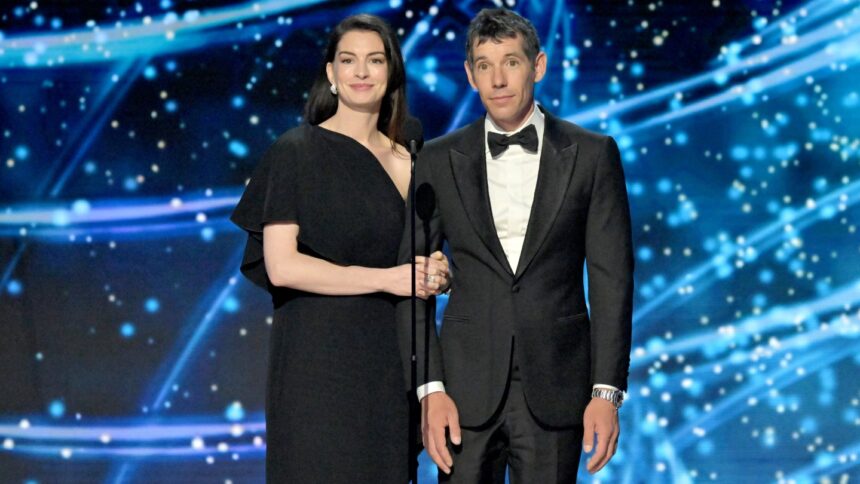
On Saturday, April 18, the world’s leading scientists and mathematicians joined Hollywood’s biggest stars in Los Angeles for the 12th annual Breakthrough Prize Awards – often referred to as the “Oscars of Science” – to celebrate outstanding scientific advances and the people who make them possible.

Founded in 2012 by tech giants Sergey Brin, Mark Zuckerberg, Priscilla Chan, Julia and Yuri Milner, and Anne Wojcicki, the Breakthrough Prize was created to honor the achievements of the world’s leading scientists, awarding approximately $15 million in prizes annually. In 2026, six Breakthrough Prizes worth $3 million each will be awarded in life sciences, fundamental physics and mathematics, bringing the cumulative amount awarded over its 15-year history to $345 million.

The annual ceremony was a star-studded affair that put science in the spotlight. Actor and Emmy Award winner James Corden returned for the fifth time to host the evening, with legends like Gigi Hadid, Lily Collins, Anne Hathaway, and Tom Hanks (who shared a video tribute to the late astronaut Jim Lovell, whom he portrayed on film). Apollo 13) Give awards and provide feedback all the time. Other new names who have been generating buzz all year were also in attendance, such as Olympic freestyle skier and model Elaine Gu, OpenAI CEO Sam Altman, Spotify CEO Daniel Ek, and Waymo CEO Tekedra Mawakana.

Academy Award-winning actors Octavia Spencer and Sean Penn kicked things off by awarding the Life Sciences Breakthrough Award to Stuart Orkin and Swee Lai Thein for their research that transformed sickle cell disease and beta thalassemia from incurable conditions to treatable conditions through gene editing therapy. While accepting the award, Thein poignantly said: “When I was a child playing on the old railway tracks in Malaysia, I never dreamed that I would be here today.”

In life sciences, Catherine A. Hay and husband-and-wife team Jean Bennett and Albert Maguire developed the first FDA-approved gene replacement therapy that restored sight to patients born with Leber congenital retinopathy—a rare hereditary retinal disease that usually leads to total blindness in early adulthood. Other awards were presented to Rosa Rademakers and Brian Trainor for independently discovering the most common genetic cause of both amyotrophic lateral sclerosis and frontotemporal dementia – a recurrent expansion mutation in the C9orf72 gene.

During the show, scientist and physician Yentley Soto Albrecht — who carries the same genetic mutation identified by Rademakers and Trainor — took the stage in a moving speech and spoke about her father, who died of amyotrophic lateral sclerosis: “My father and I share a genetic destiny, but I am changing my future.” “The scientists honored here tonight have discovered our genetic mutation. They have mapped the battlefield; now we can wage war.”
Notably, Olympic gold medalist Elaine Gu and five-time world chess champion Magnus Carlsen also honored Anthony Hayman and Clifford Brangwyn with the Life Sciences Breakthrough Award for their pioneering discovery of a fundamental new mechanism of cellular regulation. The award was actually presented in 2023, but the duo was unable to appear at the ceremony due to the Covid-19 pandemic and accepted it this year.

The Fundamental Physics Prizes were given to the Muon g–2 Collaborations at CERN, Brookhaven National Laboratory, and Fermilab, in recognition of decades of work by scientists around the world who have pushed experimental precision to extraordinary levels in measuring the muon’s anomalous magnetic moment, a key test of undiscovered particles and forces. During the performance, the ballerina suddenly appears on stage, twirling and twirling, providing a creative manifestation of the muon’s rotating magnetic moment.
Breakthrough Prize co-founder Yuri Milner and NVIDIA Founder and CEO Jensen Huang announced the Vera Rubin New Frontiers Prize, a brand-new physics prize that honors female physicists who have recently completed their PhDs and are already making important scientific contributions. Named after astronomer Vera Rubin, who discovered the fundamental evidence for dark matter, this year’s inaugural prize goes to Carolina Figueiredo, who has already revealed hidden relationships between quantum field theories.

As the finalist in Fundamental Physics, award-winning actresses Michelle Williams and Lily Collins shared the story of Special Breakthrough Prize in Fundamental Physics winner David J. Gross, emphasizing his intellectual family life, the discovery of Einstein’s book on physics, and six subsequent decades of important contributions. While accepting his award, Gross spoke about how “a scientific discovery, once made, belongs to humanity forever, through the journey of theoretical physics – and challenges us to use it wisely.”

The only Breakthrough Prize in mathematics went to Frank Merle for his transformative work in nonlinear evolutionary equations—mathematical descriptions of how waves, fluids, and other dynamical systems change over time. Merle’s insights overturned fundamental assumptions in the field, including the surprising discovery that equations long thought to be stable can in fact explode in a finite time.

The ceremony also included dazzling musical performances by Grammy Award-winner Lionel Richie, who performed his international hit “We Are the World” alongside a choir of children in attendance, and soprano Renee Fleming, who sang “Hallelujah” accompanied by composer and pianist Billy Childs in honor of the great scientists who passed away during the past year. Pop icons David Guetta and Ava Maxx then closed the show with “Forever Young” as all of the Breakthrough Award winners took the stage to a final standing ovation, bringing the sparkling evening to a lively conclusion.