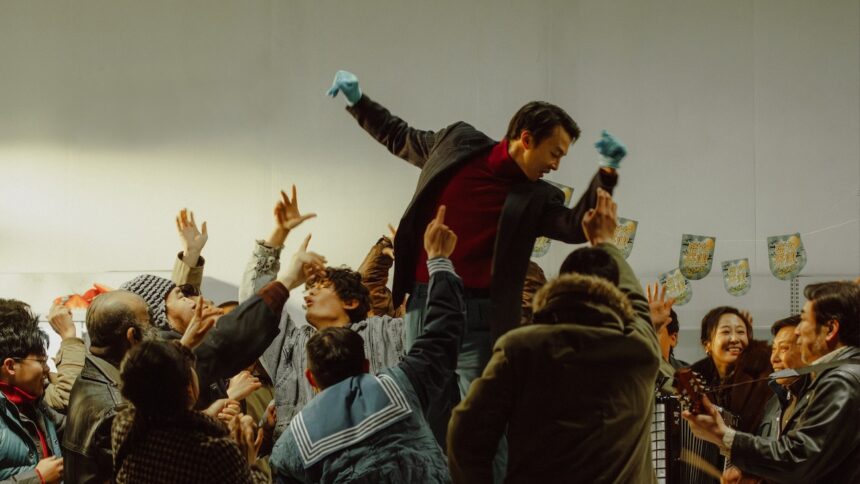
Chinese director Zhong Kaifeng officially introduced himself to the world at the Shanghai International Film Festival on Saturday night, taking home the main Gold Cup award for his feature debut. Atlantic Rhapsody.
For the Golden Goblet jury – led by Hong Kong star Tony Leung Chiu-wai – the film represents a “uniquely compelling visual experience”. For 29-year-old Zhong, the story of a young man from northern China searching for meaning in life is a sign.
“I want to say that Atlantic “It’s not a definition, it doesn’t provide answers – but today it seems He gave me an answer, and that answer is perseverance, love, hard work, and then faith.”
For SIFF itself, the win was a fitting end to a festival set out with the aim of putting young talent at the forefront. Chung’s work is a case in point, a film that the jury said “captivated and dazzled” with its “bold, experimental approach.” [that] explores the absurdity of human life” – and the festival hopes to have discovered a new voice in Chinese cinema. Another exciting emerging talent was suitably unveiled at SIFF’s New Asian Talent Awards too, when debutant Gong Yiwen won for her intimate coming-of-age drama. Her first tasteIt is a film that emerged from the SIFF project initiative for young filmmakers.
The New Asia’s Talent jury said: “The film’s patient observation and sensitivity to the texture of ordinary life announces an exciting new voice in Asian cinema.” “Her first taste is an unforgettable work about young love and coming of age, balancing emotional restraint with profound resonance, and distinguishing Gong Yiwen as a highly promising filmmaker.
The focus of this year’s SIFF was on young filmmakers, with a heavy presence of emerging talent from China and the region across screenings and a focus on the support the festival has provided to them through initiatives such as the SIFF ING Young Filmmakers Program and the SIFF YOUNG × Shanghai Program to support young filmmakers, with Joan Chen and Wen Muye acting as mentors.
The festival includes 78 productions that gained cinematic popularity after being sponsored through these programs during previous years. Several titles that came through the SIFF Project initiative also appear in this year’s lineup: Wan Bo’s action-packed drama Strangers in the mountainwas selected in the Asian New Talent Competition, along with directed by Peng Chen and Xu Wei Desert under the ocean And Kangdron Lenka Lenkawhether elsewhere in the program.
Saturday night marked the conclusion of the 10-day SIFF event, which on opening night gave fans a lineup of international and local stars — including Leung and Michelle Yeoh, who is also here to promote her latest film. This is my timeIt is her first Chinese-language production in nearly a decade, after receiving the Academy Award for Best Actress Everything everywhere at once -With jury members Guan Hu and Xin Zhilei.
There were touching tributes to industry veteran Lisa Lo (Crazy rich asians) – 100 years old according to the local calendar, still shining on the red carpet as she appeared to accept a lifetime achievement award – and director Zhang Yimou, who received an award for his “outstanding” contribution to Chinese cinema.
The winning films and a variety of other films will still be screened, along with the closing film, Zhang Disha. The decisive momentwhich will have its world premiere in Shanghai on Sunday. When the curtain falls tonight, the official tally will be about 1,600 screenings of about 420 films across the city and others in the surrounding Yangtze River Delta region.
There have been sold-out screenings of the most successful films at international festivals, including Cannes (Pawel Pawlikowski’s film). Homeland), and palpable delight among film fans of all ages at some of the retrospectives – such as those dedicated to the works of Ken Loach, Billy Wilder, and Marilyn Monroe – which provided a rare opportunity to see world classics on the big screen in all their 4K glory.
The diversity of films shown – and the audience’s reaction – was highlighted by Moroccan Yassine Al-Idrissi, who won the Gold Cup for Best Director for his wonderful comic film about a woman who refuses to give in to age or circumstances – Halima. He added: “This proves that we are all the same.” “We just need some translation.”
Also on the purely industrial side, there has been no escaping the latent presence of AI, with a series of panels bringing together industry heavyweights to discuss the various pros and cons. While many of the talks focused specifically on AI — with titles like “Smart Tech, Immersive Worlds, the Next Film Revolution” and “When AI Learns How to Create, What Creates Cinema” — the topic seeped into nearly every panel.
But SIFF also sought to provide practical – often live – examples of what technology can do, in an attempt, we assume, to clear up some of the confusion about what it can actually do. The AI Backlot initiative brought together traditional filmmakers and AI newbies and tasked them with making a short film in one month — setting them up like players so people could watch how they do their work. Chinese director Hu Zuochen was part of this program and withdrew, saying that it was “as if I had entered a whole new world.”
Festival president Chen Ju, managing director of the Shanghai International Film and Television Events Center, said before the big night that although she was “reluctant to see the festival come to an end,” she felt the 28th edition had achieved its mission of “aligning global and local resources” and “building industrial pathways to bring projects to fruition.”
“The global film industry is still going through a long period of adaptation, and creatives are in increasing need of encouragement,” she said. “As one of the most prominent film festivals in Asia, the Shanghai International Film Festival holds special significance this year by providing spiritual support and renewed confidence to Chinese-speaking filmmakers. Here, they witness the dedication of their peers and the achievements of emerging talents, and maintain their creative passion through diverse films and sincere exchanges.
“We hope this year’s festival will also give the global industry a closer look at what drives these filmmakers – their creative convictions and long-term vision for Chinese films. We hope this will lead to more sustainable and win-win partnerships across borders.”