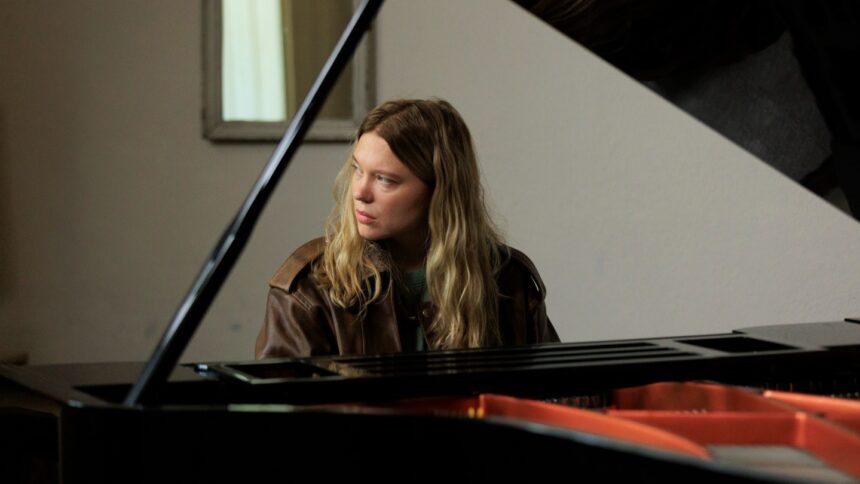
Tackling a topic close to home for writer-director Marie Kreutzer, Gentle monster He examines the ramifications when Philipp Weiss (Laurence Robb) – a middle-class Austrian documentary filmmaker and beloved father and husband – is accused of viewing, distributing, and possibly producing child pornography.
Kreutzer’s colleague, actor Florian Techtmeister, appeared in her feature film corsagein a similar case, which resulted in him being sentenced to two years in prison. But rather than examining the psychology of the accused men, Kreutzer smartly chooses to tell the story largely through the eyes of his distraught French wife Lucie, played by Léa Seydoux in a performance full of raw nerves – steely and vulnerable, angry and broken at once.
Gentle monster
Bottom line A thorny topic handled gracefully.
place: Cannes Film Festival (competition)
ejaculate: Léa Seydoux, Lawrence Robb, Gila Haas, Malou Blanchett, Anton Rubtsov, Niels Strunk, Catherine Deneuve, Patrizia Sziukowska
Director/screenwriter: Mary Kreutzer
1 hour and 55 minutes
Kreutzer’s text seeks to create a complex vision of the many ways people react when involved in situations like this, and how guilt and innocence are never completely cut and dried. This is especially evident with a subplot — not entirely necessary, but you can see why Kreutzer thought so — about a German policewoman (Gila Haas) who is investigating Philipp’s case and has her own problems with a difficult, perhaps brutal, man at home. Gentle monsterOur shady, gray morality will frustrate some viewers and displease others. Either way, it will spark lively post-screening discussions, which won’t hurt its prospects after its Cannes debut.
The central family at the heart of the story is met for the first time living in the splendor of the German countryside, in a squalid, private house that is much larger than this family of three – Philippe, Lucy, and their six- or seven-year-old son, Johnny (Malu Blanchett), need. While they’ve packed up Johnny’s room and put up a trampoline in his backyard, a test of parental commitment if ever there was one, Philip and Lucy are still sleeping on a mattress on the floor, and haven’t gotten around to buying a suitable bed yet. But that doesn’t stop them from having energetic, clearly choreographed sex while Johnny is at school or asleep, and the scenes are shot with confused excitement. (DB Judith Kaufman, who also shot corsageThe spotlight actors, especially the cream-skinned Sidhu, are beautifully cast.)
There are subtle hints that Philip’s career is not going well at the moment. Lucy’s concerts are characterized by her playing the piano and singing irregular interpretations of pop songs usually performed or written by men, such as The Cure’s “Boys Don’t Cry” or George Michael’s “Freedom” (arranged by singer-songwriter Camille, who also performs non-source instrumental covers), and the performances are not very successful. However, money does not seem to be the top priority in this trilingual family, as the parents sometimes speak to each other in English and to Johnny in their native language.
At one point, Lucie’s very French and somewhat distant mother (Catherine Deneuve, poignant in her few scenes) notes that Lucie has done the only thing worse for an artist than having children, which is move to the country. And when the film focuses on the story’s big reveal, it becomes painfully clear what it means. Lucy is very isolated in this apparently peaceful domestic situation, separated from friends, estranged from her mother, dependent on Philip, and not quite fluent in German.
This isolation becomes a particular problem when one day the police show up at their door with orders to confiscate all of Philip’s computers and hard drives. They arrest him for distributing child pornography in an online chat group on the dark web, where he uses the name GentleMonster_87, and suddenly Lucy has to call his lawyer Lucas (Nels Strunk) and deal with the legal ramifications, as well as taking care of the kids while protecting Johnny, her family, and Philip’s family from the truth.
But what exactly is the truth? Lucy certainly doesn’t know, though she’s keen to believe Phillip’s initial protestations of innocence, unable to accept that the gentle, sagging man she’s been in love with for years might also be a GentleMonster. Is this version of Philip capable of sharing footage of pre-teen children being abused online, as Detective Elsa Cohn (Hasse) claims?
By slow degrees, Philip’s story shifts to match the overwhelming evidence of IP addresses and decoded encryption, and Lucy struggles to keep up, let alone understand. Like a photograph developing in a bath of chemicals, Kreutzer’s strategies and themes slowly become clearer, and the sight is not pretty. Guilt is a pervasive entity here that spreads through almost everyone associated with Philip and Lucy. Even Det. Cohen is not above reproach. Her domineering elderly father Hermann (Sylvester Grothe) has become unrestrained by dementia and is prone to touching his caretaker (Patricia Ziukowska) inappropriately, a problem that Elsa is no more willing to confront than Lucy.
Ulrike Koffler’s editing deftly highlights the uncomfortable similarities here, and there are other fortunate touches that emphasize repetition and change, such as double scenes in which Lucy and Philippe chase each other in fast-moving cars at different points in the story. Meanwhile, Kaufman and her team use long, handheld shots to hold often close to Seydoux’s face to create momentary urgency when needed. Kreutzer’s versatility displayed in corsage Once again that is very evident in this contemporary story set around her corsageabout a woman trapped in a difficult marriage with few options no matter how much she exhausts herself for love, to paraphrase Coldplay’s “Yellow” that Camille sings during the closing credits.