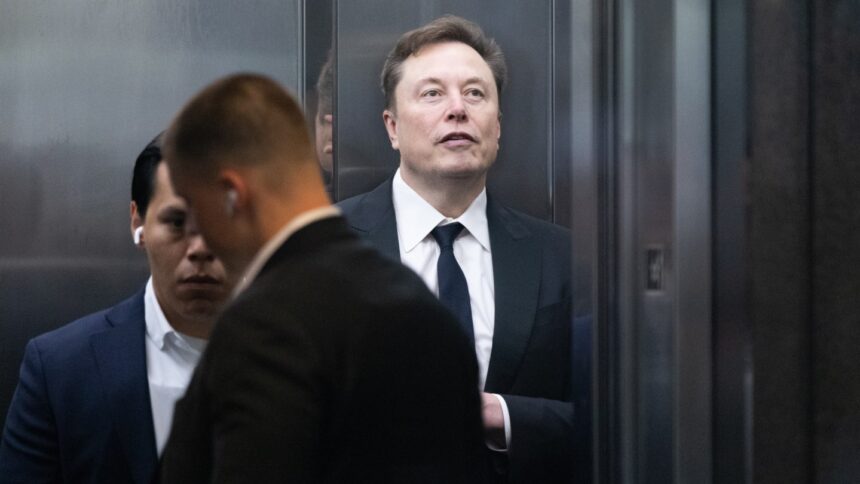
It turns out that Elon Musk’s “go fuck yourself” moment was a pivotal point for X.
Of course, Musk acquired the social media platform formerly known as Twitter in 2022, eventually renaming it simply “X.” But the slew of changes it made, including a decline in “verified” users and a commitment to free speech that also allowed previously banned content to return to the platform, led to a boycott of ads.
So, in late November 2023, Musk showed up at New York Times Dealbook conference, where he released: “Don’t advertise,” he told marketers watching. “If someone’s going to try to blackmail me with ads? Blackmail me with money? Go fuck yourself.”
They seem to have listened, although the details of that collapse have been somewhat hidden, until now, thanks to the internal financials the company disclosed in connection with its initial public offering.
In 2021, Twitter’s last full year as a public company, the company generated more than $4 billion in advertising revenue. In 2023, it fell to $2.3 billion, before falling further in 2024 to $1.73 billion.
But Musk isn’t one to let things go, and with his parent company SpaceX now preparing to go public, his broader media ambitions, which include X, are becoming a bit clearer. To that end, in 2025, for the first time since Musk bought the company, X’s ad revenue rose to $1.84 billion, the filings show.

To say SpaceX is an ambitious company is an understatement.
The project, controlled by Musk, has officially filed paperwork to go public (called Form S-1), and the document underscores those not-so-modest ambitions, which include statements like “We believe we have identified the largest total achievable market (‘TAM’) in human history,” and long-term goals of “carrying passengers and cargo to the Moon and Mars” and “mining asteroids,” both of which will rely on the company’s well-known prowess in designing and building rockets.
But what’s more important to the entertainment industry is the goal of sapping advertising dollars and subscription commitments, a very real threat to telecom owners like Comcast and AT&T, where SpaceX’s Starlink Internet ambitions are still nascent but growing rapidly.
SpaceX’s TAM has a $600 billion advertising market and is betting it can steal commitments from companies like Disney and Meta. It includes the $760 billion consumer subscription market, taking share from Netflix and ChatGPT. The company sees a $1.6 trillion opportunity in connectivity, split between $870 billion in Starlink Broadband (where it is actively targeting the likes of Comcast and Charter) and $740 billion in Starlink Mobile (the same goes for Verizon and T-Mobile).
On the advertising front,
The company is rolling out a range of new products aimed at getting both marketers to spend and creatives to create, with a renewed focus on video, given where ad dollars are flowing. said Mitchell Smith, Global Head of Content Partnerships at X Hollywood Reporter In an interview, “We were really looking at this as the year that we enter the era of creators as a platform, and really try to build a platform that fosters a healthy creator economy.”
In fact, SpaceX S-1 declares that “advertising remains a key monetization channel for our AI segment, with revenues driven by our ability to deliver highly relevant advertising.
“We aim to increase ad revenue per user by enhancing ad performance, expanding AI-driven targeting and measurement, and offering richer ad formats and creative tools.” “Our primary focus is to make ads feel like content – contextually relevant, aligned with user interests, and integrated into real-time conversations.”
There are signs beyond improved revenues that the advertising push is working, much to the chagrin of legacy media companies that may be hoping to reduce their technological competition.
“Marketers are no longer avoiding platforms with inventory that they may have historically labeled as ‘unsafe’ or ‘inappropriate’ brand, in some cases because marketers really want to reach consumers where they are, and in other cases because they recognize the business or legal considerations that may follow from avoiding platforms like X,” Madison & Wall analyst Brian Weiser wrote in a May 20 note.
Subscription revenues are similarly growing, although still very small compared to other business lines. SpaceX reports that X and Grok now have 6.3 million active paid subscribers, consisting of approximately 4.4 million paid subscribers to These subscribers certainly generate $100 million in annual recurring revenue, even if it’s small compared to the likes of Netflix.
And while OpenAI abandoned video creation when it shut down Sora, Musk and Grok are leaning into the technology, with the filing revealing that “our image and video generation system, Imagine, generated approximately 10 billion images and more than 2 billion videos per month” in the first quarter of 2026.
In fact, after OpenAI shut down Sora, Musk posted “@Grok Imagine’s next release is going to be epic. We’re doubling down on our efforts.”

Of course, AI video also brings a wave of risks, which is also reflected in the recording process.
“Some of our AI products, including Grok, offer features or modes designed to generate output that is more candid, direct, less reserved, or irreverent, such as the ‘Spicy’ visualization mode and the ‘Unhinged’ audio mode,” the filing states in the “Risk Factors” section. “These features are intended to provide users with greater flexibility and control over how they use our tools. Because these modes may be more draconian and harsh than our standard offerings, they present increased risks, including reputational damage, creation of potentially explicit content, misleading information or deceptive output, potentially non-consensual or exploitative images, intellectual property infringement, or content that could be considered exploitative, harmful, harassing, abusive, or discriminatory.
“The availability of such features may also increase the risk of regulatory scrutiny, enforcement actions, litigation, or damage claims, as well as reputational harm, user or advertiser backlash, or limitations on our ability to distribute or monetize our products in certain jurisdictions or through certain partners,” he continues.

In some ways, SpaceX’s simplest and most obvious threat against legacy media is against the brokers themselves. Comcast leveraged its regional monopoly on pay TV and home Internet to acquire NBCUniversal. Charter and AT&T haven’t been shy about leveraging their size to make huge deals.
Starlink represents a real and present threat to those companies and others that rely on it (given pay TV).
Starlink is by far the most profitable part of SpaceX’s business, with 10.3 million online subscribers as of March 31, up from 8.9 million at the end of last year, and 4.4 million at the end of 2024. Starlink’s income was about $1.2 billion in the first quarter, with $11 billion in annual revenue.
Of course, this growth came at a cost. SpaceX says it will spend $69 million on advertising in 2025, more than double the $31 million it spent the previous year. And it seems That number is rising.
According to data from iSpot, Starlink spent $8.4 million on linear TV ads between February 8 and the beginning of April. That doesn’t include the company’s high-profile Super Bowl ad, where the cost of entry starts at $10 million and only goes up. That also didn’t include the last few games of March Madness, where she was also in attendance.
According to iSpot, the company is using major sports and other methods in search of reaching audiences.
“Starlink’s advertising approach this year looks to use television to maximize audience reach and awareness,” said Tyler Bobin, Director of Brand Solutions at iSpot. “While this included buys during major sporting events like March Madness, the World Baseball Classic and the Daytona 500, the brand also balanced this premium programming strategy with low-CPM buys for sitcoms and drama reruns that provide a high number of impressions without the same high price tag for sports.”
The technology is also being rolled out to commercial airlines like United, which are betting that bringing high-speed internet to the skies could spark a new version of the streaming wars.
“There’s going to be a lot more we can do with Starlink and our seatback systems in the future,” said Andrew Nocella, United’s executive vice president and chief commercial officer. “We have a lot of really creative ideas.” Hollywood Reporter. “When you combine seatback entertainment with Starlink technology, it opens up a world of possibilities that can only be opened up by airlines that have both of these combinations.”

The threat from Starlink is being felt across the industry: Comcast stock is down nearly 24 percent over the past year, Charter stock is down 64 percent, AT&T stock is down nearly 8 percent, and T-Mobile stock is down 21 percent.
But some analysts believe things are exaggerated.
For example, Bank of America’s Michael Funk said on May 20 that a sell-off could provide an entry point for investors.
“Since September 2025, investor interest and concern have increased that low-Earth orbit (LEO) service providers could become a competitive threat,” Funk wrote. “We view LEO as a complement rather than a competitor to wireless operators and a greater threat to DLS and cable in rural areas. However, growing awareness of LEO platforms and speculation surrounding plans for space-based or dual LEO/GEO wireless platforms are likely to increase and potentially put pressure on communications multiples in the short term.”
Of course, Musk’s ambitions are much broader. If SpaceX wants to establish a “lunar economy and interplanetary manufacturing,” as it hopes, it will eventually need high-quality communications services. Market leading AI and high-speed internet for your home or phone is a piece of cake in comparison.