When you see the names of a couple of brilliant writers and directors, like Rebecca Zlotowski and Robin Campillo, they’re credited with the original idea for a dying film like Pierre Salvadori’s. Electric kiss (No electric venus), it is inevitable to wonder whether the material might have worked in other hands. Based on what appears on screen, this seems unlikely. A French period romantic comedy-drama about a widowed young painter and a quack psychiatrist who pretends to mentor his late wife, it’s bland and mediocre entertainment for local consumption only, and a disappointing choice for a Cannes opening.
Salvadori was last on the Croisette in 2018 with the most hilarious crime romance The problem is with youOne of the many reasons to regret talented actor Adele Haenel’s decision to leave the film industry. The Director’s Fortnight entry was a little overburdened with comic complications but full of the script’s dark humor, its underlying sweetness, and the director’s delightfully light touch. It’s a mysterious watch that goes down easily.
Electric kiss
Bottom line Moses remains dead.
place: Cannes Film Festival (out of competition)
He slanders: Pio Marmay, Anaïs Demoustier, Gilles Lelouch, Vimala Pons, Gustave Kerverne, Madeleine Boudoux.
exit: Pierre Salvadori
Screenwriters: Benjamin Charbit, Benoit Gravin, Pierre Salvadori
Two hours and two minutes
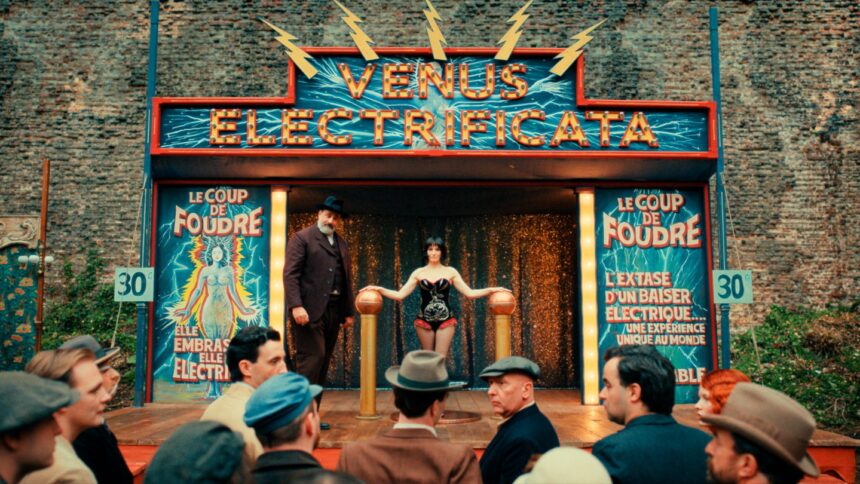
Working with the same authors, Benjamin Charbet and Benoit Gravin, Salvadori strives to breathe life into life. Electric kissa film whose atmosphere collapses with tense whimsy. This aspect is fed by the main setting of a carnival in Saint-Ouen-sur-Seine on the outskirts of Paris in 1928, full of bizarre sideshows that sell a false spectacle. And while it’s not the fault of the charming lead actress Anaïs Demoustier, her quality Audrey Tautou contributes to the unfortunate disaster. Emily Neighborhood which the new film does no favors.
Demoustier plays Suzanne, a charismatic character who risks electrocution several times a day to make sparks fly when audience volunteers curl up. She is underpaid and exploited by Titus (Gustave Kervern), the gruff, gruff man who runs “The Electrified Venus,” who made a deal to keep Susan out of her father’s hands when she was 15 years old.
She prefers her own company to that of other carnies, including her dim-witted friend Camille (Madeleine Boudoux), and listens to the fraudulent seances of the nearby medium while smoking under the caravan. She’s wandering there one night, eyeing a bottle of laudanum like it’s a Chekhov’s gun, when after-hours agent Antoine (Bio Marmay) rushes in desperate to contact his late wife, Irene. He refuses to take no for an answer and Suzanne can’t say no to money, so she introduces herself as “Madame Claudia”, and improvises convincingly enough for Antoine to book a private session the next day at his house.
Since Irene’s death, Antoine, miserable and hungover, has been wandering around their Paris villa set in a lush garden, with an art studio gathering dust. Thanks to a sleight of hand and a pair of cryptic connections, Susan once again succeeded in summoning the man’s dead wife, so much so that he was inspired to resume painting for the first time since her death.
When Antoine’s art dealer, Armand (Gilles Lelouch), discovers Suzanne’s deception, he stalks her, threatening to call the police if she returns. But he quickly reconsidered, and made a deal to split the proceeds if she could keep up the ruse and keep Antoine busy with the easel. Armand provides background information to help reinforce the illusion.
After Suzanne discovers Irene’s diary, the narrative takes a twist as it traces the early stages of Irene (Vimala Pons) and Antoine’s relationship a few years earlier.
A self-absorbed pragmatist, Irene works as a model while figuring out how to escape the poverty of her upbringing. She sees a potential stepping stone to financial security when she discovers Antoine’s undiscovered talent and convinces Armand to represent him. But complications arise when a romantic triangle forms, resonating in both timelines, and Suzanne begins to have real feelings for Antoine, an innocent wracked by misplaced guilt over his wife’s death.
The problem is that the double lines don’t hold together structurally. While the romance, deception, surprising discoveries, suicide attempts (real or fake) and slapstick comedy should gain steam, it all becomes a boring blur.
The film takes place in a space between playful fantasy – an aspect fueled by both the colorful carnival atmosphere of the 1920s and the enchanted garden around Antoine’s house – and dramatic reality. But it doesn’t engage either dimension with enough imagination to create much intrigue or generate much affection for the characters. The actors are all likable enough, especially Demoustier, but they’re stuck in weak material rather than engaging.