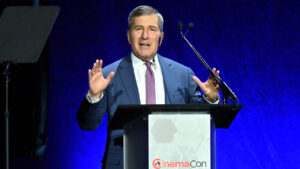
What took you so long? That’s what some on Wall Street clearly wondered when they rejoiced at news Monday morning from Comcast’s headquarters in Philadelphia that the company would follow up its split from Versant Media, home to most of its cable networks, with another spinoff. This time, Comcast plans to separate into two independent publicly traded companies through a tax-free spin-off of its media and entertainment unit NBCUniversal, along with its European media business.
Comcast shares rose on Monday, jumping 8.7% to $25.19 as of 10:40 a.m. EST after rising more than 20% before the market opened, a sign that investors were approving the spin-off of the company’s media and communications/technology businesses, and perhaps breathing a sigh of relief that it was finally coming.
“The split is particularly desirable in allocating a fairer immediate value to the studio and theme park businesses,” said Benchmark analyst Matthew Harrigan. He estimated the stock’s more than 20 percent pre-market increase “reflects only modestly.” [the] The ultimate potential value of New Comcast and NBCUniversal. In other words: sees more upside.
The further division of assets comes at a time when the idea that combining content and pay-TV distribution under one roof provides a key strategic advantage and allows for “synergies” has lost its lustre, especially in the age of streaming and digital media. He was one of the main drivers behind the deal Comcast struck in late 2009 and closed in early 2011 to first acquire a controlling stake in NBCUniversal, before assuming full control in 2013. Now, that last bastion of vertical integration is beginning to crumble.
Since AT&T’s sale of WarnerMedia, Comcast/NBCUniversal has become the last major player with a strong presence in both content and traditional distribution. In 2009, when unveiling the deal, Roberts described it as a “perfect fit” and pledged that it would help “accelerate the development of new digital products and services.” But Comcast has always been less reckless than others in the industry about promises of synergies, instead preferring to talk about “Symphony,” and its focus on cross-promotional efforts that put company-wide support behind content, services and projects that management deemed a priority.
Remnants of the traditional content and distribution mix will remain within the separate NBCU in the form of Sky, which combines Sky Studios with IP and satellite-delivered services. Harrigan noted NBCU and Sky’s “shared focus on premium media and entertainment with strong brands in entertainment, news and sports – particularly in the UK and Europe.”
Overall, however, the message from Comcast management has been that focus and investment are now the keys to success.
This did not come as a shock to some who have long argued for secession. “It’s no secret that we never agreed with the strategic logic of Comcast’s acquisition of NBCU. There were a lot of synergies within NBCU, but those synergies never crossed the boundaries between media and cable,” asserted MoffettNathanson analyst Craig Moffett. “Having them under one roof couldn’t have been better, and the combined company was saddled with a 15-year conglomerate discount to reflect the suboptimal capital allocation that leads to conglomerate demand.”
“For 14 years, the stock didn’t move. They had to do something,” LightShed Partners analyst Richard Greenfield told CNBC. “I don’t know anyone who wanted this company to stay together,” he added, except perhaps Roberts. “This is an acknowledgment that there is virtually no synergy between Comcast and NBCUniversal. Those days are over.”
“We do not expect any material disruptions to the new deal other than some minor increase in corporate expenses at two public entities…. Each company retains significant scale with concomitant new scope for strategic focus, speed, and flexibility,” Harrigan wrote.
Of course, the two more focused companies, Comcast and the new NBCUniversal, may end up buying or selling to other players in their own spaces. But the administration has halted hopes of reaching an imminent agreement. It was no surprise, then, that M&A options also appeared in analyst reports on Monday.
Benchmark’s Harrigan focused on a key comment from Monday’s management call: “Newly appointed NBCUniversal CEO Mike Kavanaugh was adamant that the separation is not a move toward more strategic transactions, a transparent reference to mergers and acquisitions with any broadcast or telecast participants.” “Both companies will build and invest for organic growth,” Harrigan concluded, meaning focusing on growth without making big deals.
After the major move was unveiled on Monday, Comcast shareholders will end up owning shares in both technology and communications-focused Comcast and media-focused NBCUniversal, which includes Universal Film and Television Studios, NBC and Telemundo networks, streaming service Peacock, cable network Bravo and its Universal Parks division. Citing “rapidly changing markets,” Comcast said: “As technological innovation, consumer behavior and competitive dynamics continue to reshape both media and communications,…each company will be better positioned to pursue its own strategic priorities, invest for growth and create long-term shareholder value.”
“It should be clear that there are real advantages to media companies that focus their efforts on either distribution or packaging,” Madison & Wall director Brian Weiser wrote in response to the Comcast split. But he also stressed: “Of course, these advantages can only be achieved when there is sustainable investment.”
His take: “NBCUniversal may be better positioned to thrive in the media industry on its own rather than as part of Comcast, but only if it pursues opportunities by making ongoing investments. It’s worth noting that nearly half of NBCU’s EBITDA is generated by its theme park business. One potential risk to the media business is that the new company overly prioritizes investing in theme parks rather than producing content and packaging it to consumers through an expanded version of Peacock.”
Brian Roberts will continue to be “actively involved” in the leadership of Comcast and NBCU, working in partnership with the CEOs of both companies. They are Mike Kavanagh, who will serve as CEO of NBCU, and Michael Angelakis, who will become CEO of Comcast, after the separation is completed.