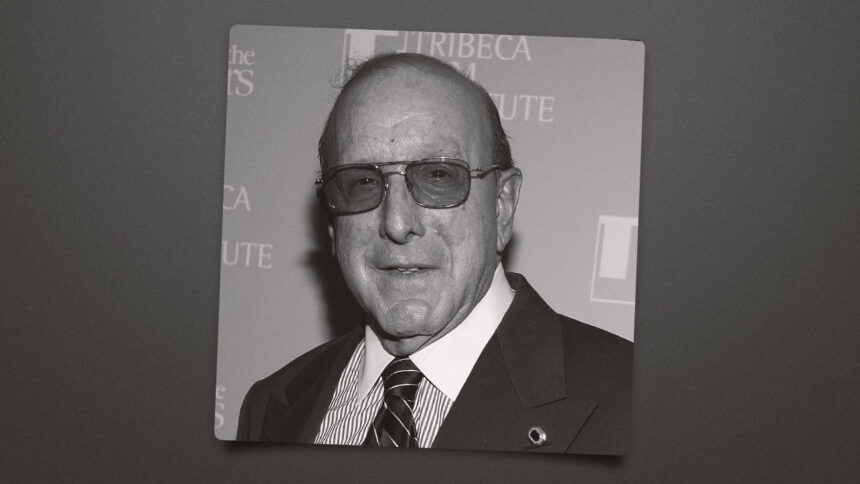
Clive Davis, the “Golden Ear” hitmaker who brought Janis Joplin, Whitney Houston and Bruce Springsteen to the world and revived the careers of Carlos Santana, Rod Stewart and Aretha Franklin, died Monday. He was 94 years old.
Davis, most recently creative director of Sony Music Entertainment, former president of Columbia, Arista Records and J Records and a member of the Rock and Roll Hall of Fame, died at his home in Manhattan, a representative announced. He was recently hospitalized with an upper respiratory tract infection.
During his career spanning six decades, the music mogul has also nurtured acts such as Billy Joel, The Grateful Dead, Alicia Keys, Simon & Garfunkel, Jennifer Hudson, Barry Manilow, Pink Floyd, Earth Wind & Fire, Aerosmith, Blood, Sweat & Tears, Kenny G, Christina Aguilera, Kelly Clarkson and Patti Smith, who once said Davis “has a weakness for the unique performer.”
Davis has won five Grammy Awards, including the Recording Academy Trustees Award in 2000. And every year on the Saturday night before the Grammys since 1976, he has gathered top music executives and artists for a gala at the Beverly Hilton Hotel when the event was in Los Angeles (the 2021 edition was held online due to the pandemic).
Davis said speaking about his ability to identify talent Playboy magazine in 2013: “I didn’t necessarily have an ear, but I think I developed one. Whether there’s a natural ear that’s been stimulated, I don’t know the answer to that. But when you see Joplin or Springsteen, you know. And the stats start going up and it gives you confidence. You think, ‘Oh my God, yeah, I said yes to Santana.'”
Clive J. Davis was born on April 4, 1932, to parents Herman and Florence, who raised him in Brooklyn’s middle-class Crown Heights neighborhood. His father made a living as an electrician and mobile tie salesman. As a child, he never collected records but loved listening to music on the radio. He attended Erasmus Hall High School and received a full scholarship to New York University.
His parents died within 10 months when he was 18, his mother died of a cerebral hemorrhage and his father suffered a heart attack. He moved in with his older sister Sina, her husband, and their daughter in Queens while attending New York University and later received another full scholarship to attend Harvard Law School.
After graduating from Harvard in 1956, Davis found frustration working in small businesses in New York. At the age of 28, Harvey Sheen offered him a job in the legal department of Columbia Records, where he would continue to build CBS’s international recording business. Davis accepted the opportunity even though he did not know much about music, but took night classes to educate himself about copyright laws, contracts, and litigation.
In 1968, his friend, manager, promoter and future Rock Hall of Famer Lou Adler encouraged Davis to come to California for the Monterey Pop Festival, which the New Yorker described in his 2012 biography. The soundtrack to my life As a “specific perception.”
“Although I started making some creative decisions at Columbia, I had no idea I would actually be in the artist contracting business,” he wrote. “Yes, seeing Janis Joplin perform provided one of the greatest musical experiences of my life.”
He brought Joplin’s band, Big Brother & the Holding Company, and Electric Flag, featuring guitarist Mike Bloomfield, to the label, ushering in the staid, tradition-bound Columbia label—which, under president Goddard Lieberson, specialized in soundtrack albums like Davis’ favorite soundtrack albums. My fair lady — In the age of rock.

Clive Davis with Aretha Franklin and Barry Manilow in 2017.
Theo Wargo/Getty ImagesFamously, he refused to seal the deal with Janis by sleeping with her, which the rock singer herself suggested, but he grew sideburns and began wearing Nehru jackets in the style of the day.
Davis was appointed General Counsel of Columbia in 1961, was promoted to Vice President in 1965 and soon after became President. He signed Santana, Joel, Aerosmith, Pink Floyd and Springsteen, revitalizing the label.
In 1971, he booked the Ahmanson Theater in Los Angeles for seven consecutive nights for shows featuring a lineup of artists including Miles Davis, the Mahavishnu Orchestra, New Riders of the Purple Sage, Johnny Mathis, Loudon Wainwright, and Springsteen.
“His career is just getting started,” Davis said of the president at the company. Playboy interview. “He comes on stage with his guitar and stands there. He plays and sings his songs and doesn’t do anything else. Encouraged by the confidence I gained from my signings, I said to him afterwards: ‘Bruce, when you’re on stage like that, you can’t just stand there.’ You have to move.’ He was listening, but I didn’t think he was really absorbing what I was saying.
Two years later, Davis met the singer at the Bottom Line in Greenwich Village and was “amazed. This wasn’t the Bruce Springsteen I signed,” he recalls. “He wasn’t sitting quietly on stage. He wasn’t walking around the stage. He was jumping on tables, literally jumping off the stage. After the concert I went backstage and he looked up and said: ‘Did I move enough for you?’ He’s become a great performer, one of the best. But that’s not why I signed him. I signed him for his lyrics.”
In a scandal that rocked the company, Davis was fired from Columbia in May 1973, accused of defrauding the company of $94,000 in expense account violations, including paying for his son Fred’s coming-of-age party and renovation of his apartment. He vehemently denied both charges, and several charges were dropped. In 1975 he wrote Clive: Inside the Register of Deeds They conspired for his return.
He was still respected by artists. Elton John said in The soundtrack to my life: “When my recording contract was about to be renegotiated, Columbia Records was the only label I would consider outside of MCA. Then Clive Davis left Columbia – and I wasn’t interested anymore. Clive was Columbia.”
Davis eventually founded Arista Records, named after his high school’s National Honor Society chapter, out of the remnants of the studio’s Bell Records label. He inherited Barry Manilow, signed Franklin, Dionne Warwick, Carly Simon, and the Grateful Dead, and introduced the world to the 19-year-old Houston, who would become one of the most successful artists in music history under his direction.
After signing with Houston in 1983, he brought her along for an appearance The Merv Griffin Show. “My introduction to Whitney was that if there was one performer for the next generation who combined the beauty and lyrical phrasing of Lena Horne with those fiery gospel roots of Aretha Franklin, it would be Whitney Houston,” Davis told MTV News in 2012.
Taking two years to personally oversee her debut album, her eponymous debut in 1985 was a blast, showing success with such hits as “You Give Good Love,” “Saving All My Love for You,” “How Will I Know,” and “The Greatest Love of All.” (Stanley Tucci played Davis in the 2022 biopic Houston I want to dance with someone.)
In 1989, Davis teamed with Atlanta-based LaFace Records, run by singer-songwriters Antonio “LA” Reid and Kenny “Babyface” Edmunds, resulting in hits from TLC, Outkast and others, and later partnered with Sean “Puffy” Combs on Bad Boy Records, which released best-selling albums by The Notorious B.I.G. and Faith Evans.
BMG, Arista’s parent company, forced Davis out in early 2000, citing its retirement policy, and replaced him with his former protégé Reed. But Davis had reason to smile at the Grammy Awards that year, when Carlos Santana returned to his album, supernaturalwas the biggest winner, taking home nine awards, including Album of the Year, Record of the Year, and Song of the Year. Davis himself has won two awards as the group’s producer.
supernatural It went platinum 15 times and has sold more than 26 million copies worldwide. “Smooth” remained at number one on the charts for 12 weeks, and “Maria Maria” also reached the top.
When BMG realized the error of its ways, it entered Partnered with Davis in the joint venture J Records, where he developed Keys and revived Stewart’s career, with The Great American Songbook Chain and Manilo.
In 2002, Davis was put in charge of RCA Music Group, where he recognized the commercial potential of the new Fox reality series. American Idol. It helped launch the career of first-year winner Kelly Clarkson (who won a Grammy for Best Pop Vocal Album for its executive production Separatism Album), Jennifer Hudson and Leona Lewis, one of the most prominent series in the United Kingdom Factor X.
In 2008, he was appointed creative director of the combined Sony BMG company.
On the Saturday night before the Grammy Awards, Davis gathered top music executives and artists for a party. Music moguls such as Jimmy Iovine, Lucien Grange, Sean Combs, Richard Branson, David Geffen and Doug Morris were among those celebrating each year, with a notable industry figure selected for their annual achievements.
The 2012 gathering was marred by Houston’s death in her room at the Beverly Hilton just hours before the party began. Davis went ahead with the festivities and turned them into a tribute to the singer.
In 2003, he founded the Clive Davis Institute of Recorded Music at New York University’s Tisch School of the Arts, and later helped create the Clive Davis Theater at the Grammy Museum in downtown Los Angeles.
in The soundtrack to my lifeHe revealed his duality.
Davis was married twice, to Helen Cohen from 1956 to 1965 and to Janet Adelberg from 1965 to 1985. Survivors include his children, Fred, Lauren, Mitch (the concert promoter), and Doug. his grandchildren, Austin, Charlie, Matthew, Hayley, Harper, Sloan, Billy and Cody; Two grandchildren. Cousin Joe; and partner Greg Shriver.
“To the world, our father was an iconic music legend whose vision, instincts and relentless pursuit of excellence formed the soundtrack to countless lives,” his family said in a statement. “He discovered, mentored and championed the greatest artists in the history of modern music, leaving an indelible mark on the culture that will last for generations.
“To his family, Clive was father and grandfather, the constant presence at the center of our lives, and a source of wisdom, strength, encouragement and unconditional love. No matter how impressive his professional accomplishments were, he never lost sight of what mattered most: the people he loved.
“Through every chapter of his remarkable life, family has remained Clive’s greatest pride and deepest joy. Today, we celebrate not only an iconic figure whose influence changed music forever, but also a man who led our family with grace, generosity and kindness. We will miss him greatly, cherish him always and carry his love with us for the rest of our lives.”