

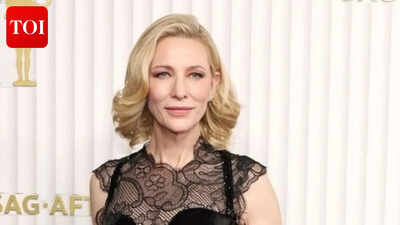
Cate Blanchett didn’t just become an actress. It became a standard. From “Elizabeth” to “The Aviator” to “Notes on a Scandal” to “Carroll” to “Tarr.” She has been in some of the most iconic and artistically significant films of the past three decades.
She has won an Oscar twice. She has been nominated for a Golden Globe Award several times. She won a BAFTA. I’ve done Shakespeare on stage. She has driven blockbusters and intimate character studies in equal measure. She has played queens, journalists, bandleaders, elves and icons with an accuracy and depth that can be matched by very few actors working anywhere in the world. She has consistently chosen work that challenges, unsettles, and refuses to be easily pigeonholed.
And in doing all of this, she lived the very truth she so clearly expressed. Thus, she once said: “The women who really change the game are always the ones no one knows what to do with at first.”
Quote of the day from Kate Blanchett
“The women who really change the game are always the women that no one knows what to do with at first.”These words were spoken by Cate Blanchett at the Women in the World Summit in Delhi, during a conversation that moved between the personal and the political with the ease of someone who has thought seriously about both for a very long time. She was discussing her role in Carol, her film’s similarities to Deepa Mehta’s Fire, the Syrian refugee crisis, and her experience reinventing British history with Shekhar Kapoor in Elizabeth. But the most pivotal moment came when she was asked about Katharine Hepburn’s role in The Aviator. “It was an iconoclast,” she said. “Talk about changing the mold.”
People didn’t know what to do with her when she came out of the box.” Then she made it personal. She recalled how early in her career, when a journalist asked her opinion, and she gave her opinion honestly, the article would describe her not as thoughtful or direct, but as “sharp” or someone who “doesn’t suffer fools.” Her response was simple and devastating.
“You asked me my opinion.”
What does it actually mean?
Cate Blanchett names a pattern that is so consistent throughout history that it almost acts as a rule.
The women who become most important are rarely the ones who are embraced immediately. Who does not fit into existing categories. Who were too much, or not enough, or simply something for which the world had not yet developed a language.This discomfort, of not knowing what to do with someone, is always a compelling form of confession. When something truly new arrives, the initial response is rarely one of celebration.
It’s friction. Because new things require modification. It requires people to expand their understanding of what is possible, and that expansion is uncomfortable. It’s easier, in the short term, to dismiss what you can’t categorize than to do the work to build a new category for it.Katharine Hepburn is the perfect example Blanchett sets. Hepburn was considered box office poison at one point in her career.
She was too independent, too unusual, and unwilling to perform femininity in the way the industry expected. She was wearing pants. I refused interviews. She said what she thought. And for a while, it cost her dearly. And then history caught up with her. She became one of the most famous actors of all time.The pattern is repeated in every field. The artists, scientists, writers, leaders, and thinkers who ultimately reshape things are rarely the ones who arrive smoothly and are immediately understood.
They are the ones who created the friction first. whose existence required the people around them to discover a new way of seeing.What makes Blanchett’s observation particularly poignant are the details she adds from her own life. She was not describing an abstract historical woman. She was describing the experience of being a young woman fresh out of drama school, giving an honest answer to a direct question, and being punished in print.
Not with anger or defensiveness, but with naming. sharp. A word that has been used for generations to describe women who speak with the same candor as men.
The label is not a description of women. It is a description of the discomfort it causes in people who are not prepared for it.Blanchett’s point is that discomfort is the signal. Not a warning. The women who elicit this response, who are approached too often, too directly, or too difficult, are often precisely the ones doing something important.
People who fit perfectly into all existing expectations rarely end up changing anything. It’s the people who don’t fit in who move the world forward, once the world finally figures out what to do with them.
Who is Cate Blanchett?
Born on May 14, 1969 in Melbourne, Australia, Cate Blanchett trained at the National Institute of Dramatic Arts before embarking on a career that would make her one of the most versatile and brilliant actors of her generation.
Her early theater work in Australia attracted much attention before her film career catapulted her to international recognition.Everything changed with the 1998 film “Elizabeth,” in which she played Queen Elizabeth I with a strength and intelligence that instantly declared her a major screen presence. She received her first Academy Award nomination for the role and has spent the ensuing years building one of the most impressive filmography in contemporary cinema.
She won the Academy Award for Best Supporting Actress for “The Aviator” and the Academy Award for Best Actress for “Blue Jasmine.”
She received further nominations for Notes on a Scandal, Carol, and Tár, which includes what many critics consider to be one of the greatest screen performances of the century so far.In addition to her screen work, she was a dedicated theater practitioner, co-directing the Sydney Theater Company for years and maintaining a serious commitment to theater throughout her career. She has been a prominent advocate for refugees through her work with Amnesty International
United Nations
The High Commissioner for Refugees has consistently and thoughtfully used her platform to speak out on the issues that matter most to her.She remains one of the few actors working today for whom it can honestly be said that no role is out of reach. She achieved this goal, in large part, by being the kind of woman that no one initially knew what to do with.